
Google Glass took smartglasses from the realm of pony-tailed academics and Silicon Valley dreamers to mainstream reality. It has dozens of apps. It has new designs from Oakley and Ray-Ban. It has fans that include both runway models and basketball players.
And if you’re in a loud room, it’s almost as worthless as it is geeky. Because talking to your gadgets is nowhere near as smooth at David Hasselhoff made it look in Knight Rider.
Sure, you can bark “Glass, take a photo” in the comfort of your living room and snap Mr. Meowsers without setting down your tea. But trying the same thing in a bustling bar is a surefire way to annoy the people around you — and perhaps get a beatdown. Meanwhile, Glass’s touch-sensitive pad handles only a few basic functions.
Quickly evolving smartglass technology could also help put a spring in ARI’s rather lethargic step.
“The smartphone is moving up into your vision, and there needs to be a new interface to evolve with the new hardware,” says cofounder Ryan Fink. “That’s where ARI comes in.”
ARI, short for Augmented Reality Interface, requires no buttons, no touchpads, and no speaking. “ARI is the Siri of gesture recognition for smartglasses,” explains Fink.
Hold your fist up in front of your face (like an old-timey boxer looking for a fight) and a box appears superimposed over it in Google Glass. After recognizing it as a command, ARI counts down 3 seconds so you can get your hand out of the way, then snaps a photo. After collecting a few, you can use the wave of your hand to leaf through Glass’s library of photos as if turning invisible pages in a photo album.
That’s just one use. Ultimately, the team hopes ARI will be able to recognize an entire library of gestures, which outside developers can bake into their apps as controls. The Pandora app, for example, could someday interpret a literal thumbs up as your approval for that Whitesnake jam it just played on your 80s station.
A new way to control Google Glass
Besides simply being less irritating than talking to your glasses, Fink and cofounder Gary Peck see it as an essential way to control Glass in scenarios where it would otherwise never work, like a factory floor.
“It’s really loud, they sometimes have stuff in their hands and they want to be able to easily interact with the content or check things off as they go through,” Fink explains. With ARI, a worker could simply wave a hand to move the display in his glasses onto the next instruction in a list, or hold up a fist to mark it done.
The same goes for athletes. A snowboarder with thick gloves might have difficulty swiping the touchpad, and a biker might not want to lift his hands from the handlebars to start a timer.
“I think at first it will be a little weird, especially to people that aren’t familiar with the technology.”
In theory, ARI solves all these issues. In execution, there are still plenty of kinks to iron out. The early alpha version we tested took a while to recognize gestures, and it takes a purposeful execution to pull off a swipe or fist in just the way ARI is looking to see it.
But quickly evolving smartglass technology could also help put a spring in ARI’s rather lethargic step. Since it constantly analyzes images from the built-in Glass camera, ARI can’t run on your phone; it has to run on the anemic processor built into Glass. As those processors get faster, so will ARI.
Glass’s camera also remains a challenge — because there’s only one. Purpose-built gesture-control systems like Microsoft’s Kinect rely on a pair of cameras to generate stereo images, which lets the computer reading your manic motions determine depth. “With dual cameras, you really get a 3D model of the world in front of you. With a single camera it’s just a plain image,” Peck explains “You have no idea that this hand is a different object from the table, it’s all just different pixels.” Peck has had to work around that primitive input to detect objects based on the look of them alone.
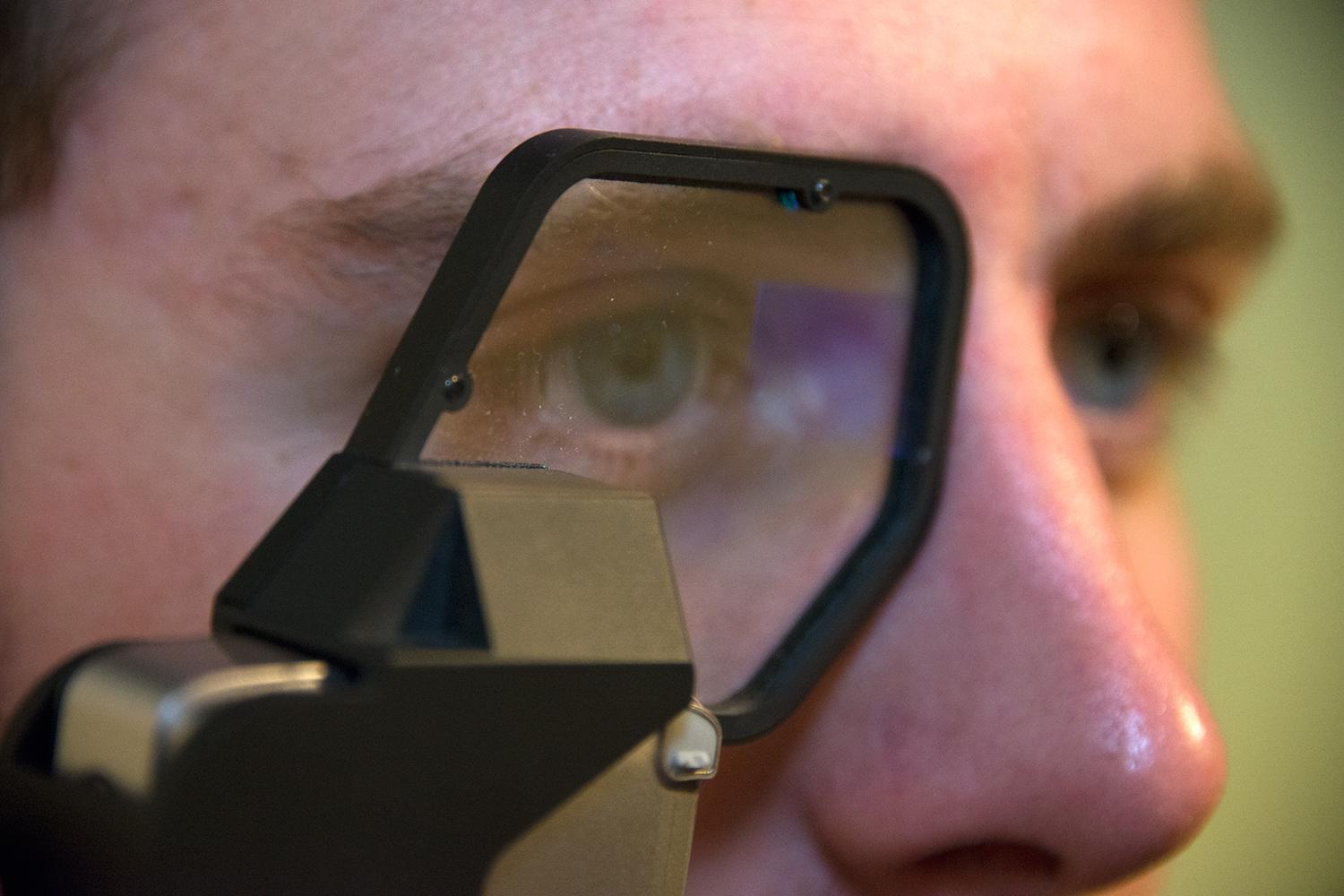


The challenge is made even more difficult by the need to preserve Google Glass’s limited battery life: The more accurate the gesture detection, the more it drains the battery. “That’s the tradeoff,” Peck said. “How can you get accuracy that’s good enough for the gestures you’re trying to do?” His code, for instance, uses low-res video from the onboard camera even though it can technically capture at 1080p — because he’s not trying to track every finger.
The geek factor here is also impossible to ignore: How do you get people to use a technology that makes you look like the world’s worst mime? “I think at first it will be a little weird, especially to people that aren’t familiar with the technology,” Fink acknowledges, but insists perceptions will change as the technology improves. “It will be much more like Iron Man or Minority Report, where it’s an immersive experience. So I think the stigmatism toward it being weird and awkward will melt away with that.”
The future of smartglasses and augmented reality remains smudgy.
One of the biggest steps forward will come from “waveguide lenses.” While Glass merely displays a small video feed in the corner of your vision, waveguide lenses can literally overlay information over your entire field of view, like true Terminator glasses. Vuzix has produced early prototypes of this technology and some expensive models meant for industrial environments, but they’ve yet to shrink to the size or price of Google Glass. Peck believes it could be at least another year before we see this level of display reach the mainstream.
The future of smartglasses and augmented reality remains smudgy, but the unknown next steps remain part of the appeal for Peck and Fink.
“It’s a new interaction paradigm. There’s a lot of figuring out — how do you present information in the most intuitive way? How do you interact with it? Peck explains. “But as an app developer, there’s no conventions. There’s no knowledge of the best way to present information that’s up here on your screen. Those are kind of interesting challenges.”


