  1. Home
  2. Emerging Tech
  3. News

Google Meet on mobile finally lands speech translation

Add as a preferred source on Google
Logo, Text
Google

If you’ve ever been in a meeting where half the team is talking in one language and the other half is nodding politely while secretly lost, your days of awkward “uh-huh”s are over. Google Meet is bringing speech translation to mobile. Following its web debut, Google Meet’s speech translation feature is now rolling out on Android and iOS. It translates spoken audio in near-real time, helping teams across the globe communicate more naturally. 

Languages you can impress with

The feature currently supports bidirectional translation between English and:

  • Spanish
  • French
  • German
  • Portuguese
  • Italian
Recommended Videos

However, only one language pair is active per meeting. So if you’re dreaming of a multilingual jamboree with three languages at once… well, Rome wasn’t built in a day.

Conference rooms can listen, too

For those hopping into a physical meeting room, you’ll still hear translations, but your own speech won’t be translated yet. It acts as your personal audience receiving the multilingual applause. On the contrary, Admins, speech translation will be ON by default, but you can toggle it on or off at the organizational unit (OU) level. End users, all you need is your Meet app and a bit of curiosity. For step-by-step instructions, Google’s Help Center has you covered.
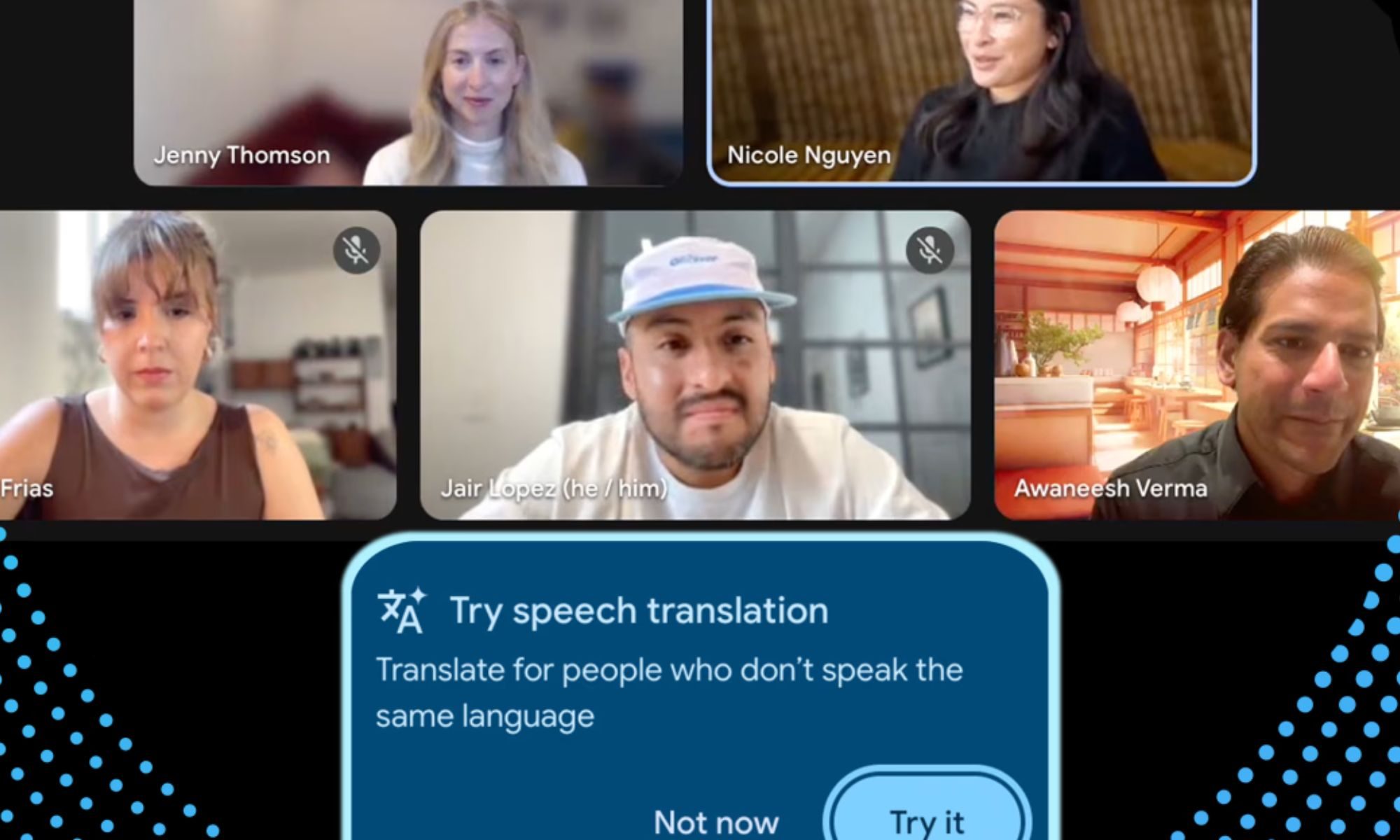
For rapid-release domains, the gradual release will start on April 8, 2026 (up to 15 days for full visibility), and the scheduled-release domains will start slightly after, on April 23, 2026 (up to 15 days).

This is available across tiers:

  1. Business: Standard, Plus
  2. Enterprise: Standard, Plus
  3. Other Editions: Frontline Plus
  4. Consumer: Google AI Pro, Ultra
  5. AI Add-ons: AI Ultra Access, Google AI Pro for Education

Google promises translation refinements and UI tweaks over time, so your meetings will only get smoother. This means, it’s going to keep getting smarter while you keep talking. This can definitely help a lot of people.

Shimul Sood
Shimul is a contributor at Digital Trends, with over five years of experience in the tech space.
Perplexity’s AI answering engine is not coming to Snapchat, after all
Perplexity is no longer sliding into Snapchat chats
Snapchat

Snapchat’s planned Perplexity integration is no longer happening. Snap revealed in its Q1 2026 investor letter that both companies “amicably ended the relationship in Q1,” ending a $400 million cash-and-equity deal announced last November.

The deal would have brought Perplexity’s AI answering engine directly into Snapchat’s Chat interface. Users would have been able to ask questions and get conversational, source-backed answers without leaving the app. Snap had earlier said the partnership would begin contributing to revenue in 2026, but its latest sales guidance now assumes no contribution from Perplexity.

Read more
Even brief AI use could hurt your ability to think, a new study finds
AI gives you answers fast, but a new study suggests it might be costing you something more valuable.
Toy, Person, Rubix Cube

A new study from researchers at Carnegie Mellon, MIT, Oxford, and UCLA suggests that using an AI chatbot for just 10 minutes could negatively impact your ability to think and problem-solve. And honestly, the findings are a little alarming.

As reported by Wired, the researchers asked participants to solve problems, including simple fractions and reading comprehension tasks. Some participants were given access to an AI assistant that could solve the problem for them.

Read more
Character.AI is being sued for allegedly letting a chatbot play doctor in Pennsylvania
Character.AI just got dragged into a first-of-its-kind AI doctor lawsuit
Character.AI on Google Play Store

Character.AI is finding itself in hot water once again. The company is facing a legal fight as one of its fictional bots allegedly acted like a medical professional. Character.AI previously added parental tools amid multiple lawsuits over inappropriate sexual content and self-harm-related messages.

Now, Pennsylvania Governor Josh Shapiro’s administration has filed a lawsuit against Character Technologies, the company behind Character.AI. He alleges that the platform allowed a chatbot to present itself as a licensed medical professional in the state.

Read more