  1. Home
  2. Emerging Tech
  3. Legacy Archives

Google robot wins Robotics Challenge Trials

Add as a preferred source on Google

The DARPA Robotics Challenge Trials, which saw teams of experts from around the world descend on a Florida racetrack over the weekend to battle it out for a place in next year’s final, has been won by Japanese team Schaft, a company recently acquired by Google.

Sixteen teams with robots designed to provide help as part of response efforts following natural or man-made disasters battled it out across eight challenging tasks, each hoping to make it to the 2014 finals where a $2 million grand prize will be awarded by the Defense Advanced Research Projects Agency (DARPA).

Recommended Videos

Tokyo-based Schaft performed ahead of its rivals in half of the challenges laid out for it at the Homestead Miami Speedway site, which included walking across uneven terrain, climbing a ladder, and clearing away debris.

Schaft, a 167-cm, 209-pound bipedal robot (shown above), scored 27 out of a possible 32 points in the various tasks, beating its closest rival – the Atlas robot developed by Boston Dynamics and controlled with software from IHMC Robotics – by seven points. Carnegie Mellon University’s CMU Highly Intelligent Mobile Platform (CHIMP) robot came third with 18 points, while the MIT-controlled Atlas robot finished in fourth place with 16 points. The top eight teams can go forward to next year’s finals taking place a year from now.
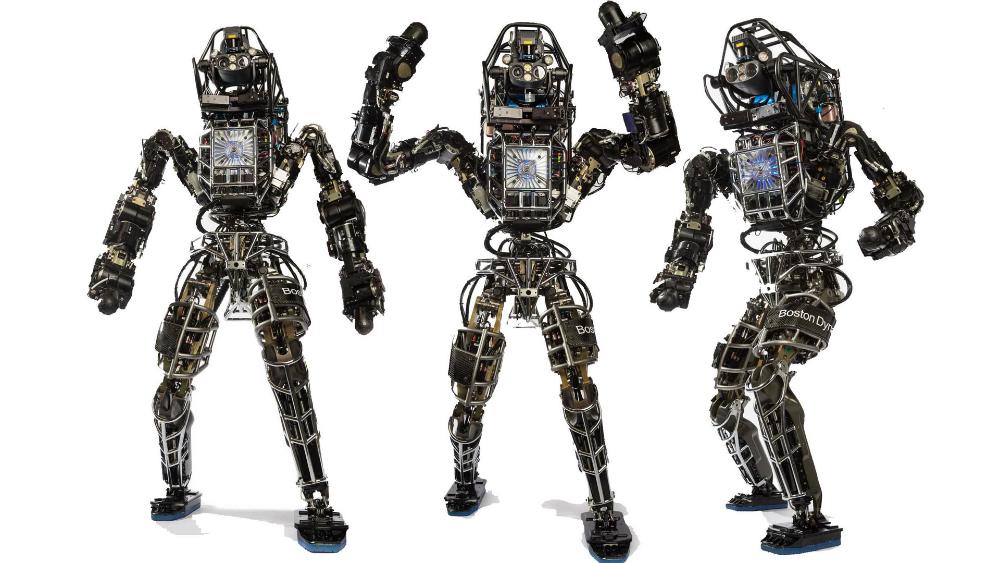
atlas humanoid robot
The Atlas humanoid robot. Image used with permission by copyright holder

You can check out the Schaft robot performing its eight tasks in the video below.

According to Adam Jacoff, a robotics research engineer with the National Institutes of Standards and Technology who helped design and develop the tasks, the DARPA Robotics Challenge Trials event is “one of the biggest robotics evaluations on Earth and dwarf many military robot tests, both in scale of ambition and the actual effort involved.”

Google, for one, will be delighted at the outstanding performances given by Schaft and robots developed by Boston Dynamics, as the Web giant announced just last week that it had acquired the two companies. Google has been taking an increasing interest in robotics, this year buying at least eight companies operating in the field. Though it has said little about its long-term robotics-based plans, DT’s Geoff Duncan recently offered up some thoughts on where Google might be going with its high-tech machinery.

[via Gizmodo]

Trevor Mogg
Contributing Editor
Not so many moons ago, Trevor moved from one tea-loving island nation that drives on the left (Britain) to another (Japan)…
This jacket pulls drinking water straight from the air
Engineers at UT Austin have developed a wearable textile that harvests ambient moisture into drinkable water.
Image showing person wearing a jacket with special fiber that pulls water from air

Engineers at the University of Texas at Austin have built a jacket that pulls drinkable water directly from the air, offering a potential solution for hikers, soldiers, agricultural workers, and emergency responders who operate far from reliable water sources.

How the jacket collects water

Read more
Google built an AI that can see football plays before they happen
DeepMind’s latest research predicts player movement up to eight seconds into the future
Google Deepmind TacticAI Featured

Football managers spend countless hours analyzing corners, free kicks, and player positioning in search of tiny competitive advantages. Google DeepMind believes artificial intelligence can make that process significantly faster, and its latest project, TacticAI, is designed to do exactly that. TacticAI is a football-specific AI assistant capable of modeling player movement, forecasting future play dynamics, and even recommending tactical adjustments for corner kicks. One of its standout abilities is predicting player trajectories up to eight seconds into the future using only broadcast-style visual data.

TacticAI was built with Liverpool FC and validated by football experts

Read more
Radical new coffee-making method uses sound, skips hot water and reduces energy bills
UNSW reserachers brewed espresso with room-temperature water and ultrasonic sound waves, cutting energy use by 75% in blind tests that fooled 100 regular drinkers.
Person brewing espresso in a lab with a modified ultrasonic espresso machine

Researchers at UNSW Sydney have figured out how to brew espresso-strength coffee without heating any water. The method replaces hot water and high pressure with ultrasonic sound waves, and in blind taste tests involving 100 regular coffee drinkers, participants could not tell the two apart.

How it works

Read more