  1. Home
  2. Emerging Tech
  3. Health & Fitness
  4. News

Graphene’s latest miracle? The ability to detect cancer cells

Add as a preferred source on Google

This is a great year for graphene researchers, who have identified astonishing new applications for the amazing wonder material seemingly every week.

The latest? The fact that it turns out to be pretty darn good at cancer detection, thereby hinting at the possibility of a future noninvasive tool for early diagnosis.

Recommended Videos

The work was carried out by scientists at the University of Illinois at Chicago, who placed brain cells (astrocytes) taken from mice onto a graphene sheet, comprising a one-atom-thick layer of carbon atoms, and found that the sheet was able to distinguish between a single cancerous cell (glioblastoma or GMB cell) and a normal cell.

“What we’ve shown is that a graphene-based system can detect the activity of a cell, and by doing that we can differentiate between a cancer cell and a normal cell,” Vikas Berry, associate professor and head of chemical engineering at UIC, told Digital Trends. “That’s because a cancer cell is hyperactive and has a different biochemistry on its surface and degree of activity that it exhibits. Based on the activity of the cell, we are able to make our differentiation.”
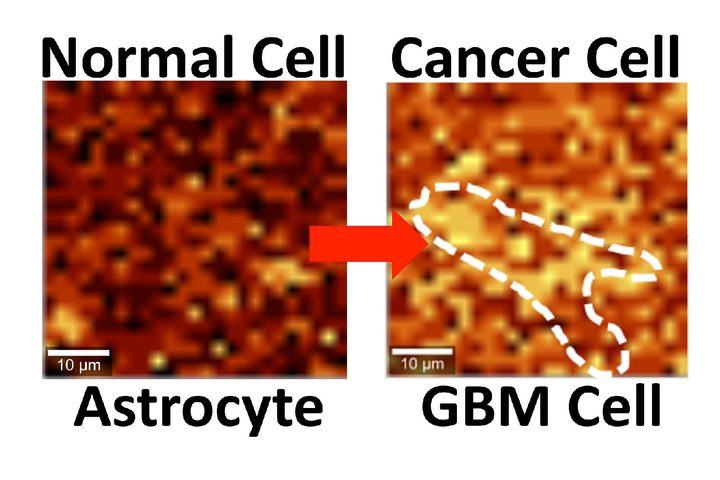
Image used with permission by copyright holder

The amazing cancer-detecting abilities of graphene relate to its impressive electrical conductivity. When exposed to a hyperactive cancerous cell, the electric field around the cell pushed away electrons in the graphene’s shared electron cloud. This changes the vibration energy of the carbon atoms: something which can be studied using ultra-high resolution vibration energy mapping. As a result, the researchers were able to tell what kind of cell the graphene was interfacing with.

“It’s an incredibly sensitive mechanism for detection,” Berry continued.

It’s exciting stuff, and could have significant real-world impacts. At present, however, it’s still a long way from clinical use. However, the researchers are hoping to expand beyond mouse trials to human patient biopsies in the future. They also hope that the same approach could be used to distinguish between different types of bacteria, and also identify sickle cells.

Luke Dormehl
I'm a UK-based tech writer covering Cool Tech at Digital Trends. I've also written for Fast Company, Wired, the Guardian…
The Android Show 2026: Gemini Intelligence, Googlebook, Android 17 updates, and everything else
Gemini Intelligence, Googlebooks, Android 17, and redesigned Android Auto. Google didn't hold back at its pre-I/O show, and the main event is still a week away.
The Android Show 2026

Every year, Google front-loads its Android announcements in a separate pre-show the week before its annual I/O conference. This year, the company did exactly that, and The Android Show: I/O Edition was anything but a warmup act. 

Google showed up well prepared, with plenty of software and a major hardware announcement that took everyone by surprise. One by one, let's talk about everything, including a deeply integrated AI overhaul, a long-overdue security upgrade, an Android Auto makeover that feels like it was designed for 2026, and a brand-new laptop category. 

Read more
Google is redefining the cursor for computers, and it’s AI-charged future looks ridiculous
Google’s Magic Pointer could be the next evolution of AI on laptops
AI, App

The humble mouse pointer has barely changed in decades. It moves, clicks, selects, drags, and occasionally turns into a spinning wheel of frustration. Google now wants to turn that tiny arrow into one of the most powerful AI tools on your laptop, which sounds ridiculous until you think about how often you use it.

The company has announced Magic Pointer for Googlebook, its new category of Gemini-powered laptops. The feature gives the cursor AI abilities, allowing it to understand what you are pointing at and help you act on it without needing a long prompt or a separate chatbot window.

Read more
6 things Gemini Intelligence is about to do across your Android devices
Logo, Disk, Symbol

Google is bringing Gemini Intelligence to Android, which brings the best of Gemini to its most intelligent devices. The company really wants you to get your work done by Gemini throughout the day, all while staying in control and keeping your data private. Google is rolling out these features starting with the Samsung Galaxy and Google Pixel devices this summer. Furthermore, we’ll see these features on other Android devices, including watches, cars, glasses, and laptops, later this year.

Your assistant is about to get a lot more hands-on, without you having to ask twice

Read more