  1. Home
  2. Emerging Tech
  3. News

Hendo plans to unveil its second-generation hoverboard next week

Add as a preferred source on Google

When Hendo first took to Kickstarter to unveil its first generation hoverboard last October, people went nuts. The project gathered up more than half a million dollars during the campaign, and ever since then, Hendo has been hard at work perfecting the technology. Now, almost exactly a year later, the company is mere days away (October 21) from officially unveiling the Hendo 2.0 — a new-and-improved hoverboard that’s been rebuilt with the help of legendary skateboarder Tony Hawk.

Hendo’s first model, which reportedly rode incredibly similar to an air-hockey puck, boasted its fair share of disadvantages — including (but not limited to) the fact it was incredibly bulky. For the 2.0, Hendo set out to make the board not only look more like an actual skateboard, but to ride like one, too. That’s when they turned to Hawk. By picking his brain on how a real skateboard handles, Hendo has reportedly been trying to give the Hendo 2.0 a more traditional (and controllable) feel under your feet. No word yet on whether it handles like the version Marty McFly rode in Back to the Future II, but the company’s illustrations do make it look much more attractive.
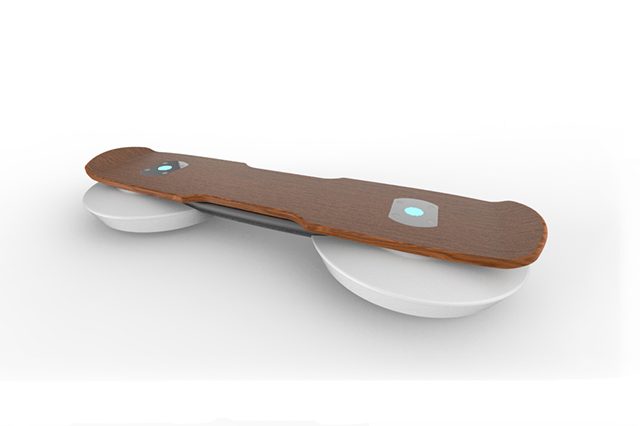
Prototype illustration of the Hendo 2.0
Prototype illustration of the Hendo 2.0 Hendo

Though Hendo took to upgrading its hoverboard’s look and feel, the company decided to stick with the same magnetic hover technology native to the Hendo 1.0. By using what it calls “Magnetic Field Architecture,” the development team outfitted the hoverboard with a series of electromagnets which react with generated magnetic fields and currents. By placing the board on a conductive surface, these magnetic currents generate a separate magnetic field which repels the board’s magnets, thus allowing the Hendo to hover.

Recommended Videos

Still, the fact that owners always need to place the board on a non-ferromagnetic conductor (in other words, a sheet of metal that isn’t iron or steel) remains one of the hoverboard’s biggest drawbacks. However, the team says that it continues to work on finding a way around this. Hendo hopes that those who initially contributed to its Kickstarter campaign may end up providing the company with vital research and ideas for how to get the board to function the same way on concrete as it does on copper. While it’s likely this crowdsourced research may be hard to come by, design partner Arx Pax’s CEO remains passionately optimistic.
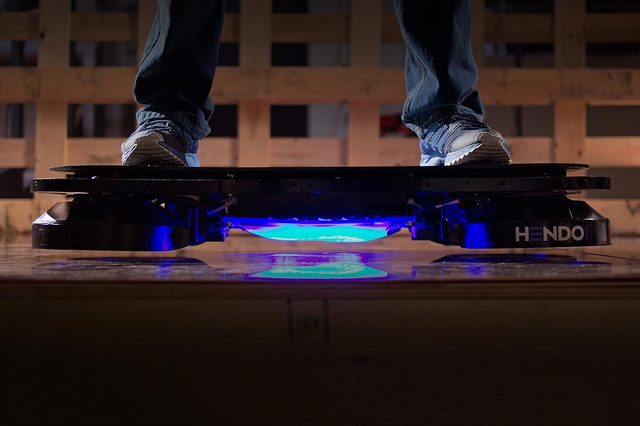
The original Hendo
The original Hendo Image used with permission by copyright holder

“We are looking for those early adopter-visionaries to partner with,” says Greg Henderson. “It’s not a question of ‘if’ this will happen, but ‘when.'”

As it waits for those early adopter-visionaries, Hendo continues to slowly unveil its minor tweaks to the Hendo 2.0 before the big Oct. 21 reveal. The gang added additional charging capabilities to the new model, outfitted the board with a longer lasting battery, included a USB port, and included wireless safety shut off. With this feature, owners have the ability to shut the board down completely even if they aren’t onboard.

With just five days remaining before Hendo’s official unveiling, it remains to be seen just how much of an impact the upgrades and Tony Hawk’s knowledge will have on the finished product. Though regardless of the uncertainty, count us among those wildly interested to see where hoverboards go next.

Rick Stella
Former Associate Editor, Outdoor
Rick became enamored with technology the moment his parents got him an original NES for Christmas in 1991. And as they say…
The best new ChatGPT feature is one most people will never use
Logo, Emblem, Symbol

For years, the biggest conversation around AI has been what these tools can do. They can browse the web, analyze documents, connect to your apps, conduct research, and increasingly act on your behalf. But as AI systems become more capable, another question has become harder to ignore: what happens when an AI assistant is tricked into handing over information it shouldn’t?

OpenAI’s new Lockdown Mode is its latest answer to that problem. Available across all ChatGPT account types, Lockdown Mode is an optional security setting designed for people and organizations handling sensitive information. The trade-off is that you get stronger protection against certain forms of data theft, but you lose access to some of ChatGPT’s most powerful features.

Read more
An app that lets anyone control a robot from their phone, no coding required
Sounds cool, right? Forget doomscrolling, now your phone can operate a robot arm instead
Representative Image

A team of researchers at Georgia Tech has developed a new smartphone-based system that could dramatically simplify how people interact with robots. Called COBALT, the platform allows users with little to no computing experience to remotely control robot arms from virtually anywhere in the world using just a phone and an internet connection.

The project, developed at Georgia Tech’s People, AI & Robotics (PAIR) Lab, transforms smartphones into motion controllers for robotic arms. Users simply move their phones in different directions, and the robot mirrors those movements in real time. Basic tasks such as grabbing, moving, and releasing objects can be performed through simple on-screen controls, making the experience feel more like playing a mobile game than operating industrial machinery.

Read more
Coursera wants users to learn through shorter, faster content
Coursera wants online learning to feel more like TikTok
Coursera

Online learning platform Coursera is taking a page straight out of TikTok’s playbook. The company has launched a new AI-powered feed designed to serve short-form educational content in a scrollable, personalized format, signaling a major shift in how digital learning platforms may try to keep users engaged.

The feature introduces bite-sized video lessons, clips, and explainers curated through artificial intelligence based on a user’s interests, learning habits, career goals, and previous course activity. Instead of committing to hour-long lectures or full certification programs upfront, users can now discover short educational snippets designed to make learning feel more casual, accessible, and addictive.

Read more