  1. Home
  2. Emerging Tech
  3. News

NASA’s Mars InSight lander is facing a rocky road as its drill hits a rock

Add as a preferred source on Google

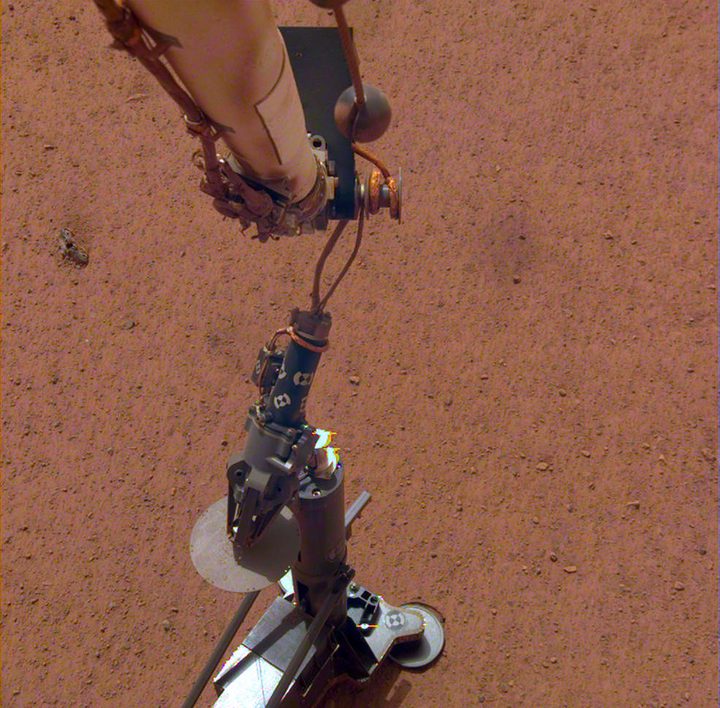
NASA’s InSight lander set its heat probe, called the Heat and Physical Properties Package (HP3), on the Martian surface on February 12. NASA/JPL-Caltech/DLR

The InSight lander on Mars has run into trouble this week with its project to drill down into the surface to measure heat from inside the planet. The lander is equipped with a probe, part of the Heat and Physical Properties Package, or HP3 instrument, that was to dig up to 16 feet down into the surface so it could collect accurate data on temperatures.

Recommended Videos

The drilling began on Thursday February 28 and continued without issues for the first few days. But once the probe had reached approximately three quarters of the depth it was aiming for, it stopped. The InSight team tried to restart with a second bout of drilling on Saturday March 2 but to no avail, and the probe didn’t reach any deeper. Data now suggests that the probe is tilted at an angle of 15 degrees.

The scientists responsible for the probe believe that it may have hit a rock, or possibly gravel. As there were few rocks on the surface of the drilling site, the team had hoped that there wouldn’t be rocks beneath the surface either. But they knew there was a risk that they would get unlucky a hit a rock which impeded drilling.

The tip of the probe, called the mole, was designed to push aside smaller rocks or to weave around larger ones, and this capacity worked well in testing before the probe was launched. But for now the team has decided to stop drilling and see what data they can gather from the probe’s current location.

“The team has … decided to pause the hammering for about two weeks to allow the situation to be analyzed more closely and jointly come up with strategies for overcoming the obstacle,” HP3 Principal Investigator Tilman Spohn of the German Aerospace Center (DLR) wrote in a blog post. “In the meantime, we are planning on carrying out thermal conductivity measurements for the first time on Mars … A lot to do and still a lot of excellent science to be expected from HP3 and from InSight!”

Georgina Torbet
Georgina has been the space writer at Digital Trends space writer for six years, covering human space exploration, planetary…
The best new ChatGPT feature is one most people will never use
Logo, Emblem, Symbol

For years, the biggest conversation around AI has been what these tools can do. They can browse the web, analyze documents, connect to your apps, conduct research, and increasingly act on your behalf. But as AI systems become more capable, another question has become harder to ignore: what happens when an AI assistant is tricked into handing over information it shouldn’t?

OpenAI’s new Lockdown Mode is its latest answer to that problem. Available across all ChatGPT account types, Lockdown Mode is an optional security setting designed for people and organizations handling sensitive information. The trade-off is that you get stronger protection against certain forms of data theft, but you lose access to some of ChatGPT’s most powerful features.

Read more
An app that lets anyone control a robot from their phone, no coding required
Sounds cool, right? Forget doomscrolling, now your phone can operate a robot arm instead
Representative Image

A team of researchers at Georgia Tech has developed a new smartphone-based system that could dramatically simplify how people interact with robots. Called COBALT, the platform allows users with little to no computing experience to remotely control robot arms from virtually anywhere in the world using just a phone and an internet connection.

The project, developed at Georgia Tech’s People, AI & Robotics (PAIR) Lab, transforms smartphones into motion controllers for robotic arms. Users simply move their phones in different directions, and the robot mirrors those movements in real time. Basic tasks such as grabbing, moving, and releasing objects can be performed through simple on-screen controls, making the experience feel more like playing a mobile game than operating industrial machinery.

Read more
Coursera wants users to learn through shorter, faster content
Coursera wants online learning to feel more like TikTok
Coursera

Online learning platform Coursera is taking a page straight out of TikTok’s playbook. The company has launched a new AI-powered feed designed to serve short-form educational content in a scrollable, personalized format, signaling a major shift in how digital learning platforms may try to keep users engaged.

The feature introduces bite-sized video lessons, clips, and explainers curated through artificial intelligence based on a user’s interests, learning habits, career goals, and previous course activity. Instead of committing to hour-long lectures or full certification programs upfront, users can now discover short educational snippets designed to make learning feel more casual, accessible, and addictive.

Read more