  1. Home
  2. Emerging Tech
  3. News

ISS receives new hardware for the coolest experiment in the universe

Add as a preferred source on Google

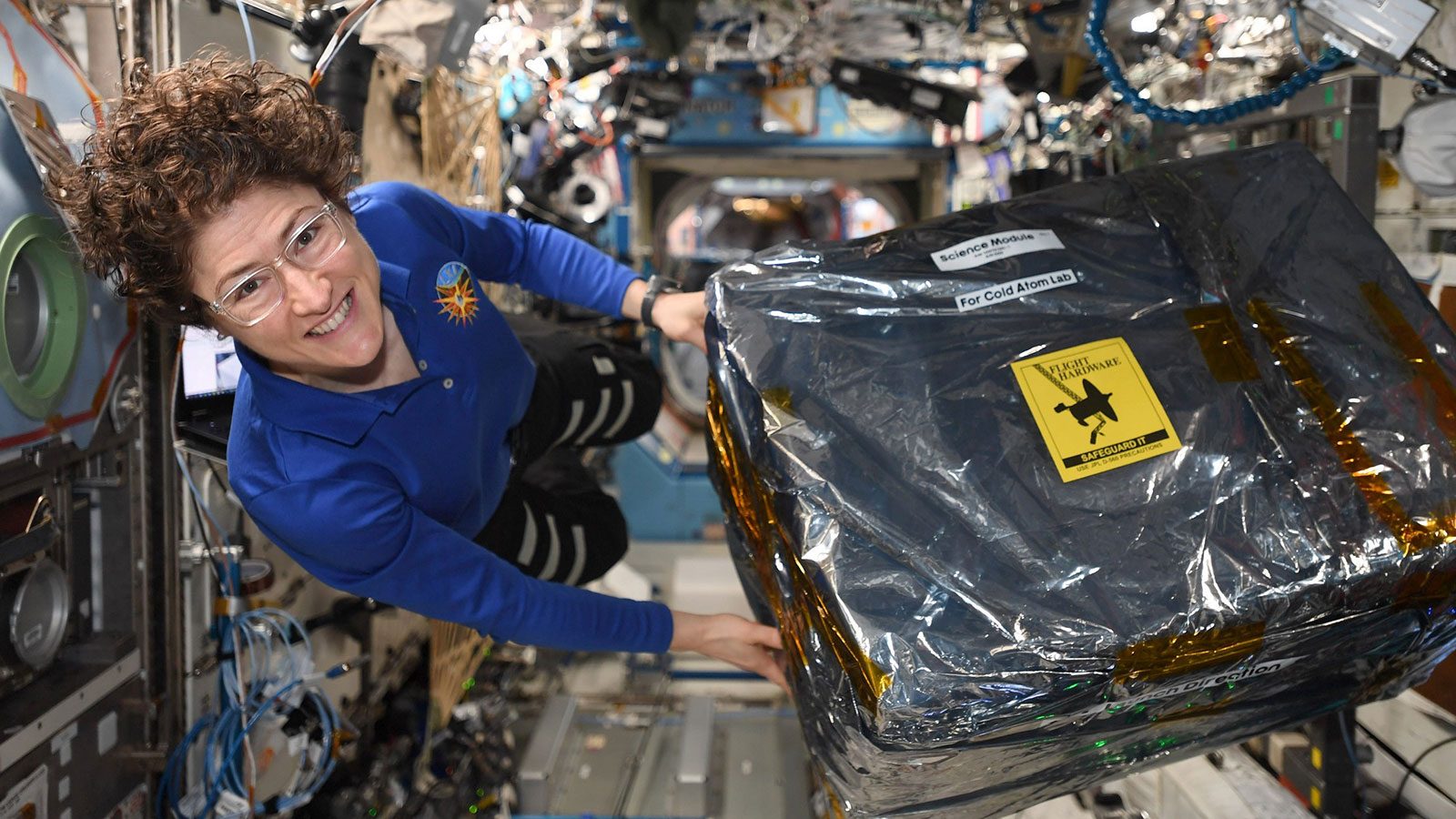
ISS astronaut Christina Koch unloads new hardware for the Cold Atom Lab.
Astronaut Christina Koch unloads new hardware for the Cold Atom Lab aboard the International Space Station the week of Dec. 9, 2020. NASA

The International Space Station (ISS) is the site of research into all sorts of topics, from whether microbes can survive in space to how building materials respond to low gravity to whether robots can assist astronauts in space missions. But some of the most intriguing work being done there is in the area of particle physics, as particle detectors in space can detect cosmic radiation which would be blocked by the Earth’s atmosphere.

Recommended Videos

Now, the ISS has taken custody of new hardware for another particle physics experiment: The Cold Atom Lab, which NASA says “conduct[s] a variety of experiments to help answer questions about how our world works at the smallest scales.”

The lab is the size of a mini-fridge and has been in operation on the ISS since July 2018. It chills atoms almost down to absolute zero, or minus 459 degrees Fahrenheit (minus 273 degrees Celsius), which is the lowest temperature possible at which particles essentially stop vibrating.

Using the lab, researchers are able to investigate topics like superfluidity, in which a fluid has zero viscosity and flows without losing kinetic energy, and superconductivity, when a material is cooled so much it has no electrical resistance.

The advantage of working with extremely low temperatures is that atoms normally move extremely fast — faster than the speed of sound — which makes them difficult to study. When the atoms are chilled to near-absolute zero temperatures in the Cold Atom Lab, they move at a literal snail’s pace, making them much easier for scientists to observe.

The new hardware for the lab includes an atom interferometer, which can measure gravity with high precision and help researchers examine fundamental theories of gravity.

In a blog post, NASA say this could lead to breakthroughs which would benefit both space exploration and our understanding of Earth: “Further development of this technology in space could lead to improved inertial-force sensors, which could be used to design tools for enhanced spacecraft navigation, to probe the composition and topology of planets and other celestial bodies, and to study Earth’s climate.”

Georgina Torbet
Georgina has been the space writer at Digital Trends space writer for six years, covering human space exploration, planetary…
DJI ‘s first 360° drone offers 8K video recording and a freakishly long transmission range
From omnidirectional obstacle sensing to 42 GB of onboard storage, the Avata 360 is DJI doing what DJI does best: raising the bar for everyone else.
DJI Avata 360° drone.

DJI has officially entered the 360° drone arena with the launch of the Avata 360. It’s the company’s first-ever fully immersive FPV drone, and a direct shot at the Antigravity A1, a rival built by an Insta360-incubated brand. Looks like the drone wars just got more interesting. 

What makes the Avata 360 worth looking at?

Read more
I transferred all my chats from other AI apps to Gemini — and it works flawlessly
Google Gemini Graphics Featured

You know that moment when AI assistants like ChatGPT, Gemini, or Claude suddenly lose the plot mid-conversation and start hallucinating like they’re absolutely sure they’re right? Yeah…it’s equal parts funny and painfully annoying. My usual reaction is switching between apps, hoping one of them gets it right. But the real problem is that I have to start over every single time. It feels like I’m stuck in a loop explaining my life story to different AIs, one after the other.

Now with Gemini, I can now jump in from other AI apps without that whole reset conversation. Finally, the Google gods have blessed us. I tried it out expecting the usual hiccups, but it was surprisingly smooth and quick.

Read more
Google expands Search Live globally with voice and camera AI
The feature is now available in 200+ countries with multilingual support
Google Search Live

Google is taking another big step toward turning Search into a full-blown AI assistant. The company has officially expanded Search Live globally, making the feature available in over 200 countries and territories, along with support for dozens of languages.

https://twitter.com/google/status/2037201891130523917

Read more