  1. Home
  2. Emerging Tech
  3. News

What happens to concrete when you mix it in space? ISS astronauts investigate

Add as a preferred source on Google

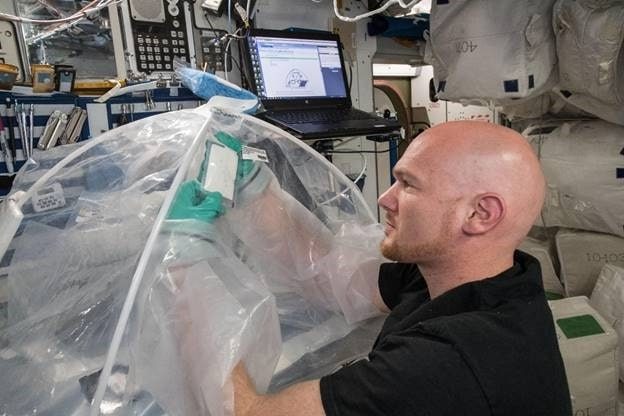
European Space Agency astronaut Alexander Gerst works on the MICS experiment aboard the International Space Station. NASA

Concrete is a material used everywhere on Earth due to its strength and relatively light weight. That makes it a useful candidate for a material to build structures in space as well. But you can’t simply mix up cement in space the same way you do on Earth and expect to reach the same result. The astronauts on board the International Space Station (ISS) have been performing experiments to see how concrete reacts during the hardening process in microgravity, and how this affects its microstructure and material properties.

Recommended Videos

“On missions to the moon and Mars, humans and equipment will need to be protected from extreme temperatures and radiation, and the only way to do that is by building infrastructures on these extraterrestrial environments,” principal investigator Aleksandra Radlinska of Pennsylvania State University explained in a statement. “One idea is building with a concrete-like material in space. Concrete is very sturdy and provides better protection than many materials.”

NASA ScienceCasts: Cementing Our Place in Space

The project is called the Microgravity Investigation of Cement Solidification (MICS) project, and it involved mixing concrete in space for the first time. The researchers tested a number of variations of cement powder using different additives and ratios of powder to water. They found some key differences in the hardening process from what would happen on Earth, in particular, that the space concrete ended up being more porous which will likely make it slightly less strong.

“Even though concrete has been used for so long on Earth, we still don’t necessarily understand all the aspects of the hydration process. Now we know there are some differences between Earth- and space-based systems and we can examine those differences to see which ones are beneficial and which ones are detrimental to using this material in space,” Radlinska said. “Also, the samples were in sealed pouches, so another question is whether they would have additional complexities in an open space environment.”

It’s good news that mixing concrete in space is possible at all, even if the result is not quite the same as it would be on Earth. Eventually, concrete and other materials could be used to produce lightweight and strong habitats in space, and current research will improve the cement processing techniques to make the finished material more reliable.

The findings are published in the journal Frontiers in Materials.

Georgina Torbet
Georgina has been the space writer at Digital Trends space writer for six years, covering human space exploration, planetary…
You can now generate images with Gemini’s memory without paying a dime
Study guide created by Gemini

Google has made one of Gemini's most interesting AI tricks a lot easier to try. The company is rolling out its personalized image generation feature to eligible U.S. users for free, removing a paywall that previously kept it exclusive to Gemini's paid tiers.

Powered by Google's Nano Banana image model, the feature does more than generate pretty pictures; it taps into Gemini's understanding of you, making AI-generated images feel surprisingly personal.

Read more
Meta’s Brain2Qwerty v2 turns thoughts into text, and it doesn’t need brain implants
The latest AI model decodes brain signals into coherent sentences using external scanners.
Meta Brain2Qwerty v2 Featured

Artificial intelligence is getting surprisingly good at understanding humans. Now, Meta wants it to understand our brains too. The company has unveiled Brain2Qwerty v2, an upgraded AI system that can translate brain activity into full sentences, all without requiring brain implants or surgery. The goal isn't mind reading for the masses. Instead, it's to help people who have lost the ability to speak communicate again.

How a Brain-powered keyboard works

Read more
AI chatbots can often feed into your delusions. Researchers say you should look for three signs
Experts warn that chatbot design choices can reinforce unhealthy beliefs in vulnerable users.
ChatGPT on a smartphone

Artificial intelligence chatbots have become incredibly good at sounding human. But a new review paper by psychiatrist Marc Augustin and fellow researchers Thomas A. Pollak and Helen Morrin, published in NPP—Digital Psychiatry and Neuroscience, argues that existing AI research points to an overlooked psychological risk. The paper, highlighted by The Wall Street Journal, reviews previous studies and proposes a framework explaining how three common chatbot behaviors can combine to reinforce delusional thinking in vulnerable users, creating what the authors call an "amplification spiral."

Researchers say these are the three warning signs

Read more