  1. Home
  2. Emerging Tech
  3. News

Watch the James Webb Space Telescope deploy its massive origami mirror

Add as a preferred source on Google
The James Webb Space Telescope's Folding Mirrors

The successor to the Hubble Space Telescope, NASA’s James Webb Space Telescope, has passed an important test by deploying its huge mirror into the configuration it will use once launched into space.

Recommended Videos

The telescope’s primary mirror is 6.5 meters across, the biggest NASA has ever created, and it will make the telescope the most powerful ever built once it is completed. The mirror is so large it can’t fit into a rocket, so it folds up like origami to fit into the 5-meter space available in the payload fairing and will then deploy to its full size once in space. Testing the deployment required the use of special gravity offsetting equipment which simulates a zero-gravity environment.

“Deploying both wings of the telescope while part of the fully assembled observatory is another significant milestone showing Webb will deploy properly in space,” Lee Feinberg, optical telescope element manager for Webb at NASA’s Goddard Space Flight Center, said in a statement. “This is a great achievement and an inspiring image for the entire team.”
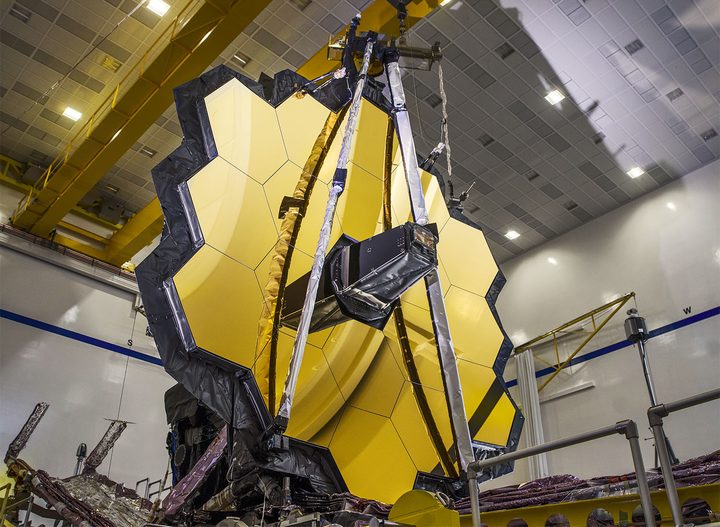
Deployment tests like these help safeguard mission success by physically demonstrating that NASA’s James Webb Space Telescope is able to move and unfold as intended.
Deployment tests like these help safeguard mission success by physically demonstrating that NASA’s James Webb Space Telescope is able to move and unfold as intended. NASA/Chris Gunn

The James Webb project had been making progress, such as when it successfully deployed its tennis court-sized sunshield in a test last year. However, ongoing issues with delays meant that a report in January stated that the project was unlikely to meet its planned launch date of November 2020. Then, with the global outbreak of coronavirus, officially called COVID-19, the NASA project had to be put on hold.

The test of the mirror was performed before work was suspended, in early March. The current status of the project is that the Northrop Grumman team working on the telescope has resumed work on integration and testing with reduced personnel and will continue to work for a few more weeks until the setup of the Deployable Tower Assembly is complete. Then the Northrop Grumman team will also suspend its work as it cannot continue without the input of the NASA team.

NASA is still hoping to launch the telescope in 2021, but whether that will be possible depends on how the coronavirus situation unfolds over the next few weeks and how long the suspension of work continues.


Georgina Torbet
Georgina has been the space writer at Digital Trends space writer for six years, covering human space exploration, planetary…
The best new ChatGPT feature is one most people will never use
Logo, Emblem, Symbol

For years, the biggest conversation around AI has been what these tools can do. They can browse the web, analyze documents, connect to your apps, conduct research, and increasingly act on your behalf. But as AI systems become more capable, another question has become harder to ignore: what happens when an AI assistant is tricked into handing over information it shouldn’t?

OpenAI’s new Lockdown Mode is its latest answer to that problem. Available across all ChatGPT account types, Lockdown Mode is an optional security setting designed for people and organizations handling sensitive information. The trade-off is that you get stronger protection against certain forms of data theft, but you lose access to some of ChatGPT’s most powerful features.

Read more
An app that lets anyone control a robot from their phone, no coding required
Sounds cool, right? Forget doomscrolling, now your phone can operate a robot arm instead
Representative Image

A team of researchers at Georgia Tech has developed a new smartphone-based system that could dramatically simplify how people interact with robots. Called COBALT, the platform allows users with little to no computing experience to remotely control robot arms from virtually anywhere in the world using just a phone and an internet connection.

The project, developed at Georgia Tech’s People, AI & Robotics (PAIR) Lab, transforms smartphones into motion controllers for robotic arms. Users simply move their phones in different directions, and the robot mirrors those movements in real time. Basic tasks such as grabbing, moving, and releasing objects can be performed through simple on-screen controls, making the experience feel more like playing a mobile game than operating industrial machinery.

Read more
Coursera wants users to learn through shorter, faster content
Coursera wants online learning to feel more like TikTok
Coursera

Online learning platform Coursera is taking a page straight out of TikTok’s playbook. The company has launched a new AI-powered feed designed to serve short-form educational content in a scrollable, personalized format, signaling a major shift in how digital learning platforms may try to keep users engaged.

The feature introduces bite-sized video lessons, clips, and explainers curated through artificial intelligence based on a user’s interests, learning habits, career goals, and previous course activity. Instead of committing to hour-long lectures or full certification programs upfront, users can now discover short educational snippets designed to make learning feel more casual, accessible, and addictive.

Read more