  1. Home
  2. Emerging Tech
  3. Legacy Archives

Digital love: Kajimoto lab developing the e-kiss

Add as a preferred source on Google

ekissLove knows no bounds, and with the help of some new tech that adage may be more than a stock greeting card saying.

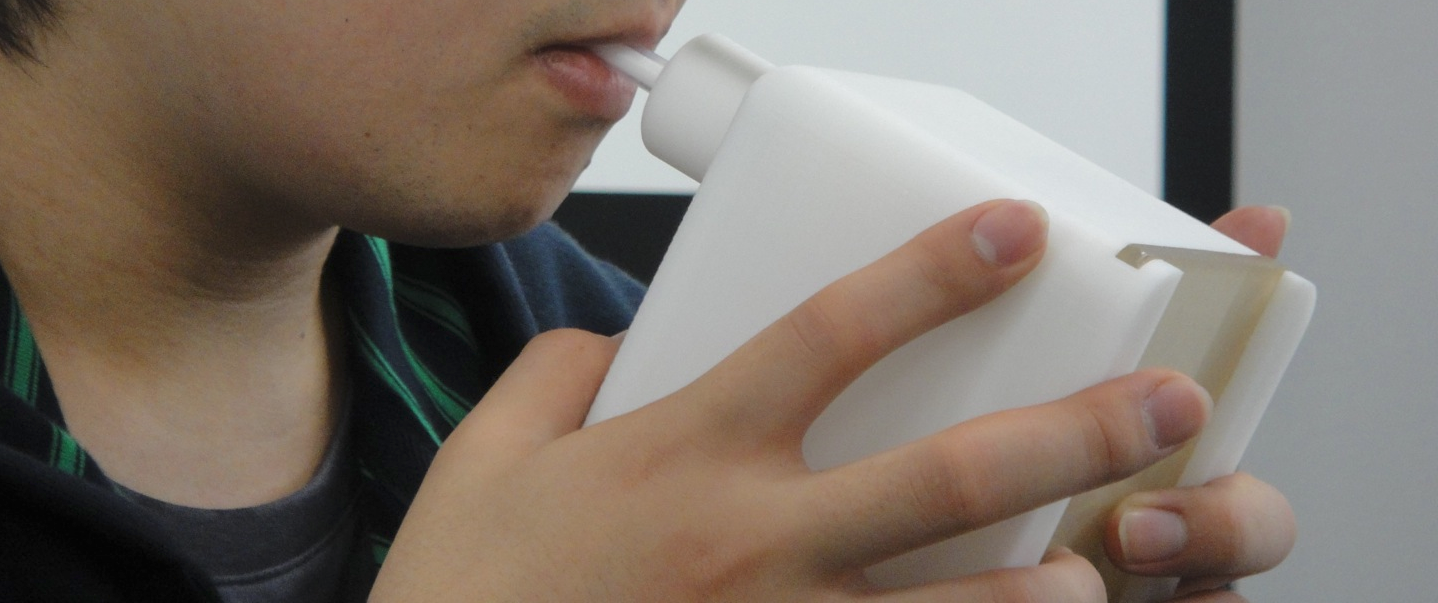
Japanese researchers from the Kajimoto Laboratory at the University of Electro-Communications are working on a device which will help lovers physically transcend the distance keeping them apart. The engineers are developing a Kiss Transmission Device which aims to simulate the entire experience of a kiss.

Recommended Videos

The present, rough-looking model consists of two straw-like devices connected over a single PC. A user takes a device and swirls their tongue around one of the straws. Then, the way the A-straw interface is moved is transmitted to the B-straw device which mimics the movement.

One researcher explained, “It is called bilateral control, and the turn angle information is sent reciprocally by both devices to maintain the same position. Right now the values are handled by one PC, but if a system is put together to handle the values over a network, then it would be easy for this operation to be conducted remotely.”

It hardly seems  a romantic picture, but the researchers aim to recreate all the elements of a kiss including a sense of taste, the way a person breathes and even the moistness of the tongue. The dreams for the device also include a less sentimental possibility, as specific values can be recorded and replayed multiple times. Nobuhiro Takahashi told Diginfo.tv, “For example, if you have a popular entertainer use this device and record it, that could be hugely popular if you offer it to fans.”

The Kajimoto lab’s focus is human interface with an emphasis on tactile interface. One of their other projects was a device called the Sense-Roid. This device mirrored back the same hug given it by using sensors, vibrators and artificial muscles; basically allowing a person to hug themselves. Just one more advance in lifelike simulacra.

Jeff Hughes
Former Digital Trends Contributor
I'm a SF Bay Area-based writer/ninja that loves anything geek, tech, comic, social media or gaming-related.
Chrome is getting better at understanding the breaks and punctations you never say out loud
Voice typing in Chrome is about to feel much more natural
Google Chrome on Android Featured

Google is quietly making voice dictation in Chrome feel a lot more natural. With the latest Chrome 151 Beta, the company is introducing a new capability that allows the browser's speech recognition engine to automatically infer punctuation based on the way people speak, eliminating the need to explicitly say commands like "comma" or "full stop."

The update may sound minor at first glance, but it addresses one of the biggest frustrations with voice typing: speaking naturally often produces text that lacks punctuation unless users consciously dictate every punctuation mark. By teaching Chrome to understand pauses, rhythm, and speech patterns, Google is taking another step toward making conversations with computers feel more human.

Read more
Horror films play music to warn about danger. These headphones use the same trick to save you from robots
Spherephones replaces factory alarms with music that tells you what is coming and from where.
spherephones-georgia-tech

The ear has always processed what is coming before the eye does. In horror movies, the music always tells you something bad is coming. Now researchers at Georgia Tech are using the same idea in real life to keep factory workers safe around robots.

They have built a wearable headset called Spherephones that converts nearby robot movement into spatial music, giving you a warning before a machine gets too close. It helps the user stay aware without breaking their attention.

Read more
Elon Musk refutes report claiming that an AI device is in development at SpaceX
The billionair's two-word denial on X doesn't explain what part of the Wall Street Journal's report he's disputing.
Elon Musk speaking into a microphone with a blue background

Elon Musk has denied a Wall Street Journal report claiming SpaceX showed investors a prototype AI device before its recent IPO. "Utterly false," Musk wrote on X, responding to a post about the report that has since been deleted, offering no further explanation.

A denial that leaves more questions than it answers

Read more