  1. Home
  2. Emerging Tech
  3. Outdoors
  4. News

Ditch your bulky commuter bike helmet and ride smarter with the foldable Lid

Add as a preferred source on Google

Cycling without a helmet isn’t advisable for obvious reasons. Then again, having to carry around a bulky bike helmet with you all day can make it a tempting option for commuters. That’s where a smart new helmet, currently raising funds on Indiegogo, comes into play. Called Lid, the helmet is able to fold up when you’re not using it — courtesy of a neat design boasting separate movable parts, a bit like sliding tectonic plates, and some well-placed magnets. The result is a helmet that will comfortably fit into a bag when it is not being used to safeguard our noggins.

“Our research told us that ‘helmet hassle’ is the No. 1 reason why cyclists opt not to wear a helmet, and also that safety concerns prevent many commuters from cycling altogether,” creator Sam Terry told Digital Trends. “We went about changing this and developed an eco-friendly helmet which would bring ‘safety with convenience’, by folding to a size and shape which would slip easily into a backpack, satchel, or handbag. We’ve designed Lid with clean lines and an urban profile, so we think it also looks great too.”

Recommended Videos

In terms of protection, Terry said the helmet has been extensively impact-tested and has passed the necessary standards. Each of the helmet’s five segments boasts its own impact absorption capability, so there’s no compromise in terms of safety versus a traditional, single-piece helmet.
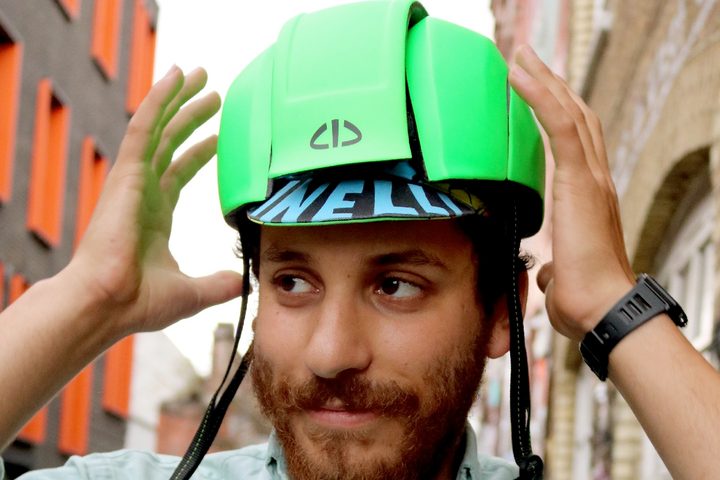
Image used with permission by copyright holder

“In 2011, I began commuting to work in London by bike,” Terry continued, explaining the project’s origins. “At first, cycling in London was pretty intimidating to me. London’s bike-share scheme had recently been launched, and I could see the potential for cycling, but it shocked me at how few of the users were wearing helmets. I saw a guy take a hard fall from one of the bikes and crack his head, which got me thinking. I knew that the short journey times on the bikes of 20 minutes meant that users weren’t willing to carry around a helmet with them all day. That’s where the idea for a helmet that could compact to fit into a bag, but also look great too, came from.”

Clearly, there is a demand for the project, since it raised 50 percent of its funding target in just two hours on Indiegogo. If you want to get your hands (and, eventually, your head) on a unit, you can pre-order one now. Prices start at $70, with shipping set for May.

Luke Dormehl
I'm a UK-based tech writer covering Cool Tech at Digital Trends. I've also written for Fast Company, Wired, the Guardian…
Robots just ran the Beijing half-marathon faster than the world record holder
humanoid robot running a marathon

A humanoid robot just ran a half-marathon faster than the world record holder. It might not seem impressive at first, but considering last year, the fastest robot at Beijing's humanoid robot half-marathon finished in two hours and 40 minutes, this is a huge achievement. 

As reported by the Associated Press, the winning robot at this year's Beijing half-marathon crossed the finish line in 50 minutes and 26 seconds, comfortably beating the human world record of 57 minutes recently set by Jacob Kiplimo. 

Read more
As if the plate wasn’t already full, AI is about to worsen the global e-waste crisis
New report highlights a rising environmental concern
Stack of graphics cards and motherboards in a landfill site e-waste

AI is already changing how the world works, but it’s also quietly making one of our biggest environmental problems even worse. And no, this isn’t about energy consumption this time. It’s about the hardware. Because every smarter AI model comes with a physical cost.

AI is about to supercharge the e-waste problem

Read more
Smart glasses are finding a surprise niche — Korean drama and theater shows
Urban, Night Life, Person

Every year, millions of people follow Korean content without speaking a word of the language. They stream shows with subtitles, read translated lyrics, and find workarounds. But live theater has always been a different problem — you can't pause or rewind it. That's the problem: a Korean startup thinks it's cracked, and Yuroy Wang was one of the first to try it. The 22-year-old Taipei retail worker is a K-pop fan who loves Korean culture but doesn't speak the language. When he went to see "The Second Chance Convenience Store," a touring play based on a Korean novel that was a bestseller in Taiwan, he expected supertitles. What he got instead was a pair of chunky black-framed AI-powered glasses sitting on his nose, translating the dialogue in real time directly on the lenses. "As soon as I found out they were available, I couldn't wait to try them," he said. Wang is part of a growing audience discovering that smart glasses, a category of tech that has struggled to find mainstream purpose for years, might have just found their calling in the most unexpected of places: live Korean theater.

How do the glasses work?

Read more