  1. Home
  2. Emerging Tech
  3. Cars
  4. News

New Lidar tech uses 128 lasers to help self-driving cars see in high resolution

Add as a preferred source on Google

When it comes to autonomous vehicles, Lidar is one of the driving forces that make it all possible. A laser-based surveying method, Lidar builds up a depth-based image of the world by shining out laser lights and then measuring how long it takes for the reflected pulse to be bounced back to the sensor.

And thanks to the work of pioneering company Velodyne, Lidar just got a whole lot better.

Recommended Videos

Unveiled this week, Velodyne’s new VLS-128 sensor set a new record by doubling the number of laser beams on its previous top-of-the-line Lidar system to a massive 128, while shrinking the overall size of the sensor by 70 percent. By doing so, the system promises to bring a crazy new level of resolution to the myriad applications that call for Lidar technology — from helping cars drive autonomously to mapping sites from the air.

“A 360-degree Lidar sensor such as the VLS-128 is optimal for keeping drivers and passengers safe in all situations,” Anand Gopalan, chief technology officer at Velodyne, told Digital Trends. “It provides the clearest view of both stationary and moving objects on or around the road, and in any direction around the vehicle. In addition, Velodyne’s Lidar sensors are capable of producing up to 3 million data points per second, with a range of up to 300 meters and accuracy [of around] 3 [centimeters].”
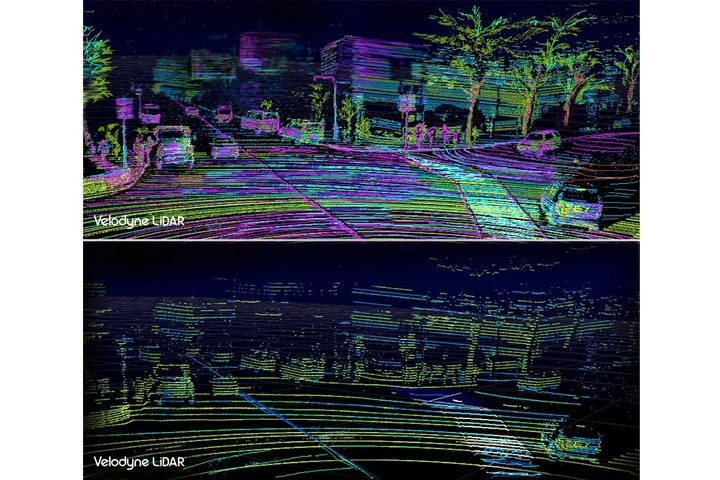
Image used with permission by copyright holder

As can be seen from the above image, the new VLS-128’s resolution is considerably better than its (already highly competent) predecessor. When you factor in faster scanning and better algorithms, it’s anywhere from three to 10 times better than existing technology. In terms of what this means for its use in the real world, Velodyne suggests that it will sideline other sensors, such as cameras and radars, that are used by current autonomous vehicles. While those other sensors will almost certainly stay a part of the next generation of self-driving cars, there’s a good chance that they will be relegated simply to acting as backup devices.

“We are ramping production up now, and we expect to start providing engineering samples to key customers by the end of the year,” Gopalan said. “Production will be fully ramped up in early 2018.”

Luke Dormehl
I'm a UK-based tech writer covering Cool Tech at Digital Trends. I've also written for Fast Company, Wired, the Guardian…
Gemini is about to get wings on your phone with agentic skills
Logo, Disk, Symbol

Google I/O is almost here, and now that Google has already wrapped up The Android Show, all eyes are shifting toward the company’s AI ambitions — especially Gemini. While nothing has been officially announced yet, a new leak gives us an early glimpse of what Google could be preparing behind the scenes.

Your inbox might soon fear Gemini more than spam

Read more
AI shouldn’t make decisions for you, but this one will tell when you’re making a bad one
Cornell researchers built an AI tool that checks your decisions against your own values.
Toy, Person, Rubix Cube

If you have ever stared at a long list of options and felt your brain just give up, you are not alone. Researchers at Cornell University get it, and they have built a tool called Interactive Explainable Ranking (IER) that steps in right at that moment, not to decide for you, but to quietly point out when your choices do not match the values you care about.

How does this tool actually work?

Read more
Ultra-thin transparent solar cells promise invisible charging for wearables, cars, and homes
Your car windows and smart glasses could one day harvest sunlight
Adult, Female, Person

A new kind of near-invisible solar cell could one day help everyday glass surfaces generate electricity. This could include car windows and sunroofs, smart glasses, wearables, building façades, and home windows.

Scientists at Nanyang Technological University, Singapore, have developed ultrathin transparent perovskite solar cells that are about 10,000 times thinner than a strand of human hair and around 50 times thinner than conventional perovskite solar cells. The NTU research team, led by Associate Professor Annalisa Bruno, published the findings in ACS Energy Letters (via TechXplore).

Read more