  1. Home
  2. Emerging Tech
  3. News

Can’t see the stars? You’re not alone — 80 percent of the world can’t either

Add as a preferred source on Google

The stars at night may be big and bright deep in the heart of Texas, but for 80 percent of the world, that’s apparently completely untrue. In what may be one of the more unfortunate effects of humanity’s activities on Earth, we’ve now successfully managed to block out the light of the stars for the majority of the world. According to a new atlas of artificial night sky brightness, our galaxy is not visible to 60 percent of Europeans and nearly 80 percent of North Americans. Indeed, our own electricity-powered lights have drowned out the natural luminosity of the Milk Way, and in Singapore, Kuwait, and Malta, the night sky (or rather, the stars in them) are completely imperceptible.
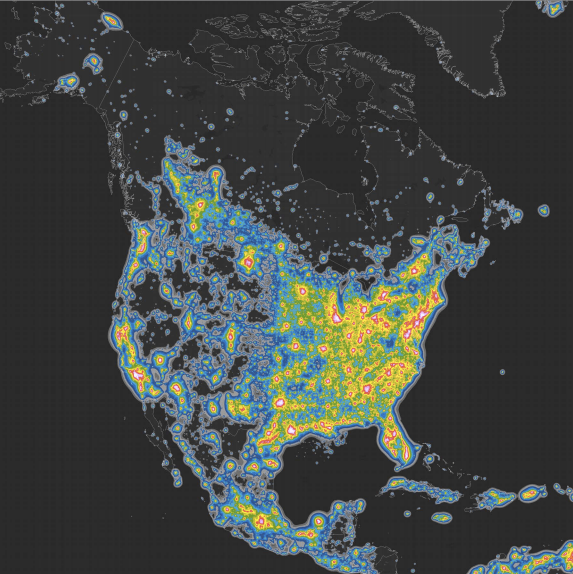
(Falchi et al, 2016)
(Falchi et al, 2016) Image used with permission by copyright holder

Calling the current situation a “cultural loss of unprecedented magnitude,” lead author Fabio Falchi of the Light Pollution Science and Technology Institute in Italy noted the magnitude of the effects of light pollution today. Modern lighting has actually made it impossible for 77 percent of those in the U.K. to see the Milky Way, and unsurprisingly, in China, the situation is even worse.

Recommended Videos

“Humanity has enveloped our planet in a luminous fog that prevents most of Earth’s population from having the opportunity to observe our galaxy,” the study authors wrote in their findings.

Scientists were able to determine our dearth of starlight by collecting data from space from the Suomi National Polar-orbiting Partnership satellite, and coupling this information with computer models of sky luminescence, as well as field studies of sky brightness taken from both professionals and the public. Ultimately, the researchers concluded, more than 99 percent of those living the U.S. and EU member states experience “light pollution” — and only in areas like central Scotland, Corsica, or central Spain do people live in non-polluted environments.

“It’s really one of the most thorough studies that we have to date on light pollution across the globe,” Cheryl Ann Bishop, who is the communications director for the International Dark-Sky Association, which fights light pollution, told NPR. “The fact that we’re bathing our planet in artificial light at night is a relatively new phenomenon, and it’s essentially akin to a human experiment that we’re only just beginning to understand the ramifications of.”

Lulu Chang
Fascinated by the effects of technology on human interaction, Lulu believes that if her parents can use your new app…
The best new ChatGPT feature is one most people will never use
Logo, Emblem, Symbol

For years, the biggest conversation around AI has been what these tools can do. They can browse the web, analyze documents, connect to your apps, conduct research, and increasingly act on your behalf. But as AI systems become more capable, another question has become harder to ignore: what happens when an AI assistant is tricked into handing over information it shouldn’t?

OpenAI’s new Lockdown Mode is its latest answer to that problem. Available across all ChatGPT account types, Lockdown Mode is an optional security setting designed for people and organizations handling sensitive information. The trade-off is that you get stronger protection against certain forms of data theft, but you lose access to some of ChatGPT’s most powerful features.

Read more
An app that lets anyone control a robot from their phone, no coding required
Sounds cool, right? Forget doomscrolling, now your phone can operate a robot arm instead
Representative Image

A team of researchers at Georgia Tech has developed a new smartphone-based system that could dramatically simplify how people interact with robots. Called COBALT, the platform allows users with little to no computing experience to remotely control robot arms from virtually anywhere in the world using just a phone and an internet connection.

The project, developed at Georgia Tech’s People, AI & Robotics (PAIR) Lab, transforms smartphones into motion controllers for robotic arms. Users simply move their phones in different directions, and the robot mirrors those movements in real time. Basic tasks such as grabbing, moving, and releasing objects can be performed through simple on-screen controls, making the experience feel more like playing a mobile game than operating industrial machinery.

Read more
Coursera wants users to learn through shorter, faster content
Coursera wants online learning to feel more like TikTok
Coursera

Online learning platform Coursera is taking a page straight out of TikTok’s playbook. The company has launched a new AI-powered feed designed to serve short-form educational content in a scrollable, personalized format, signaling a major shift in how digital learning platforms may try to keep users engaged.

The feature introduces bite-sized video lessons, clips, and explainers curated through artificial intelligence based on a user’s interests, learning habits, career goals, and previous course activity. Instead of committing to hour-long lectures or full certification programs upfront, users can now discover short educational snippets designed to make learning feel more casual, accessible, and addictive.

Read more