  1. Home
  2. Emerging Tech
  3. News

Did there used to be liquid water on Mars? New images give clues

Add as a preferred source on Google

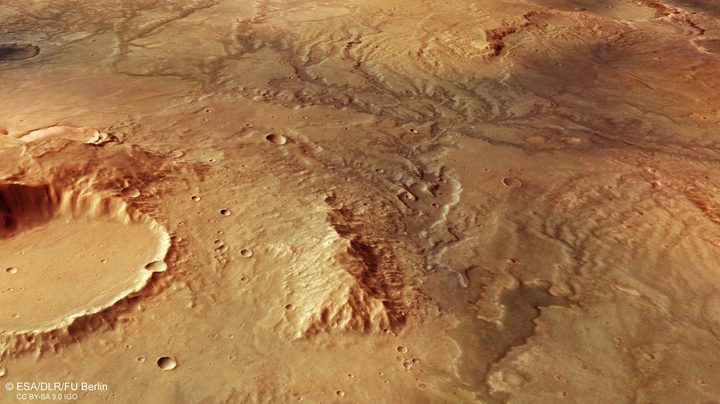
This image from ESA’s Mars Express shows a valley network on Mars. This oblique perspective view was generated using a digital terrain model and Mars Express data gathered on November 19, 2018. ESA / DLR / FU Berlin / CC BY-SA 3.0 IGO

Although it’s now well known that there is frozen water on Mars, scientists are not yet certain whether liquid water exists on the planet. Researchers have discovered what may be liquid water hidden under an ice cap and have speculated the water could theoretically be warmed by underground volcanoes, but the presence of liquid water is far from certain. However, Mars may be cold and dry now, but evidence suggests in the distant past the conditions on the planet were very different.

Recommended Videos

The European Space Agency (ESA)’s Mars Express orbiter has captured images of a region of branching valleys and trenches which suggest that liquid water once flowed on the surface. The topography of the region in the southern highlands of Mars, near the Huygens impact crater, suggests that water flowed downhill from the north towards the south, creating valleys of up to 1.2 miles (2 km) across and 656 feet (200 m) deep.
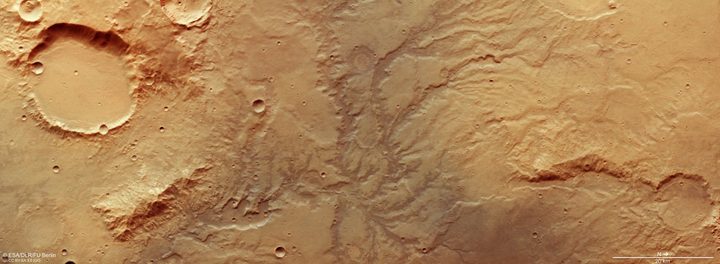
This image from ESA’s Mars Express shows a network of dried-up valleys on Mars, and comprises data gathered on November 19, 2018. North is to the right. ESA / DLR / FU Berlin / CC BY-SA 3.0 IGO

Researchers believe that billions of years ago Mars had a thick, dense atmosphere which locked in heat and kept the surface of the planet insulated enough for liquid water to flow. Mars’ atmosphere was gradually lost over the years due to changes in its magnetic field, and the planet’s surface became colder. Additionally, the volcanic activity within the planet may have changed too, reducing the heat generated from beneath the surface, making it so cold that water on the surface would freeze. This is part of the reason that Mars became inhospitable to life.

“Today, it is thought that climate change took place on Mars about 3.7 to 3.8 billion years ago, when environmental conditions changed from a somewhat neutral, potentially life-sustaining and sporadically humid environment to a much more acidic, dry, cold environment that is hostile to life,” Dr. Ralf Jaumann, a researcher in the DLR Institute of Planetary Research and principal investigator of Mars Express’ High Resolution Stereo Camera, explained in a statement.

“This climate change transformed our neighboring planet from being a one with temporary rivers and lakes that was, so to speak, ‘full of hope’ as regards the possible emergence and development of life, into a one that was just dry and salty.”

Georgina Torbet
Georgina has been the space writer at Digital Trends space writer for six years, covering human space exploration, planetary…
DJI’s first 360° drone offers 8K video recording and a freakishly long transmission range
From omnidirectional obstacle sensing to 42 GB of onboard storage, the Avata 360 is DJI doing what DJI does best: raising the bar for everyone else.
DJI Avata 360° drone.

DJI has officially entered the 360° drone arena with the launch of the Avata 360. It’s the company’s first-ever fully immersive FPV drone, and a direct shot at the Antigravity A1, a rival built by an Insta360-incubated brand. Looks like the drone wars just got more interesting. 

What makes the Avata 360 worth looking at?

Read more
I transferred all my chats from other AI apps to Gemini — and it works flawlessly
Google Gemini Graphics Featured

You know that moment when AI assistants like ChatGPT, Gemini, or Claude suddenly lose the plot mid-conversation and start hallucinating like they’re absolutely sure they’re right? Yeah…it’s equal parts funny and painfully annoying. My usual reaction is switching between apps, hoping one of them gets it right. But the real problem is that I have to start over every single time. It feels like I’m stuck in a loop explaining my life story to different AIs, one after the other.

Now with Gemini, I can now jump in from other AI apps without that whole reset conversation. Finally, the Google gods have blessed us. I tried it out expecting the usual hiccups, but it was surprisingly smooth and quick.

Read more
Google expands Search Live globally with voice and camera AI
The feature is now available in 200+ countries with multilingual support
Google Search Live

Google is taking another big step toward turning Search into a full-blown AI assistant. The company has officially expanded Search Live globally, making the feature available in over 200 countries and territories, along with support for dozens of languages.

https://twitter.com/google/status/2037201891130523917

Read more