  1. Home
  2. Emerging Tech
  3. News

Lowe's is testing a bow-like exoskeleton that gives warehouse workers superhuman strength

Add as a preferred source on Google

Engineers have been tinkering with exoskeletons to amplify our physical abilities for years. While there are certainly boundless military applications for this technology, there are also many commercial uses. Lowe’s, for example, just unveiled a prototype exoskeleton it hopes to aid employees on the job.

As part of the program, Lowe’s plans to equip its employees with a basic non-motorized exoskeleton to maximize productivity and efficiency. The project is a joint collaboration between Lowe’s research facility, the Innovation Labs, and Virginia Tech’s Assistive Robotics Laboratory.

Recommended Videos

The suit itself fits like a rock-climbing harnesses, with a series of flexible carbon-fiber trusses along the backside. These rods sit along the spine and behind the thighs. Bending as the person squats, the rods transfer the energy of basic movements more evenly. This stored kinetic energy essentially springs back as the individual stands upright. Lowe’s employees spend much of their day moving heavy items and the company hopes these exoskeletons will reduce the overall strain on muscles and joints.

“As they bend and stand, carbon fiber in the suit’s legs and back act like a taut bow ready to launch an arrow, helping them spring back up with greater ease,” Lowe’s explained in a press release.
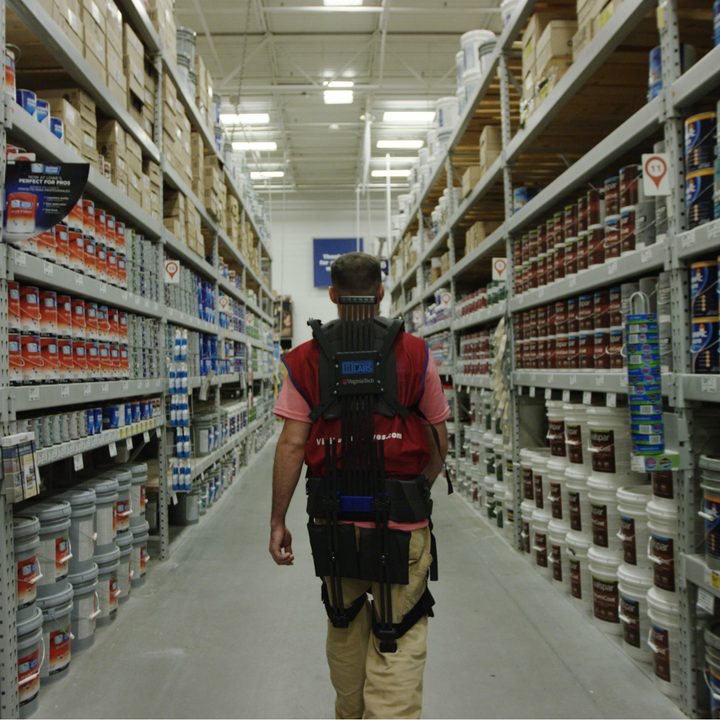
Image used with permission by copyright holder

Lowe’s has been testing the exoskeletons on four employees at store in Christiansburg, Virginia for more than a month. After these tests, the company will decide whether or not to expand this initiative to other stores. However, Lowe’s isn’t the only company looking to use exoskeletons to aid in workforce productivity.

General Motors recently partnered with NASA to create a motorized glove that makes it easier to grip and lift heavy objects. Panasonic and Hyundai are also working on their own exoskeletons designs. As for now, the Lowe’s exoskeleton prototype is rather elementary, and designed to test the baseline functionality of the suit — but future iterations will likely be more sophisticated.

“We didn’t want to over-engineer it, make it too fancy, or give it too many bells and whistles,” explained Nel. “We’re putting it in the rough and rumble world of a real store and will iterate on top of that… we’ll add a jetpack in 2018.”

The exoskeleton is still in the early stages of development at this point, but keep your fingers crossed and you might find one at your local hardware store sometime next year.

Dallon Adams
Former Editorial Assistant
Dallon Adams is a graduate of the University of Louisville and currently lives in Portland, OR. In his free time, Dallon…
This new video editor lets Claude organize, generate, and edit right on your timeline
Laptop running Claude Fable

For years, AI video tools have mostly lived outside the editing process. You generate a clip, download it, import it into your editor, and continue working. A new app called Palmier Pro aims to eliminate some of those extra steps by bringing AI directly into the video timeline.

The newly launched software, available for macOS, is being marketed as a video editor that Claude can use. Instead of treating AI as a separate chatbot or content generator, Palmier is designed to let an AI assistant interact with an active video project and make changes within it.

Read more
MIT experts just made a special memory. When humans forget, robots will just fetch the lost item
MIT’s new robot memory could make lost keys your robot’s problem
A robotic arm.

Robots may be the new best friend for forgetful humans. MIT researchers have developed a long-term memory framework for robots that can help them build a detailed mental model of large, complicated spaces. The system is called DAAAM, short for Describe Anything, Anywhere, Anytime, at Any Moment, and the goal is to let robots remember objects, locations, and details over time.

This might not sound headline-grabbing, though robots are still surprisingly bad at something humans do casually. You may remember that your keys were on the kitchen counter last night, or that a half-finished part was left in a factory bin. However, a robot working beside you would struggle to connect that object and location in a useful way.

Read more
A strange little electric nose may be the missing piece for smart fridges
The carbon nanotube chip detects food, allergens, and spoilage signals at room temperature.
Electronics, Hardware, Printed Circuit Board

UC Berkeley researchers have built an electric nose that can detect gases tied to spoiled food and common allergens more consistently than a human sniff test. The device uses a 16-sensor gas sensor chip that turns reactions with food-related gases into electrical signals.

Kitchen judgment can get messy because food doesn't always look or smell risky before it becomes a problem. Milk, eggs, chicken, fruit, and nuts release different chemical signatures, and people usually have to decide with whatever their nose catches in the moment.

Read more