  1. Home
  2. Emerging Tech
  3. News

This CO2-sucking rock takes eons to form naturally. Now we can grow it in weeks

Add as a preferred source on Google
Image used with permission by copyright holder

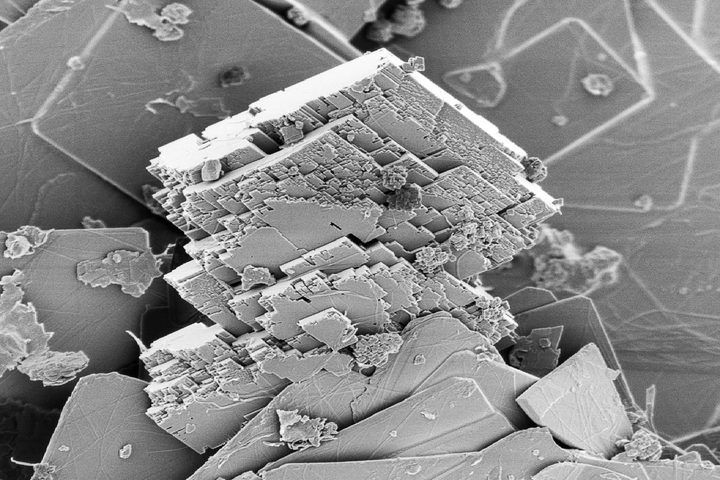
Could lab-grown magnesite help fight back against climate change? That’s what a new research project carried out by investigators from Trent University, in Ontario, Canada and The University of British Columbia suggests. Magnesite, a.k.a. magnesium carbonate, is capable of sucking up carbon dioxide (CO2) at an impressive rate, with one metric ton of magnesite capturing half as much CO2. Unfortunately, it can take thousands of years to grow — reduced to just 72 days using the new process.

“Although many technologies for sequestering CO2 have been shown to work, the challenge is finding ways to do this economically and at a large scale,” Ian Power, an environmental geoscientist at Trent University, told Digital Trends. “Magnesite can form at high temperatures — say, in industrial reactors — but high temperatures means greater energy input, and that would likely mean higher cost. We demonstrated that it is possible to accelerate the formation of magnesite, at room temperature, from hundreds to thousands of years [down to just] tens of days.”

Recommended Videos

The reason it is so important to sequester CO2 is because, even with the amount of greenhouse gases which have been pumped into the environment, the climate will continue to get warmer — even if we were to stop all emissions immediately. As a result, what is needed is a way to get back some of the greenhouse gases already in the atmosphere.

The room temperature process pioneered by the researchers used microspheres made of polystyrene as a catalyst to trigger the reaction process, helping the magnesite to form. These microspheres weren’t changed by the production of magnesite, meaning that they could be reused.

Given that the world currently emits around 40 billion tonnes of CO2 per year, a whole lot of this material would be needed for this to have a noticeable impact — but being able to produce it more rapidly is definitely a good start. Next, the researchers want to work on ways to scale up the process.

“Our study was at the laboratory scale,” Power continued. “We demonstrated a very novel approach to forming magnesite. We [now] want to better understand the fundamental science even better, and possibly [also] explore how bacteria could be used to form magnesite. Bacteria can have similar cell walls as the polystyrene microspheres we used in our experiments, and have been shown to mediate carbonate formation.”

A paper describing the work was recently published in the journal Crystal Growth & Design. Powers’ co-authors on the project included Paul Kenward, Gregory Dipple, and Mati Raudsepp from the University of British Columbia.

Luke Dormehl
I'm a UK-based tech writer covering Cool Tech at Digital Trends. I've also written for Fast Company, Wired, the Guardian…
Robots just ran the Beijing half-marathon faster than the world record holder
humanoid robot running a marathon

A humanoid robot just ran a half-marathon faster than the world record holder. It might not seem impressive at first, but considering last year, the fastest robot at Beijing's humanoid robot half-marathon finished in two hours and 40 minutes, this is a huge achievement. 

As reported by the Associated Press, the winning robot at this year's Beijing half-marathon crossed the finish line in 50 minutes and 26 seconds, comfortably beating the human world record of 57 minutes recently set by Jacob Kiplimo. 

Read more
As if the plate wasn’t already full, AI is about to worsen the global e-waste crisis
New report highlights a rising environmental concern
Stack of graphics cards and motherboards in a landfill site e-waste

AI is already changing how the world works, but it’s also quietly making one of our biggest environmental problems even worse. And no, this isn’t about energy consumption this time. It’s about the hardware. Because every smarter AI model comes with a physical cost.

AI is about to supercharge the e-waste problem

Read more
Smart glasses are finding a surprise niche — Korean drama and theater shows
Urban, Night Life, Person

Every year, millions of people follow Korean content without speaking a word of the language. They stream shows with subtitles, read translated lyrics, and find workarounds. But live theater has always been a different problem — you can't pause or rewind it. That's the problem: a Korean startup thinks it's cracked, and Yuroy Wang was one of the first to try it. The 22-year-old Taipei retail worker is a K-pop fan who loves Korean culture but doesn't speak the language. When he went to see "The Second Chance Convenience Store," a touring play based on a Korean novel that was a bestseller in Taiwan, he expected supertitles. What he got instead was a pair of chunky black-framed AI-powered glasses sitting on his nose, translating the dialogue in real time directly on the lenses. "As soon as I found out they were available, I couldn't wait to try them," he said. Wang is part of a growing audience discovering that smart glasses, a category of tech that has struggled to find mainstream purpose for years, might have just found their calling in the most unexpected of places: live Korean theater.

How do the glasses work?

Read more