  1. Home
  2. Emerging Tech
  3. News

Mars 2020 will capture high-definition color images from the Jezero Crater

Add as a preferred source on Google

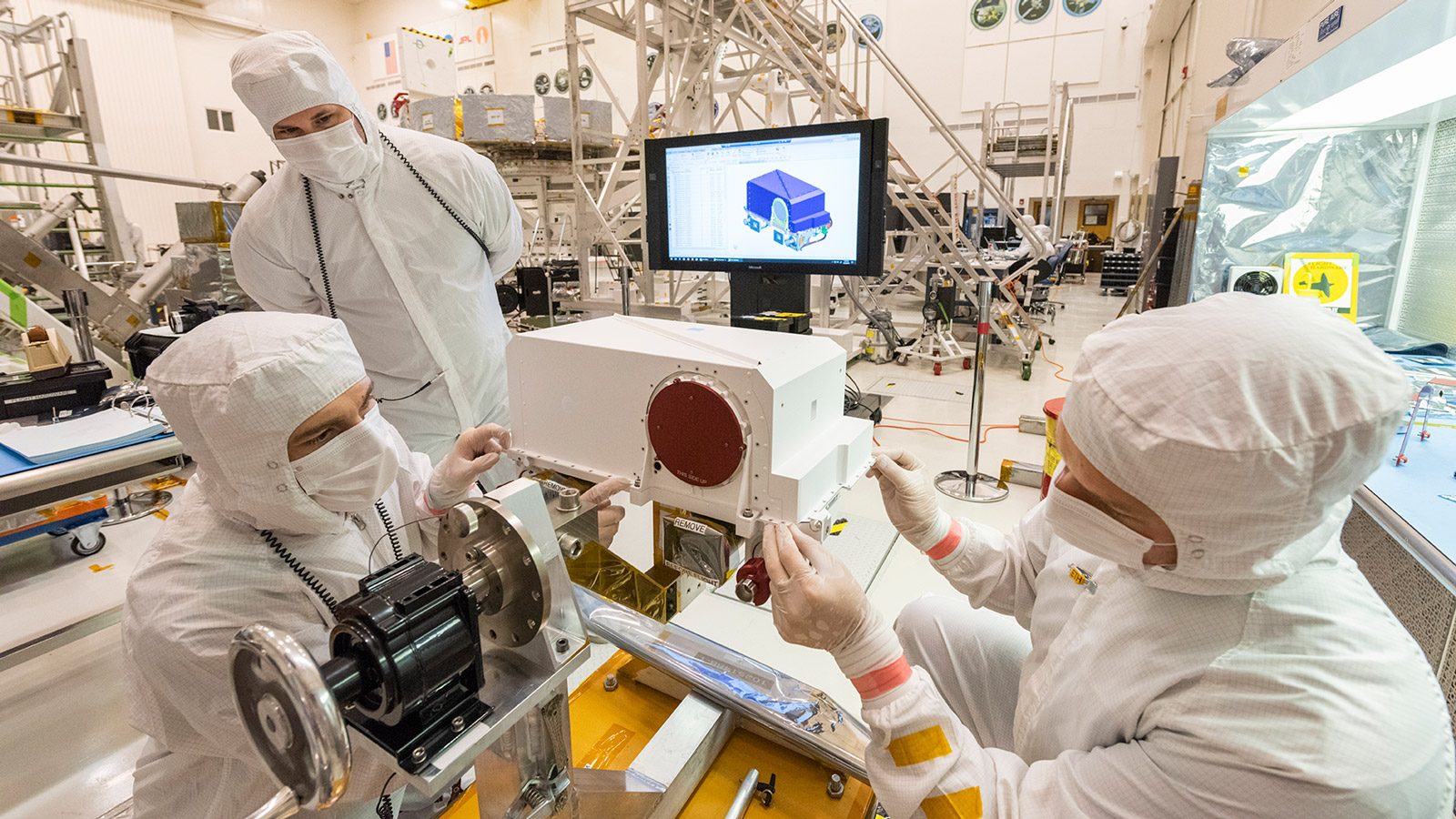
In this picture taken on May 23, 2019, in the Spacecraft Assembly Facility’s High Bay 1 clean room at the Jet Propulsion Laboratory in Pasadena, California, engineers re-install the cover to the remote sensing mast (RSM) head after integration of two Mastcam-Z high-definition cameras that will go on the Mars 2020 rover. NASA/JPL-Caltech

The Mars 2020 rover is getting ready to join its sibling Curiosity on the surface of the planet, with scientists fitting vital instruments for the mission.

Recommended Videos

The rover will be heading to an area of Mars called the Jezero Crater, at the edge of an impact basin called the Isidis Basin. The Jezero Crater has been a target of scientific interest for some time, and was also in the running to be the exploration site of the Curiosity rover before the Gale Crater was chosen instead.

Now scientists will finally get the chance to gather data from the Jezero Crater. It is believed to be the site of an ancient lake, and it is even remotely possible that life could once have developed in this area. Even if, as is probable, there is no sign of life in the region, there likely will be minerals that form in the presence of water, which scientists can investigate for clues about the development of the lake over time.

But in order to navigate and document the crater, the rover will need to collect visual information. For this purpose, it is being equipped with two high definition cameras called Mastcam-Z which will be installed this week. Mastcam-Z will be able to collect images in color, and well as having the ability to zoom. This will help scientists to observe the mineralogy and structure of the rocks and sediment on Mars.

“Mastcam-Z will be the first Mars color camera that can zoom, enabling 3D images at unprecedented resolution,” Mastcam-Z Principal Investigator Jim Bell of Arizona State University said in a statement. “With a resolution of three-hundredths of an inch (0.8 millimeters) in front of the rover and less than one-and-a-half inches (38 millimeters) from over 330 feet (100 meters) away — Mastcam-Z images will play a key role in selecting the best possible samples to return from Jezero Crater.”

For now, the camera is covered with a lens cover (the round red object in the photo above) while it is fitted to a mast called the remote sensing mast (RSM). The RSM will be raised once the rover touches down on Mars to get a view of the environment.

Georgina Torbet
Georgina has been the space writer at Digital Trends space writer for six years, covering human space exploration, planetary…
DJI’s first 360° drone offers 8K video recording and a freakishly long transmission range
From omnidirectional obstacle sensing to 42 GB of onboard storage, the Avata 360 is DJI doing what DJI does best: raising the bar for everyone else.
DJI Avata 360° drone.

DJI has officially entered the 360° drone arena with the launch of the Avata 360. It’s the company’s first-ever fully immersive FPV drone, and a direct shot at the Antigravity A1, a rival built by an Insta360-incubated brand. Looks like the drone wars just got more interesting. 

What makes the Avata 360 worth looking at?

Read more
I transferred all my chats from other AI apps to Gemini — and it works flawlessly
Google Gemini Graphics Featured

You know that moment when AI assistants like ChatGPT, Gemini, or Claude suddenly lose the plot mid-conversation and start hallucinating like they’re absolutely sure they’re right? Yeah…it’s equal parts funny and painfully annoying. My usual reaction is switching between apps, hoping one of them gets it right. But the real problem is that I have to start over every single time. It feels like I’m stuck in a loop explaining my life story to different AIs, one after the other.

Now with Gemini, I can now jump in from other AI apps without that whole reset conversation. Finally, the Google gods have blessed us. I tried it out expecting the usual hiccups, but it was surprisingly smooth and quick.

Read more
Google expands Search Live globally with voice and camera AI
The feature is now available in 200+ countries with multilingual support
Google Search Live

Google is taking another big step toward turning Search into a full-blown AI assistant. The company has officially expanded Search Live globally, making the feature available in over 200 countries and territories, along with support for dozens of languages.

https://twitter.com/google/status/2037201891130523917

Read more