  1. Home
  2. Emerging Tech
  3. News

Mars has its own water cycle, explaining why it lost its water over time

Add as a preferred source on Google

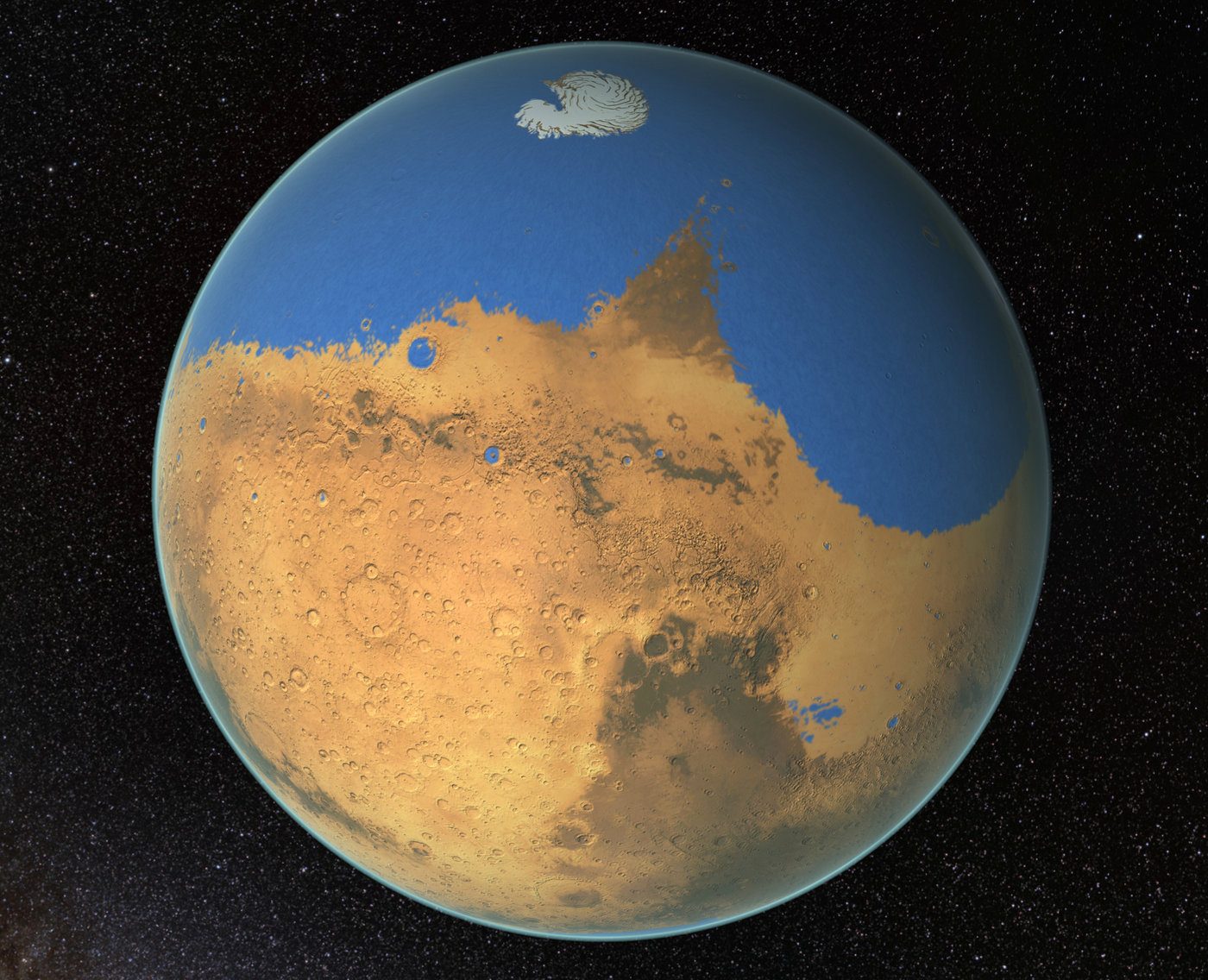
An artist’s impression of how Mars could have looked billions of years ago, with an ocean covering part of its surface. NASA/GSFC

When you were at school, you likely learned about the Earth’s water cycle: how water evaporates from the surface of oceans and lakes when they are warmed by the Sun, rising into the atmosphere and settling as clouds, then falling back to Earth as rain. But now scientists have discovered a very different sort of water cycle that could be operating on Mars.

Recommended Videos

Billions of years ago, Mars used to have water on its surface. But over time, this water was lost until only a small amount of frozen water remained on the surface and a small amount of water vapor existed in the atmosphere.

Now scientists at the Moscow Institute of Physics and Technology and the Max Planck Institute for Solar System Research have created a computer simulation which shows how water vapor moves through the Martian atmosphere, and which could explain why Mars lost its water over time while Earth did not.

The start of the Martian water cycle happens only every two Earth years during summer on Mars’s southern hemisphere. During this brief period, water vapor can rise from the lower atmosphere to the upper atmosphere, from where it is carried by winds to the planet’s North Pole. At the pole, some of this water is split by the Sun’s ultraviolet radiation into hydrogen and hydroxyl radicals, and the hydrogen escapes into space. The rest of the water sinks back down into the lower atmosphere near the poles.

The system works because the middle layer of the atmosphere, which is normally ice cold, becomes permeable to water in certain locations and at certain times of year. This is due to the way that Mars orbits around the Sun, in a highly elliptical orbit which brings it much closer to the Sun at some times than at others. During summer in the southern hemisphere, the planet is 42 million kilometers (26 million miles) closer to the Sun that when it is at its further point, making the area considerably warmer.

“When it is summer in the southern hemisphere, at certain times of day water vapor can rise locally with warmer air masses and reach the upper atmosphere,” Paul Hartogh of the Max Planck Institute for Solar System Research explained in a statement. “Apparently, the Martian atmosphere is more permeable to water vapor than that of the Earth. The new seasonal water cycle that has been found contributes massively to Mars’ continuing loss of water.”

The findings are published in the journal Geophysical Research Letters.

Georgina Torbet
Georgina has been the space writer at Digital Trends space writer for six years, covering human space exploration, planetary…
Amazon thinks you love AI, so it has launched a special storefront for AI-powered gadgets
Google AI mode mockup showing new feature

You're browsing for a new laptop — one has a better processor, another has more RAM, a third says "AI-powered" in bold letters, and you're not entirely sure what that means. But Amazon has noticed you pausing on that third one, and it has thoughts. The company just launched an AI Store on Amazon.in — a dedicated storefront that rounds up AI-enabled gadgets across categories, from smartphones and laptops to refrigerators and washing machines. So, instead of you wading through spec sheets trying to figure out which "AI feature" actually does something useful, the store spells it out for you.

What the AI store actually is

Read more
Gemini now makes personalized images by understanding your taste from Photos library
Logo, Disk, Symbol

Up until now, using Google Gemini meant being very specific. If you wanted an image, you’d spell it all out, the mood, the lighting, the tiny details, just to get something close to what you had in mind. That’s still how most AI tools operate. But this is where things start to shift. With the integration of Nano Banana 2 and Google Photos, Gemini feels much more familiar. It leans on your preferences, what you like, what you usually capture, and the kind of visuals you gravitate towards, and uses that context to shape what it creates for you.

So instead of over-explaining every prompt, you’re nudging it in a direction, and it fills in the rest in a way that feels personal. The goal here is simple: spend less time describing and more time seeing your ideas come to life, almost the way you imagined them, without having to say everything out loud.

Read more
This AI lets self-driving cars “remember” past drives to plan safer routes
A memory of the past could make self-driving cars safer on the road
Self driving car from Waymo

One of the biggest problems with self-driving systems is that they can see the road perfectly well and still make shaky short-term decisions in messy city traffic. The advanced systems struggle to keep up with complex and fluctuating road situations. But a new study argues that these cars don't need better vision, but a better memory.

In the peer-reviewed paper KEPT (Knowledge-Enhanced Prediction of Trajectories from Consecutive Driving Frames with Vision-Language Models), researchers from Tongji University and collaborators developed a system that helps autonomous vehicles "remember" past driving scenes before choosing what to do next.

Read more