  1. Home
  2. Emerging Tech
  3. News

Did there used to be liquid water on Mars? New images give clues

Add as a preferred source on Google

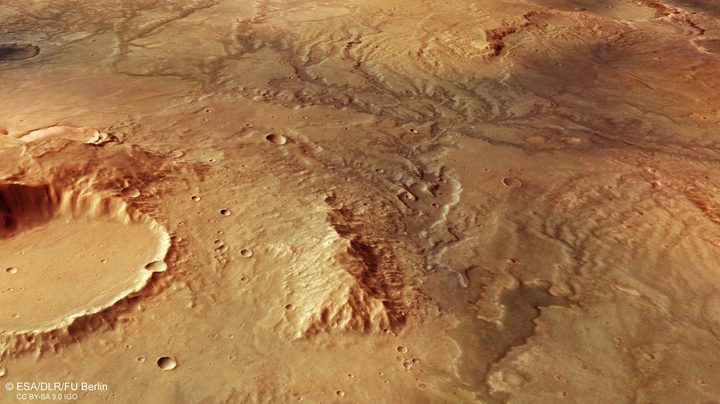
This image from ESA’s Mars Express shows a valley network on Mars. This oblique perspective view was generated using a digital terrain model and Mars Express data gathered on November 19, 2018. ESA / DLR / FU Berlin / CC BY-SA 3.0 IGO

Although it’s now well known that there is frozen water on Mars, scientists are not yet certain whether liquid water exists on the planet. Researchers have discovered what may be liquid water hidden under an ice cap and have speculated the water could theoretically be warmed by underground volcanoes, but the presence of liquid water is far from certain. However, Mars may be cold and dry now, but evidence suggests in the distant past the conditions on the planet were very different.

Recommended Videos

The European Space Agency (ESA)’s Mars Express orbiter has captured images of a region of branching valleys and trenches which suggest that liquid water once flowed on the surface. The topography of the region in the southern highlands of Mars, near the Huygens impact crater, suggests that water flowed downhill from the north towards the south, creating valleys of up to 1.2 miles (2 km) across and 656 feet (200 m) deep.
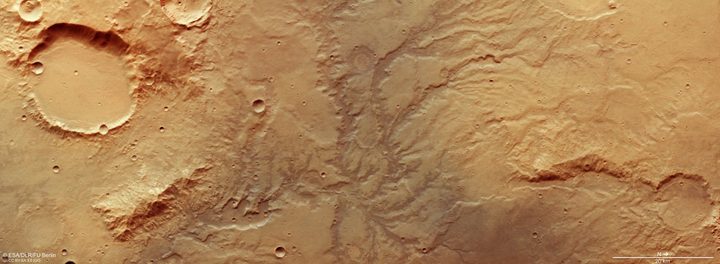
This image from ESA’s Mars Express shows a network of dried-up valleys on Mars, and comprises data gathered on November 19, 2018. North is to the right. ESA / DLR / FU Berlin / CC BY-SA 3.0 IGO

Researchers believe that billions of years ago Mars had a thick, dense atmosphere which locked in heat and kept the surface of the planet insulated enough for liquid water to flow. Mars’ atmosphere was gradually lost over the years due to changes in its magnetic field, and the planet’s surface became colder. Additionally, the volcanic activity within the planet may have changed too, reducing the heat generated from beneath the surface, making it so cold that water on the surface would freeze. This is part of the reason that Mars became inhospitable to life.

“Today, it is thought that climate change took place on Mars about 3.7 to 3.8 billion years ago, when environmental conditions changed from a somewhat neutral, potentially life-sustaining and sporadically humid environment to a much more acidic, dry, cold environment that is hostile to life,” Dr. Ralf Jaumann, a researcher in the DLR Institute of Planetary Research and principal investigator of Mars Express’ High Resolution Stereo Camera, explained in a statement.

“This climate change transformed our neighboring planet from being a one with temporary rivers and lakes that was, so to speak, ‘full of hope’ as regards the possible emergence and development of life, into a one that was just dry and salty.”

Georgina Torbet
Georgina has been the space writer at Digital Trends space writer for six years, covering human space exploration, planetary…
Amazon thinks you love AI, so it has launched a special storefront for AI-powered gadgets
Google AI mode mockup showing new feature

You're browsing for a new laptop — one has a better processor, another has more RAM, a third says "AI-powered" in bold letters, and you're not entirely sure what that means. But Amazon has noticed you pausing on that third one, and it has thoughts. The company just launched an AI Store on Amazon.in — a dedicated storefront that rounds up AI-enabled gadgets across categories, from smartphones and laptops to refrigerators and washing machines. So, instead of you wading through spec sheets trying to figure out which "AI feature" actually does something useful, the store spells it out for you.

What the AI store actually is

Read more
Gemini now makes personalized images by understanding your taste from Photos library
Logo, Disk, Symbol

Up until now, using Google Gemini meant being very specific. If you wanted an image, you’d spell it all out, the mood, the lighting, the tiny details, just to get something close to what you had in mind. That’s still how most AI tools operate. But this is where things start to shift. With the integration of Nano Banana 2 and Google Photos, Gemini feels much more familiar. It leans on your preferences, what you like, what you usually capture, and the kind of visuals you gravitate towards, and uses that context to shape what it creates for you.

So instead of over-explaining every prompt, you’re nudging it in a direction, and it fills in the rest in a way that feels personal. The goal here is simple: spend less time describing and more time seeing your ideas come to life, almost the way you imagined them, without having to say everything out loud.

Read more
This AI lets self-driving cars “remember” past drives to plan safer routes
A memory of the past could make self-driving cars safer on the road
Self driving car from Waymo

One of the biggest problems with self-driving systems is that they can see the road perfectly well and still make shaky short-term decisions in messy city traffic. The advanced systems struggle to keep up with complex and fluctuating road situations. But a new study argues that these cars don't need better vision, but a better memory.

In the peer-reviewed paper KEPT (Knowledge-Enhanced Prediction of Trajectories from Consecutive Driving Frames with Vision-Language Models), researchers from Tongji University and collaborators developed a system that helps autonomous vehicles "remember" past driving scenes before choosing what to do next.

Read more