  1. Home
  2. Emerging Tech
  3. News

Hate doing the dishes? MIT and its robots may be able to help

Add as a preferred source on Google

It’s a common dilemma — you love to eat, but hate doing the dishes. You can’t just buy tons of paper plates because you’re an adult. And you can’t let everything sit in the sink because it’s just not socially acceptable. So what’s to be done? MIT thinks the answer may lie in robots, which is precisely why a team of scientists at the renowned institution is looking to teach an automaton how to clean up after you in the kitchen.

MIT, whose robotic work has already resulted in major innovations (notably the beer delivery machine), has ambitious plans for the future — one in which cyborgs do all the menial tasks that currently take up the time and energy we could be using to further stretch our brains. But teaching a robot how to wash dirty dishes is no simple task. As Wired explains, there’s a lot that goes on (perhaps subconsciously for us) in the process — you have to figure out what happens when you put plates and bowls atop one another, when you rinse them in the sink, and when you ultimately put them in the dish washer. All these small (but annoying tasks) that we barely think about would have to be manually taught to robots, effectively giving them some form of human intuition.

Recommended Videos

The man leading this charge is Ilker Yildirim, a post doc at MIT working in the university’s Brain and Cognitive Science Department and its Computer Science and Artificial Intelligence Lab, or CSAIL. He, along with a team of researchers, are trying to figure out how to create an AI system that can actually predict how objects will move in the same way that we can. Being able to determine how many mugs you can pile together without breaking, after all, is key to doing seemingly simple tasks — like the dishes. And teaching robots how to figure this out is at the forefront of Yildirim’s work.

“These won’t be manufacturing robots, which have a pretty finely defined set of actions that they need to take over and over again,” he told Wired. “These are robots that must deal with uncertainty. If a robot places dishes in a dishwasher, it must understand the subtleties of how they stack on top of each other. It must know if it will topple them if it takes a certain action. It must deeply understand its physical environments.”

All of this is a push towards giving robots a seriously advanced form of artificial intelligence, composed of both hardware and software that ultimately seek to replicate the neurons found in the human brain. And while we’re not quite there yet, thanks to the folks at MIT, we’re certainly getting closer. So no — you can’t stop washing your dishes altogether just yet. But one day soon, that may all change.

Lulu Chang
Fascinated by the effects of technology on human interaction, Lulu believes that if her parents can use your new app…
Bacteria could be the secret sauce to keeping your computers cool
Scientists find bacteria can grow thermal materials that outperform current cooling tech.
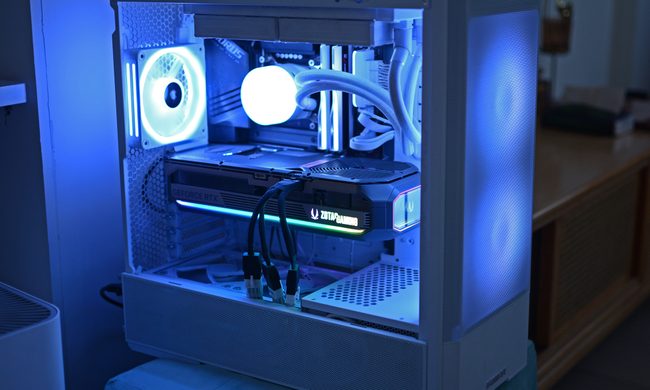
The Zotac RTX 5070 Ti Amp Extreme Infinity plugged into a white gaming PC

Your PC and laptop runs hotter every year, especially now that AI tools and heavy software push it harder than ever. Heat is a real bottleneck for performance, which is why people have gone to wild lengths to solve it, like strapping an actual ice machine to an RTX GPU. A new study points to a far less extreme fix for this problem, and it involves bacteria (via TechXplore).

Researchers have developed a new way to grow thermal interface materials, the substances that sit between a chip and its cooling system to help heat escape faster. The process involves feeding bacteria sugar and metal ions, letting the microbes build the material naturally instead of relying on traditional chemical manufacturing.

Read more
Bored of reading papers? This AI tool turns them into TikTok-like videos
PaperTok brings academic papers to people with short attention spans
Head, Person, Face

Academic papers aren't what you'd consider a fun read. For the average person, the dense, long, and field-specific language-filled papers can be quite intimidating to get into. These are usually packaged as PDFs that look like they were designed to test your willpower. A group of University of Washington researchers thinks there may be a better way to get that work in front of regular people. They are turning the papers into short-form videos.

The tool is called PaperTok, and it uses AI to help researchers convert academic papers into short, social-friendly videos. Think TikTok, except the idea is to explain research instead of sharing brain-rotting content. The best part? PaperTok is building a platform around scientists and researchers who are involved in the process, rather than simply using AI to summarize these papers.

Read more
As AI voices get harder to spot, ElevenLabs adopts Google’s SynthID to help you sniff the fakes
Artificial Intelligence

There was a time when spotting AI-generated content was almost a game. Images came with extra fingers, chatbots wrote like overly enthusiastic interns, and synthetic voices had an unmistakable robotic edge. Those days are disappearing fast.

Today, AI voices can laugh, whisper, pause naturally, and even sound emotional enough to fool many listeners. That’s exciting for creators, but it’s also creating a growing trust problem. If you can’t tell whether a clip is real or AI-generated, how do you know what to believe?

Read more