  1. Home
  2. Emerging Tech
  3. News

Orbiter spots Curiosity from space, shows our rover friend on surface of Mars

Add as a preferred source on Google

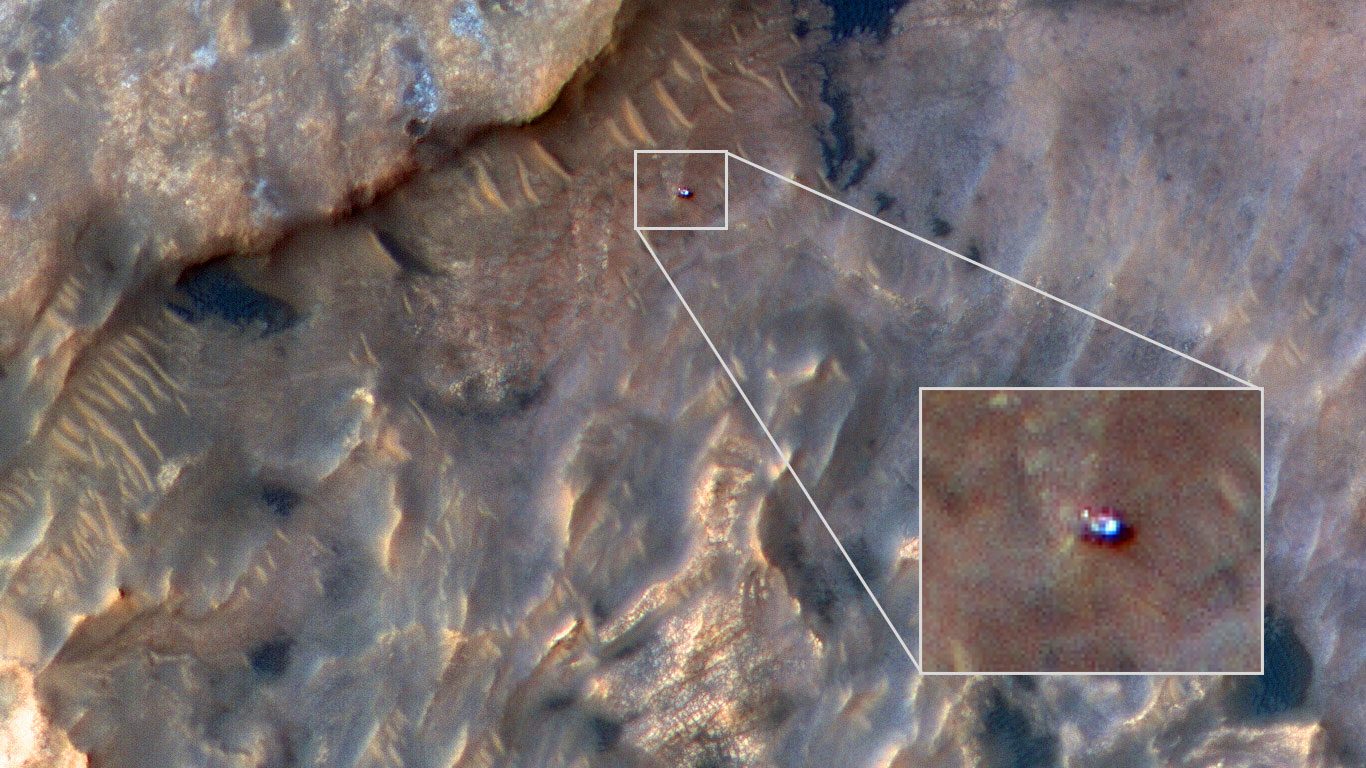
NASA’s Curiosity Mars rover can be seen in this image taken from space on May 31, 2019, by the HiRISE camera aboard the Mars Reconnaissance Orbiter. In the image, Curiosity appears as a bluish speck. NASA/JPL-Caltech

If you’ve been wondering how Curiosity is faring on Mars, now you can see for yourself, thanks to this image of the rover captured from orbit by NASA’s HiRISE camera.

Recommended Videos

Curiosity is sitting pretty in a location called Woodland Bay, which is part of the clay-bearing unit it has been exploring for several months. It is searching for clay in particular because it forms when water is present, so finding clay indicates that there could have been surface water on Mars in the distant past. The clay-bearing unit lies on one side of Mount Sharp, a mountain 3 miles (5 kilometers) tall which is located inside the Gale Crater.

If you look very closely, you can see Curiosity’s mast sticking out on the top left of the rover. This is the remote sensing mast, a long arm which holds up instruments like the ChemCam, which analyzes the composition of rocks from a distance using a laser, and the Mastcam, a high definition camera which captures images and video from the surface of the planet. When this image was taken, the rover was facing about 10 on a clock face, so the mast appears in front of the rover.

The rover and its mast in particular are very bright in the image, due to the way that HiRISE works. Due to its smooth surfaces, the rover reflects light which is picked up by the HiRISE camera. “A specular (mirror-like) reflection occurs when most of the light hitting a surface is reflected in a single direction, and can be seen by an observer looking from exactly that direction,” Alfred McEwen, Principal Investigator for HiRISE, explained in a statement.  “So for HiRISE to see specular reflections on the rover, the sun and MRO need to be in just the right locations.”

HiRISE is an instrument aboard the Mars Reconnaissance Orbiter (MRO), an orbiting craft which both gathers data for scientific missions and helps other craft to land on the planet. It helped choose landing sites for previous Mars landers like the Phoenix, and it acted as support during the landing of InSight. HiRISE is enjoying something of a famous few weeks, as it’s the same camera which spotted the Star Trek logo on Mars last month.

Georgina Torbet
Georgina has been the space writer at Digital Trends space writer for six years, covering human space exploration, planetary…
DJI’s first 360° drone offers 8K video recording and a freakishly long transmission range
From omnidirectional obstacle sensing to 42 GB of onboard storage, the Avata 360 is DJI doing what DJI does best: raising the bar for everyone else.
DJI Avata 360° drone.

DJI has officially entered the 360° drone arena with the launch of the Avata 360. It’s the company’s first-ever fully immersive FPV drone, and a direct shot at the Antigravity A1, a rival built by an Insta360-incubated brand. Looks like the drone wars just got more interesting. 

What makes the Avata 360 worth looking at?

Read more
I transferred all my chats from other AI apps to Gemini — and it works flawlessly
Google Gemini Graphics Featured

You know that moment when AI assistants like ChatGPT, Gemini, or Claude suddenly lose the plot mid-conversation and start hallucinating like they’re absolutely sure they’re right? Yeah…it’s equal parts funny and painfully annoying. My usual reaction is switching between apps, hoping one of them gets it right. But the real problem is that I have to start over every single time. It feels like I’m stuck in a loop explaining my life story to different AIs, one after the other.

Now with Gemini, I can now jump in from other AI apps without that whole reset conversation. Finally, the Google gods have blessed us. I tried it out expecting the usual hiccups, but it was surprisingly smooth and quick.

Read more
Google expands Search Live globally with voice and camera AI
The feature is now available in 200+ countries with multilingual support
Google Search Live

Google is taking another big step toward turning Search into a full-blown AI assistant. The company has officially expanded Search Live globally, making the feature available in over 200 countries and territories, along with support for dozens of languages.

https://twitter.com/google/status/2037201891130523917

Read more