NASA’s Curiosity rover has provided scientists with unexpected insight into the gravity on Mars by using the rover’s sensors as a makeshift gravimeter.
The Curiosity rover has accelerometers for measuring acceleration and gyroscopes for measuring orientation and angular velocity on board, just like the sensors in a smartphone which tell you where you are on a map and in which direction you are facing. The very accurate sensors on the Curiosity are used to navigate the surface of Mars and point its other instruments in the right direction. While these instruments weren’t designed for measuring gravity, scientists realized that they could use them to gather data on the mountain that Curiosity is currently exploring, called Mount Sharp.
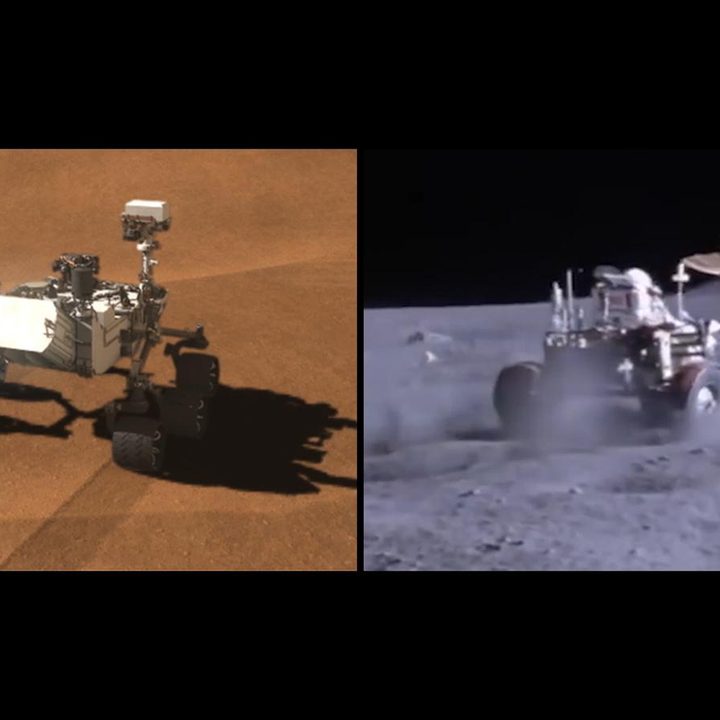
The inspiration for the gravity measurement technique came from a lunar mission almost 50 years ago. Back on the Apollo 17 mission to the Moon in 1972, astronauts were able to measure the lunar gravity using a tool they had on board their buggy called a gravimeter. While there are no astronauts to collect data on Mars, researchers realized that there were tools in the Curiosity that they could combine together to get the same information about Mars as they had on the moon.
Mount Sharp is one of the largest mountains on Mars, and it is positioned strangely within the huge 96-mile-wide Gale Crater. The mountain rises 18,000 feet from the crater’s floor, and scientists still aren’t sure how it developed, though they think it could be due to the crater having been filled with sediment and compacted downwards.
When the Curiosity is stationary, the accelerometers detect the gravitational pull of the planet on the rover. And when Curiosity is ascending a slope, as it has been since 2014, researchers can see how much additional gravity is added by the mountain. The answer turns out to be less than expected, meaning that Mount Sharp is less dense than previously believed.
“The lower levels of Mount Sharp are surprisingly porous,” lead researcher Kevin Lewis of Johns Hopkins University said in a statement. “We know the bottom layers of the mountain were buried over time. That compacts them, making them denser. But this finding suggests they weren’t buried by as much material as we thought.”
“To me, Mars is the uncanny valley of Earth,” he added. “It’s similar but was shaped by different processes. It feels so unnatural to our terrestrial experience.”
The findings are published in Science.