  1. Home
  2. Emerging Tech
  3. News

NASA’s Artemis capsule is complete, will carry the first woman to the moon

Add as a preferred source on Google
Vice President Pence Commemorates Apollo 11 With Administrator Bridenstine

The crew capsule which will carry American astronauts to the moon as part of the Artemis project has been completed. The completion of the Artemis 1 capsule was announced by Vice President Mike Pence during a speech at NASA’s Kennedy Space Center in Florida celebrating the 50 year anniversary of the historic Apollo moon landing mission.
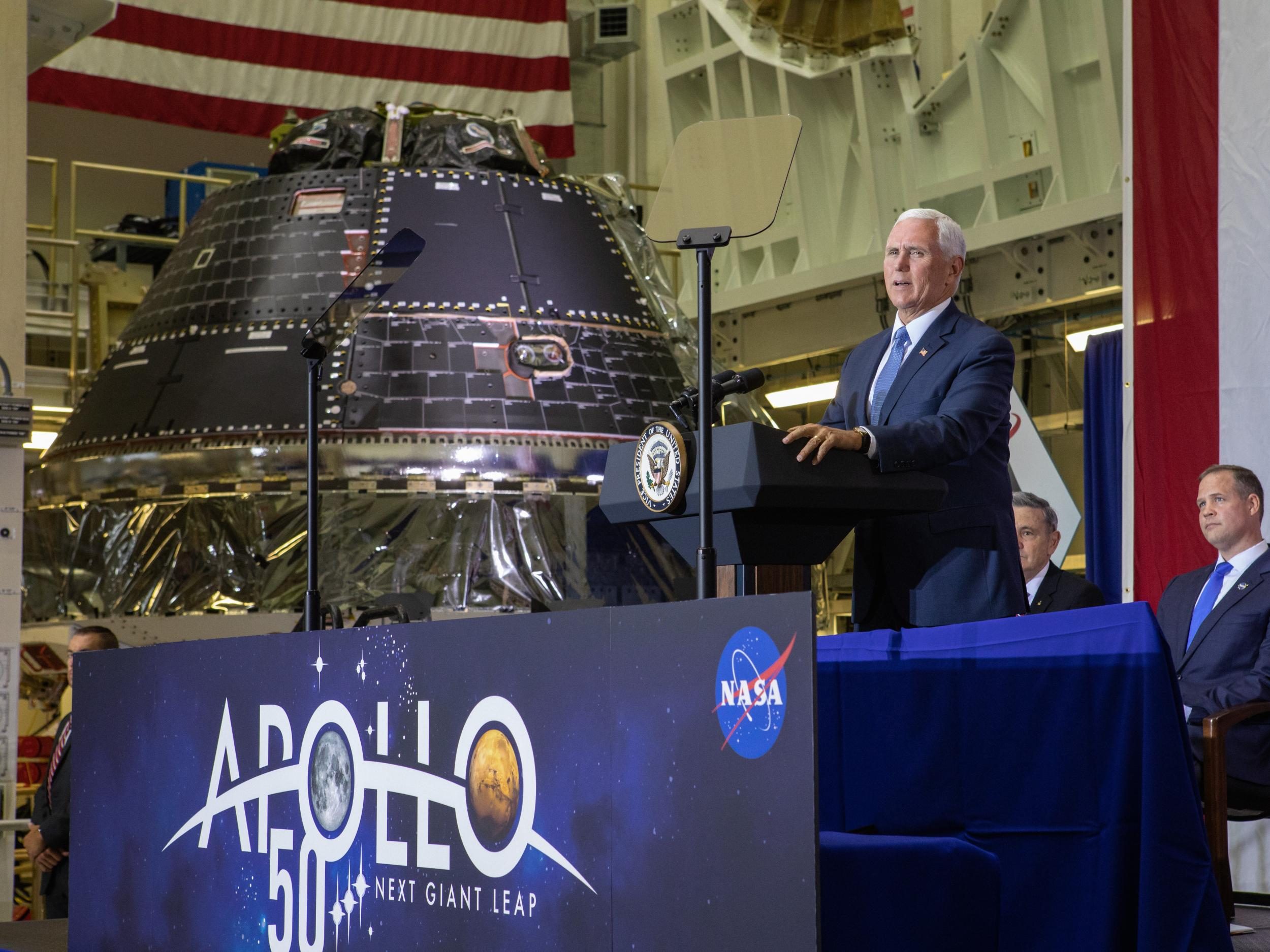
Vice President Mike Pence on stage at the NASA celebration of the 50th anniversary of the moon landing. NASA

Fifty years after successfully landing a man on the moon, NASA is hoping to recreate this feat. But this time, at least one of the crew members will be a woman. NASA has announced that this capsule will carry the “first woman on the moon.”

Recommended Videos

“Similar to the 1960s, we too have an opportunity to take a giant leap forward for all of humanity,” NASA Administrator Jim Bridenstine said in a statement. “President Trump and Vice President Pence have given us a bold direction to return to the Moon by 2024 and then go forward to Mars. Their direction is not empty rhetoric. They have backed up their vision with the budget requests need to accomplish this objective. NASA is calling this the Artemis program in honor of Apollo’s twin sister in Greek mythology, the goddess of the Moon. And we are well on our way to getting this done.”

Artemis 1 will be carried aboard a Orion spacecraft and a next-generation Space Launch System (SLS) rocket. The idea is that the mission will start with sending a team to the moon for 2024, and then the moon can be used as a stopover for planned manned missions to Mars.

The Orion crew module began its life with the building of a pressure vessel, the inside of the capsule system, at NASA’s Michoud Assembly Facility in New Orleans. Once the pressure vessel was complete it was shipped to the Kennedy Space Center to be built into a full capsule, with all the required parts being integrated.

The Orion will be joined by the European Space Agency’s European Service Module, a German-built module which will provide power, propulsion, and cooling. The two modules need to be joined and have a heat shield back panel installed.

Once this is complete, the next phase for Artemis is testing, which will take place in NASA’s Plum Brook Station in Sandusky, Ohio.

Georgina Torbet
Georgina has been the space writer at Digital Trends space writer for six years, covering human space exploration, planetary…
Smart glasses are finding a surprise niche — Korean drama and theater shows
Urban, Night Life, Person

Every year, millions of people follow Korean content without speaking a word of the language. They stream shows with subtitles, read translated lyrics, and find workarounds. But live theater has always been a different problem — you can't pause or rewind it. That's the problem: a Korean startup thinks it's cracked, and Yuroy Wang was one of the first to try it. The 22-year-old Taipei retail worker is a K-pop fan who loves Korean culture but doesn't speak the language. When he went to see "The Second Chance Convenience Store," a touring play based on a Korean novel that was a bestseller in Taiwan, he expected supertitles. What he got instead was a pair of chunky black-framed AI-powered glasses sitting on his nose, translating the dialogue in real time directly on the lenses. "As soon as I found out they were available, I couldn't wait to try them," he said. Wang is part of a growing audience discovering that smart glasses, a category of tech that has struggled to find mainstream purpose for years, might have just found their calling in the most unexpected of places: live Korean theater.

How do the glasses work?

Read more
Amazon thinks you love AI, so it has launched a special storefront for AI-powered gadgets
Google AI mode mockup showing new feature

You're browsing for a new laptop — one has a better processor, another has more RAM, a third says "AI-powered" in bold letters, and you're not entirely sure what that means. But Amazon has noticed you pausing on that third one, and it has thoughts. The company just launched an AI Store on Amazon.in — a dedicated storefront that rounds up AI-enabled gadgets across categories, from smartphones and laptops to refrigerators and washing machines. So, instead of you wading through spec sheets trying to figure out which "AI feature" actually does something useful, the store spells it out for you.

What the AI store actually is

Read more
Gemini now makes personalized images by understanding your taste from Photos library
Logo, Disk, Symbol

Up until now, using Google Gemini meant being very specific. If you wanted an image, you’d spell it all out, the mood, the lighting, the tiny details, just to get something close to what you had in mind. That’s still how most AI tools operate. But this is where things start to shift. With the integration of Nano Banana 2 and Google Photos, Gemini feels much more familiar. It leans on your preferences, what you like, what you usually capture, and the kind of visuals you gravitate towards, and uses that context to shape what it creates for you.

So instead of over-explaining every prompt, you’re nudging it in a direction, and it fills in the rest in a way that feels personal. The goal here is simple: spend less time describing and more time seeing your ideas come to life, almost the way you imagined them, without having to say everything out loud.

Read more