  1. Home
  2. Emerging Tech
  3. News

NASA’s Orion craft completes space environment testing ahead of lunar mission

Add as a preferred source on Google

NASA has completed space environment testing on its Orion spacecraft, which will be launched as part of the planned Artemis lunar mission. The craft will eventually carry up to four astronauts to the moon in a mission planned to launch in 2024.

The Orion spacecraft was transported last year to NASA’s Plum Brook Station facility in Sandusky, Ohio, a remote test facility for the NASA Glenn Research Center. Plum Brook was chosen because it’s the only NASA facility large enough to test the craft, which will be 5 meters (16.5 feet) in diameter once complete and will have a mass of around 22.7 metric tons (25 tons).

Recommended Videos

The testing that Orion has gone through at Plum Brook began with two months of thermal vacuum testing, in which low temperatures and a lack of atmosphere were simulated to check that the craft can withstand the space environment. This testing involved subjecting the craft to temperatures from –175 degrees Celsius (-283 degrees Fahrenheit) to 75 degrees Celsius (167 degrees Fahrenheit) in a vacuum, which it passed without issues.
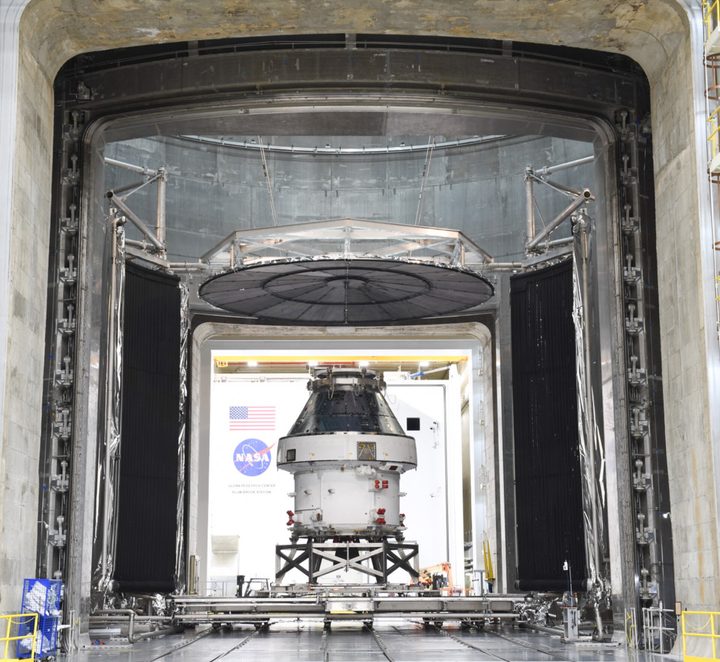
The Orion spacecraft completes its testing
The Orion spacecraft completes its testing NASA–Marvin Smith

“I think we were all surprised at how well everything did,” Nicole Smith, project manager for the testing at NASA’s Plum Brook Station, said to ABC News. “When we were doing the thermal vacuum testing, we really planned for it to be more like 62 days, but the vehicle performed so well and the facility performed so well that we didn’t need the extra time. It was in there for 47 days.”

The next step of testing was electromagnetic interference testing, which ensures that all of the electronics on board work correctly and don’t stop working when subjected to various types of electromagnetic noise. Within the service module part of the craft alone, there are nearly seven miles of wiring to connect all 31 components, including engines, propellant tanks, and solar wings.

With these tests complete, the spacecraft is ready to be shipped to NASA’s Kennedy Space Center, where further launch preparations can begin. Preparations include assembling the solar panels and conducting more tests to ensure everything works perfectly.

Marla Perez-Davis, director of NASA’s Glenn Research Center, said to ABC: “These are exciting times for NASA, as Artemis will usher in the new era of space exploration and light our way to Mars.”


Georgina Torbet
Georgina has been the space writer at Digital Trends space writer for six years, covering human space exploration, planetary…
AI chatbots can often feed into your delusions. Researchers say you should look for three signs
Experts warn that chatbot design choices can reinforce unhealthy beliefs in vulnerable users.
ChatGPT on a smartphone

Artificial intelligence chatbots have become incredibly good at sounding human. But a new review paper by psychiatrist Marc Augustin and fellow researchers Thomas A. Pollak and Helen Morrin, published in NPP—Digital Psychiatry and Neuroscience, argues that existing AI research points to an overlooked psychological risk. The paper, highlighted by The Wall Street Journal, reviews previous studies and proposes a framework explaining how three common chatbot behaviors can combine to reinforce delusional thinking in vulnerable users, creating what the authors call an "amplification spiral."

Researchers say these are the three warning signs

Read more
Lost access to your crypto wallet? Don’t Google your way out of it
Security researchers warn that fake recovery tools are becoming the latest trap for crypto owners.
Bitcoin crypto wallet featured

Forgetting the recovery phrase to a crypto wallet can be stressful enough. Unfortunately, that's exactly the moment scammers are waiting for. A new warning highlights a growing scam in which cybercriminals disguise malware as cryptocurrency recovery software, tricking desperate users into handing over far more than just access to their wallets.

The fake recovery tool that's actually malware

Read more
Chinese AI lab says it can match Anthropic’s all-poweful Claude Mythos at sniffing security bugs
Security researchers say Z.ai's latest model can rival Anthropic's Mythos in one critical area.
China Z.Ai GLM-5.2 Featured Banner

For the past few weeks, Anthropic's Mythos has been viewed as the gold standard for AI-powered cybersecurity. That lead may already be shrinking. According to a new report from The Wall Street Journal, security researchers say Chinese AI startup Z.ai's GLM-5.2 can now match Mythos when it comes to finding software security vulnerabilities, even if it still trails Anthropic and OpenAI in broader reasoning tasks.

GLM-5.2 is closing the gap in one very important area

Read more