  1. Home
  2. Emerging Tech
  3. News

NASA’s planet-hunting satellite sends back its first image — and it’s amazing

Add as a preferred source on Google
The Unique Orbit of NASA’s Newest Planet Hunter

NASA’s new planet-hunting mission, the Transiting Exoplanet Survey Satellite (TESS), was launched on April 18. After getting accustomed to its new surroundings and doing a quick buzz past the moon, it’s already produced a stunning image that was just released by NASA. As part of the calibration sequence for one of its four on-board cameras, TESS captured a swatch of the sky that includes more than 200,000 stars.
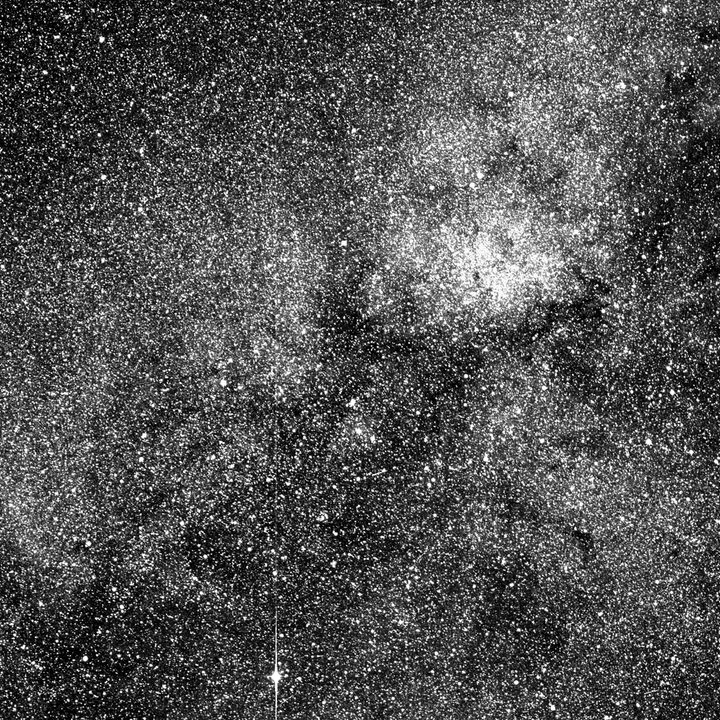
TESS satellite captures southern sky
A test image from the TESS satellite captures a swath of the southern sky along the plane of our galaxy. NASA/MIT/TESS

The two-second exposure is centered on the southern constellation Centaurus. The Coalsack Nebula is featured in the upper right quadrant, and the star Beta Centauri can be seen at the lower left edge.

Recommended Videos

The stunning display has captivated scientists and space enthusiasts around the globe. “We are truly excited about how well the TESS cameras are working,” MIT planetary scientist George Ricker told Forbes. “This beautiful image just popped up on the MIT payload operations display screens right after initial turn-on of the TESS instrument.”

Keep in mind, this image was produced using only one of TESS’s four cameras. Once the mission becomes fully operational, NASA expects future images to cover more than 400 times as much sky. A “first light” image suitable for detailed scientific analysis will be released in June. Meanwhile, here’s everything you need to know about the mission.

The four cameras will scan 26 entire sectors of the sky, covering both hemispheres during its two-year mission. The observations will focus on possible “transits” of exoplanets, where a far-away planet passes in front of its star causing a measurable drop in brightness. (And there’s quite a few way-off worlds; from the Dracula planet to Earth’s bigger, older cousin, here are the 10 best exoplanets discovered so far.)

“We learned from Kepler that there are more planets than stars in our sky, and now TESS will open our eyes to the variety of planets around some of the closest stars,” said Paul Hertz of NASA. “TESS will cast a wider net than ever before for enigmatic worlds whose properties can be probed by NASA’s upcoming James Webb Space Telescope and other missions.”

TESS is on its way to an unusual but highly stable elliptical orbit that takes it around the Earth every 13.7 days. After getting a gravity assist by passing within 5,000 miles of the moon, a final thruster burn on May 30 will finalize its orbit. The satellite will begin its detailed observation mission utilizing all four cameras in mid-June.

The search for exoplanets and ultimately, extraterrestrial life, will kick into high gear in the coming years. The aging Kepler satellite may be on its last legs (and about to run out of fuel), but the launch of the James Webb telescope will help scientists build on the discoveries made by TESS and expand our knowledge of the universe even further. If NASA can ever launch the darn thing.


Mark Austin
Former Digital Trends Contributor
Mark’s first encounter with high-tech was a TRS-80. He spent 20 years working for Nintendo and Xbox as a writer and…
The best new ChatGPT feature is one most people will never use
Logo, Emblem, Symbol

For years, the biggest conversation around AI has been what these tools can do. They can browse the web, analyze documents, connect to your apps, conduct research, and increasingly act on your behalf. But as AI systems become more capable, another question has become harder to ignore: what happens when an AI assistant is tricked into handing over information it shouldn’t?

OpenAI’s new Lockdown Mode is its latest answer to that problem. Available across all ChatGPT account types, Lockdown Mode is an optional security setting designed for people and organizations handling sensitive information. The trade-off is that you get stronger protection against certain forms of data theft, but you lose access to some of ChatGPT’s most powerful features.

Read more
An app that lets anyone control a robot from their phone, no coding required
Sounds cool, right? Forget doomscrolling, now your phone can operate a robot arm instead
Representative Image

A team of researchers at Georgia Tech has developed a new smartphone-based system that could dramatically simplify how people interact with robots. Called COBALT, the platform allows users with little to no computing experience to remotely control robot arms from virtually anywhere in the world using just a phone and an internet connection.

The project, developed at Georgia Tech’s People, AI & Robotics (PAIR) Lab, transforms smartphones into motion controllers for robotic arms. Users simply move their phones in different directions, and the robot mirrors those movements in real time. Basic tasks such as grabbing, moving, and releasing objects can be performed through simple on-screen controls, making the experience feel more like playing a mobile game than operating industrial machinery.

Read more
Coursera wants users to learn through shorter, faster content
Coursera wants online learning to feel more like TikTok
Coursera

Online learning platform Coursera is taking a page straight out of TikTok’s playbook. The company has launched a new AI-powered feed designed to serve short-form educational content in a scrollable, personalized format, signaling a major shift in how digital learning platforms may try to keep users engaged.

The feature introduces bite-sized video lessons, clips, and explainers curated through artificial intelligence based on a user’s interests, learning habits, career goals, and previous course activity. Instead of committing to hour-long lectures or full certification programs upfront, users can now discover short educational snippets designed to make learning feel more casual, accessible, and addictive.

Read more