  1. Home
  2. Emerging Tech
  3. News

NASA’s WFIRST telescope has a new approach to the hunt for exoplanets

Add as a preferred source on Google

NASA is working on a new instrument for spotting distant exoplanets — the Wide Field Infrared Survey Telescope, or WFIRST. This tool could be used to identify not only small, distant planets, but also other cosmic bodies like brown dwarfs and black holes.
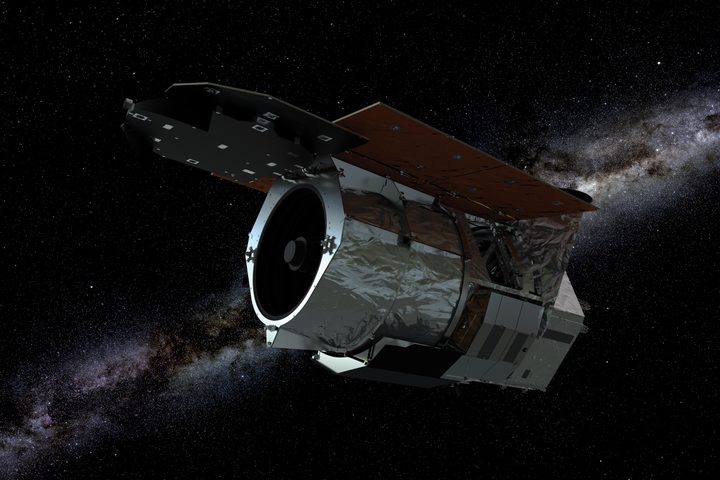
Artist’s illustration of the WFIRST spacecraft.
Artist’s illustration of the WFIRST spacecraft. NASA’s Goddard Space Flight Center

Spotting exoplanets with microlensing

Most instruments for detecting exoplanets, such as NASA’s exoplanet hunter satellite TESS, work by using the transit method. This is where telescopes observe distant stars and look for periodic dimming in their brightness, which suggests the presence of a planet passing between the star and the telescope in an event called a transit.

Recommended Videos

WFIRST, however, will use both the transit method and a different method called microlensing. This is where, when a small planet passes in front of a star, it bends the light in a way that can be observed from a great distance. This technique works only on infrequent events where stars align just so, but the signals that these events produce are stronger than the signals from the transit method and can be used to detect smaller or more distant planets.

“Microlensing signals from small planets are rare and brief, but they’re stronger than the signals from other methods,” David Bennett, who leads the gravitational microlensing group at NASA’s Goddard Space Flight Center, said in a statement. “Since it’s a one-in-a-million event, the key to WFIRST finding low-mass planets is to search hundreds of millions of stars.”

WFIRST will make its microlensing observations in the direction of the center of the Milky Way galaxy. The higher density of stars will yield more exoplanet detections.
WFIRST will make its microlensing observations in the direction of the center of the Milky Way galaxy. The higher density of stars will yield more exoplanet detections. NASA's Goddard Space Flight Center/CI Lab

“Trying to interpret planet populations today is like trying to interpret a picture with half of it covered,” said Matthew Penny, an assistant professor of physics and astronomy at Louisiana State University in Baton Rouge who led a study to predict WFIRST’s microlensing survey capabilities. “To fully understand how planetary systems form we need to find planets of all masses at all distances. No one technique can do this, but WFIRST’s microlensing survey, combined with the results from Kepler and TESS, will reveal far more of the picture.”

“WFIRST’s microlensing survey will not only advance our understanding of planetary systems,” said Penny, “it will also enable a whole host of other studies of the variability of 200 million stars, the structure and formation of the inner Milky Way, and the population of black holes and other dark, compact objects that are hard or impossible to study in any other way.”

Georgina Torbet
Georgina has been the space writer at Digital Trends space writer for six years, covering human space exploration, planetary…
Robots just ran the Beijing half-marathon faster than the world record holder
humanoid robot running a marathon

A humanoid robot just ran a half-marathon faster than the world record holder. It might not seem impressive at first, but considering last year, the fastest robot at Beijing's humanoid robot half-marathon finished in two hours and 40 minutes, this is a huge achievement. 

As reported by the Associated Press, the winning robot at this year's Beijing half-marathon crossed the finish line in 50 minutes and 26 seconds, comfortably beating the human world record of 57 minutes recently set by Jacob Kiplimo. 

Read more
As if the plate wasn’t already full, AI is about to worsen the global e-waste crisis
New report highlights a rising environmental concern
Stack of graphics cards and motherboards in a landfill site e-waste

AI is already changing how the world works, but it’s also quietly making one of our biggest environmental problems even worse. And no, this isn’t about energy consumption this time. It’s about the hardware. Because every smarter AI model comes with a physical cost.

AI is about to supercharge the e-waste problem

Read more
Smart glasses are finding a surprise niche — Korean drama and theater shows
Urban, Night Life, Person

Every year, millions of people follow Korean content without speaking a word of the language. They stream shows with subtitles, read translated lyrics, and find workarounds. But live theater has always been a different problem — you can't pause or rewind it. That's the problem: a Korean startup thinks it's cracked, and Yuroy Wang was one of the first to try it. The 22-year-old Taipei retail worker is a K-pop fan who loves Korean culture but doesn't speak the language. When he went to see "The Second Chance Convenience Store," a touring play based on a Korean novel that was a bestseller in Taiwan, he expected supertitles. What he got instead was a pair of chunky black-framed AI-powered glasses sitting on his nose, translating the dialogue in real time directly on the lenses. "As soon as I found out they were available, I couldn't wait to try them," he said. Wang is part of a growing audience discovering that smart glasses, a category of tech that has struggled to find mainstream purpose for years, might have just found their calling in the most unexpected of places: live Korean theater.

How do the glasses work?

Read more