  1. Home
  2. Emerging Tech
  3. News

How did that planet get there? TESS investigates a planetary mystery

Add as a preferred source on Google

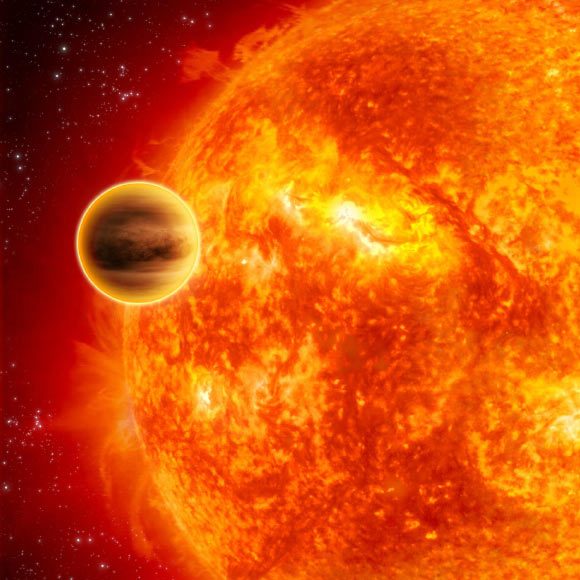
An artist’s impression of a hot-Jupiter exoplanet. C. Carreau / ESA

NASA’s planet-hunting satellite TESS, or Transiting Exoplanet Survey Satellite, has made another intriguing discovery. This time, it’s located a planet somewhere where it shouldn’t be, right in the middle of a zone in which any planet should have been annihilated by its star.

Recommended Videos

The star HD 203949 is located 257 light-years away and is a K2-type giant star, slightly cooler than our sun. Traveling around this star is a large planet, HD 203949b, which is 8.2 times the mass of Jupiter and in a 184-day circular orbit.

So far, so typical. But there’s something odd about HD 203949b because it should have been engulfed by its star long ago. The boundaries of a star, called its envelope, expand and contract over time. When the giant star HD 203949 was younger in its red giant phase, its envelope should have covered the planet and destroyed it — and yet the planet is still there.

The researchers investigated this mystery more closely using computer simulations. They came up with a theory that the planet must have started out further away from the star and been drawn closer toward it over time.

“We determined how this planet could have reached its current location, and to do so whether or not the planet had to survive engulfment within the stellar envelope of the red giant star,” co-author Dr. Dimitri Veras explained in a statement. “The work sheds new light on the survivability of planets when their parent stars begin to die, and might even reveal new aspects of tidal physics.”

This discovery of a planet shifting its orbit over time shows how complex the relationships within planetary systems can be. “This study is a perfect demonstration of how stellar and exoplanetary astrophysics are linked together,” co-author Dr. Vardan Adibekyan said in the same statement. “Stellar analysis seems to suggest that HD 203949 is too evolved to still host a planet at such a short orbital distance, while from the exoplanet analysis we know that the planet is there.”

“The solution to this scientific dilemma is hidden in the simple fact that stars and their planets not only form but also evolve together,” Dr. Adibekyan continued. “In this particular case, the planet managed to avoid engulfment.”

The findings are published in the Astrophysical Journal.

Georgina Torbet
Georgina has been the space writer at Digital Trends space writer for six years, covering human space exploration, planetary…
After flubbing with Siri, Apple plans to host AI agents on the App Store
One problem is about money Apple won't commit to not charging. The other is about AI agents Apple can't figure out how to control. WWDC needs to solve both.
Electronics, Mobile Phone, Phone

Apple is currently facing a Siri problem that has nothing to do with Siri at all. With WWDC 2026 just weeks away, The Information reports the company is actively courting developers to integrate their apps with the new Siri coming in iOS 27. 

The mechanism powering the overhauled Siri, App Intents, is an API that lets Siri execute actions inside third-party apps without you actively opening them, which sounds quite useful, I’d say. However, some of the world’s largest developers are dragging their feet on it, not because it’s tough, but because Apple left the door open on charging for it later.

Read more
EV batteries just need some AI top-up nudge, and they get a big 23% life boost, finds research
Charging fast and lasting long seemed impossible. A new AI trick says otherwise.
EV Charging

EV battery charging technology has always had to find the right balance between charging speed and battery longevity. If the charging speed is too fast, it wears down the battery. If the charging is too slow, nobody is happy. 

Researchers Meng Yuan from Victoria University of Wellington and Changfu Zou from Chalmers University of Technology in Sweden may have cracked this long-standing problem using an AI technique called deep reinforcement learning, and the results are pretty encouraging.

Read more
Alexa for Shopping is a chatty new AI assistant with some cool tricks to make you spend at Amazon
Alexa now remembers your plans and turns them into shopping lists
Logo of Amazon’s new Alexa+ assistant.

After years of using Alexa to answer questions, control smart homes, play music, and handle everyday tasks, Amazon has found a more obvious job for it. Alexa is becoming your personal shopper, meant to help you find what you need faster and get it into your cart with fewer second thoughts.

Amazon is rolling out Alexa for Shopping to U.S. customers on the Amazon Shopping app, Amazon.com, and Echo Show devices. It combines the existing Rufus shopping chatbot with Alexa+ personalization, enabling the assistant to use product knowledge, shopping history, browsing behavior, past purchases, preferences, and Alexa conversations to improve recommendations. The assistant is free for signed-in Amazon customers and does not require Prime, an Echo device, or the Alexa app.

Read more