  1. Home
  2. Emerging Tech
  3. News

Algorithm lets swarms of robots work together to create shapes without colliding

Add as a preferred source on Google
Shape Formation in Homogeneous Swarms Using Local Task Swapping

The idea of swarms of comparatively low-cost robots that are able to work together to pull off feats that single large robots are unable to do is pretty exciting. But getting large numbers of robots to carry out coordinated activities without bumping into one another is hard work. The challenge of achieving this is one reason why swarm robotics remains a work in progress, rather than something that is routinely seen in the real world.

Recommended Videos

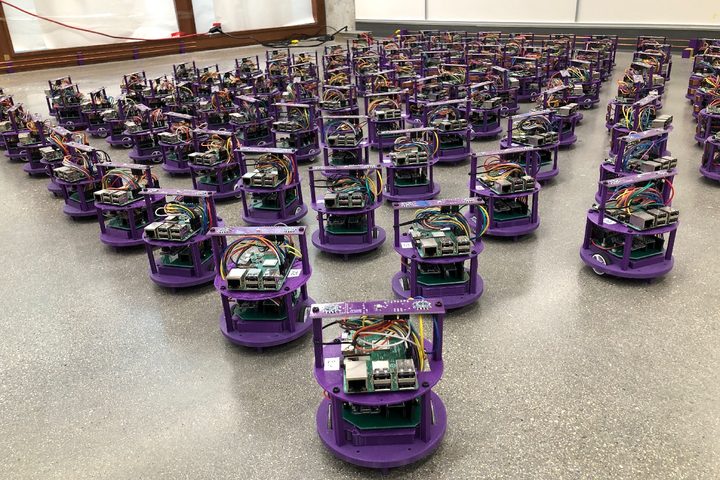
Researchers at Northwestern University, in Evanston, Illinois, recently achieved an impressive demonstration, however. They have developed and tested an algorithm for a decentralized swarm of robots which lets them reliably, safely, and efficiently converge to form a predetermined shape in under a minute. The researchers have shown that their algorithm works both on a simulation of 1,024 robots and on a swarm of 100 real robots in a laboratory. Impressively, the robots are able to perform their shape-throwing without getting in one another’s way. That’s easier said than done.

“The robots are given a set of goal points that represent the shape to be formed and they have to figure out as a group which robot goes to which goal, and how do they get there with no collisions,” Mike Rubenstein, assistant professor of computer science and mechanical engineering, told Digital Trends. “The main idea of the controller is that, whenever a robot senses another robot, they check to see if swapping goal locations will reduce the total distance traveled by the pair. If so, they swap goals. A side effect of this behavior is that they will automatically avoid collisions.”
Mike Rubinstein/Northwestern University

Robots rearranging themselves into giant shapes, such as letters, sounds like it might have limited usefulness. (Automated cheerleaders at future robot sports games?) However, Rubinstein said that this system could actually be applied in a broad range of possible applications. Scenarios in which robots adhering to a specific formation is important could be useful for everything from teaming up to carry objects to, potentially, forming together like the Power Rangers’ Megazord to establish larger modular self-configurable robots.

“The hope is that by avoiding a centralized system, the swarm behavior can more easily scale to large numbers, and is more robust to individual failures,” he said.

This approach isn’t perfect in every scenario, though. “A centralized approach can usually provide more efficient motion, and is easier to guarantee good behaviour when all the robots are working as desired,” Rubenstein explained. “A more centralized approach would be better in cases of small swarms.”

A paper describing the work was recently published in the journal IEEE Transactions on Robotics.

Luke Dormehl
I'm a UK-based tech writer covering Cool Tech at Digital Trends. I've also written for Fast Company, Wired, the Guardian…
Robots just ran the Beijing half-marathon faster than the world record holder
humanoid robot running a marathon

A humanoid robot just ran a half-marathon faster than the world record holder. It might not seem impressive at first, but considering last year, the fastest robot at Beijing's humanoid robot half-marathon finished in two hours and 40 minutes, this is a huge achievement. 

As reported by the Associated Press, the winning robot at this year's Beijing half-marathon crossed the finish line in 50 minutes and 26 seconds, comfortably beating the human world record of 57 minutes recently set by Jacob Kiplimo. 

Read more
As if the plate wasn’t already full, AI is about to worsen the global e-waste crisis
New report highlights a rising environmental concern
Stack of graphics cards and motherboards in a landfill site e-waste

AI is already changing how the world works, but it’s also quietly making one of our biggest environmental problems even worse. And no, this isn’t about energy consumption this time. It’s about the hardware. Because every smarter AI model comes with a physical cost.

AI is about to supercharge the e-waste problem

Read more
Smart glasses are finding a surprise niche — Korean drama and theater shows
Urban, Night Life, Person

Every year, millions of people follow Korean content without speaking a word of the language. They stream shows with subtitles, read translated lyrics, and find workarounds. But live theater has always been a different problem — you can't pause or rewind it. That's the problem: a Korean startup thinks it's cracked, and Yuroy Wang was one of the first to try it. The 22-year-old Taipei retail worker is a K-pop fan who loves Korean culture but doesn't speak the language. When he went to see "The Second Chance Convenience Store," a touring play based on a Korean novel that was a bestseller in Taiwan, he expected supertitles. What he got instead was a pair of chunky black-framed AI-powered glasses sitting on his nose, translating the dialogue in real time directly on the lenses. "As soon as I found out they were available, I couldn't wait to try them," he said. Wang is part of a growing audience discovering that smart glasses, a category of tech that has struggled to find mainstream purpose for years, might have just found their calling in the most unexpected of places: live Korean theater.

How do the glasses work?

Read more