  1. Home
  2. Emerging Tech
  3. Web
  4. Legacy Archives

Prime Air: Amazon letter to FAA reveals progress with drone delivery plan

Add as a preferred source on Google

When Amazon boss Jeff Bezos unveiled plans for a drone delivery service at the end of last year, many viewed it as little more than a cleverly timed publicity stunt designed to remind consumers of the e-commerce giant’s existence. Cyber Monday was, after all, the following day.

But since then, Bezos has reiterated his desire to offer customers living close to its fulfillment centers the chance to have their purchases delivered by a flying machine rather than some guy in a truck.

Recommended Videos

And now the company is taking another step forward in its ‘Prime Air’ project, this week filing a request with the Federal Aviation Administration (FAA) for permission to test its small unmanned aircraft system (sUAS) in locations outside of the FAA’s designated testing sites for commercial operators.

In the request, Amazon says that current rules mean that up to now it’s been forced to conduct test flights either indoors or in other countries. Now that the project has advanced, it wants to start testing outdoors at its R&D base near Seattle.

Progress

The letter, penned by Amazon VP of global public policy Paul Misener, offers up a few details on those project advancements, saying they’re now experimenting with eighth- and ninth-generation flying systems, with progress made in the areas of “agility, flight duration, redundancy, and sense‐and‐avoid sensors and
algorithms.”

The latest iteration of its Prime Air machine can travel more than 50 mph and can carry 5-pound payloads, which, according to Misener, covers 86 percent of all products sold on Amazon.
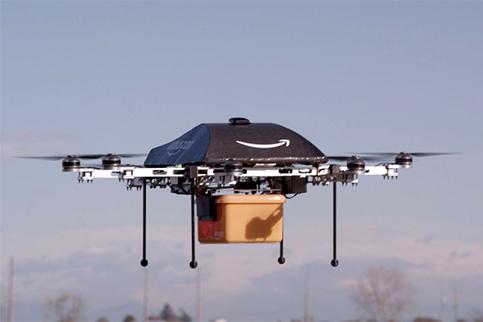
Amazon Prime drone 2
Image used with permission by copyright holder

The VP argues that granting Amazon permission to test outdoors in the US is in the public interest as “it advances Congress’s goal of getting commercial sUAS flying in the United States safely and soon.”

He even makes the bold claim that “one day, seeing Amazon Prime Air will be as normal as seeing mail trucks on the road today.”

Reassurances

It reassured the FAA that all testing would be done on private property with only Amazon employees and contract personnel present.

“Granting this request will do nothing more than allow Amazon to do what thousands of hobbyists and manufacturers of model aircraft do every day, and we will abide by much stronger safety measures than currently required for these groups by FAA policies and regulations,” Misener said.

The request is further evidence that Amazon is making steady progress with its plan to get packages to customers “in 30 minutes or less using aerial vehicles,” though the company will likely have many more regulatory hoops to jump through before it has any hope of getting its service off the ground.

[via Cnet]

Trevor Mogg
Contributing Editor
Not so many moons ago, Trevor moved from one tea-loving island nation that drives on the left (Britain) to another (Japan)…
The Android Show 2026: Gemini Intelligence, Googlebook, Android 17 updates, and everything else
Gemini Intelligence, Googlebooks, Android 17, and redesigned Android Auto. Google didn't hold back at its pre-I/O show, and the main event is still a week away.
The Android Show 2026

Every year, Google front-loads its Android announcements in a separate pre-show the week before its annual I/O conference. This year, the company did exactly that, and The Android Show: I/O Edition was anything but a warmup act. 

Google showed up well prepared, with plenty of software and a major hardware announcement that took everyone by surprise. One by one, let's talk about everything, including a deeply integrated AI overhaul, a long-overdue security upgrade, an Android Auto makeover that feels like it was designed for 2026, and a brand-new laptop category. 

Read more
Google is redefining the cursor for computers, and it’s AI-charged future looks ridiculous
Google’s Magic Pointer could be the next evolution of AI on laptops
AI, App

The humble mouse pointer has barely changed in decades. It moves, clicks, selects, drags, and occasionally turns into a spinning wheel of frustration. Google now wants to turn that tiny arrow into one of the most powerful AI tools on your laptop, which sounds ridiculous until you think about how often you use it.

The company has announced Magic Pointer for Googlebook, its new category of Gemini-powered laptops. The feature gives the cursor AI abilities, allowing it to understand what you are pointing at and help you act on it without needing a long prompt or a separate chatbot window.

Read more
6 things Gemini Intelligence is about to do across your Android devices
Logo, Disk, Symbol

Google is bringing Gemini Intelligence to Android, which brings the best of Gemini to its most intelligent devices. The company really wants you to get your work done by Gemini throughout the day, all while staying in control and keeping your data private. Google is rolling out these features starting with the Samsung Galaxy and Google Pixel devices this summer. Furthermore, we’ll see these features on other Android devices, including watches, cars, glasses, and laptops, later this year.

Your assistant is about to get a lot more hands-on, without you having to ask twice

Read more