  1. Home
  2. Emerging Tech
  3. Smart Home
  4. News

Watching this robot fail at building IKEA furniture will make you feel better about yourself

Add as a preferred source on Google

If you’ve struggled to put together IKEA furniture armed with nothing more than a prayer and a picture book, this will make you feel better. Not only are you not alone, but even machines can’t do it any better than you can. A new effort spearheaded by Francisco Suárez-Ruiz and Quang-Cuong Pham of the Nanyang Technological University in Singapore shows that even robots, who in addition to their own fine motor skills, were developed by individuals with some serious engineering degrees, struggle with constructing IKEA furniture. IKEA, let this be a lesson to you — literally no one knows what you’re asking us to do.

The issue the robots faced, MIT Technology Review explains, is that they’re not human. Seriously. Whereas robots can be programmed to do certain, predetermined tasks very precisely and very efficiently, the rather imprecise and inefficient process of say, building an IKEA chair just doesn’t fit within the robot’s standard modus operandi. Suarez-Ruiz and Pham were trying to address this issue by building a bot equipped with two arms, each with six-axis motion and grippers at their ends, and a six-camera vision system that supposedly gives precise readings even at 3 mm (0.11 inches).

Recommended Videos

Screen Shot 2015-09-30 at 2.26.49 PMRelatedCheck out this 4-gram robot that walks like an inchworm and jumps like a flea

But despite these impressive specs, the robot ran into issues almost from the get-go, mostly a result of its still very limited field of vision. The seemingly simple task of inserting a wooden dowel into a pre-drilled hole required a number of complex maneuvers (ultimately successfully completed) but after a significant bit of struggling. Really, the robots just look alternately blind, confused, or a bit drunk as they attempt to insert the pin. Which, honestly, is also probably what I look like anytime I take on the arduous task of building Swedish furniture on my own.

As much as the robot struggled during this initial phase, the researchers promise, “This work will continue until completion of all the tasks required for assembling an IKEA chair.” So prepare yourself for a lot more amusing robot antics. God knows this won’t be an easy task.

Lulu Chang
Fascinated by the effects of technology on human interaction, Lulu believes that if her parents can use your new app…
Bacteria could be the secret sauce to keeping your computers cool
Scientists find bacteria can grow thermal materials that outperform current cooling tech.
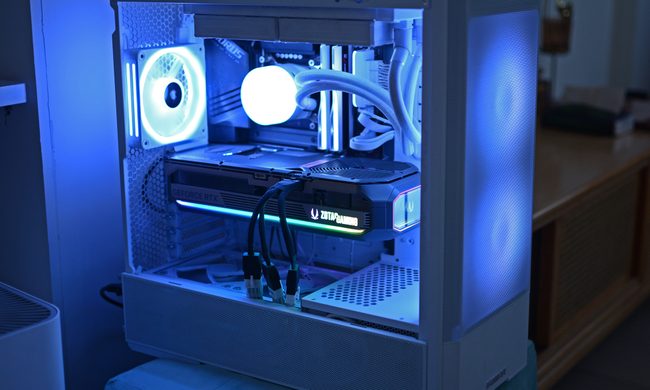
The Zotac RTX 5070 Ti Amp Extreme Infinity plugged into a white gaming PC

Your PC and laptop runs hotter every year, especially now that AI tools and heavy software push it harder than ever. Heat is a real bottleneck for performance, which is why people have gone to wild lengths to solve it, like strapping an actual ice machine to an RTX GPU. A new study points to a far less extreme fix for this problem, and it involves bacteria (via TechXplore).

Researchers have developed a new way to grow thermal interface materials, the substances that sit between a chip and its cooling system to help heat escape faster. The process involves feeding bacteria sugar and metal ions, letting the microbes build the material naturally instead of relying on traditional chemical manufacturing.

Read more
Bored of reading papers? This AI tool turns them into TikTok-like videos
PaperTok brings academic papers to people with short attention spans
Head, Person, Face

Academic papers aren't what you'd consider a fun read. For the average person, the dense, long, and field-specific language-filled papers can be quite intimidating to get into. These are usually packaged as PDFs that look like they were designed to test your willpower. A group of University of Washington researchers thinks there may be a better way to get that work in front of regular people. They are turning the papers into short-form videos.

The tool is called PaperTok, and it uses AI to help researchers convert academic papers into short, social-friendly videos. Think TikTok, except the idea is to explain research instead of sharing brain-rotting content. The best part? PaperTok is building a platform around scientists and researchers who are involved in the process, rather than simply using AI to summarize these papers.

Read more
As AI voices get harder to spot, ElevenLabs adopts Google’s SynthID to help you sniff the fakes
Artificial Intelligence

There was a time when spotting AI-generated content was almost a game. Images came with extra fingers, chatbots wrote like overly enthusiastic interns, and synthetic voices had an unmistakable robotic edge. Those days are disappearing fast.

Today, AI voices can laugh, whisper, pause naturally, and even sound emotional enough to fool many listeners. That’s exciting for creators, but it’s also creating a growing trust problem. If you can’t tell whether a clip is real or AI-generated, how do you know what to believe?

Read more