  1. Home
  2. Emerging Tech
  3. News

Elon Musk receives FCC approval to launch over 7,500 satellites into space

Add as a preferred source on Google
Starlink

The FCC this week unanimously approved SpaceX’s ambitious plan to launch 7,518 satellites into low-Earth orbit. These satellites, along with 4,425 previously approved satellites, will serve as the backbone for the company’s proposed Starlink broadband network. As it does with most of its projects, SpaceX is thinking big with its global broadband network. The company is expected to spend more than $10 billion to build and launch a constellation of satellites that will provide high-speed internet coverage to just about every corner of the planet.

SpaceX plans initially to launch 4,425 Starlink satellites into a low-Earth orbit followed by an additional 7,518 satellite at an even lower orbit. The first group of satellites will operate at an altitude of 1,110km to 1,325km and will form the backbone of the company’s Starlink broadband service. The additional satellites will circle the Earth at altitudes from 335km to 346km and will boost capacity and lower latency, especially in densely populated areas. Because of these low orbits, SpaceX says its planned Starlink broadband network will have latencies as low as 25ms and gigabit speeds that will rival existing cable or fiber optic systems. Not only will it be fast, but the Starlink network also will reach those areas that have poor or no internet connectivity.

Recommended Videos

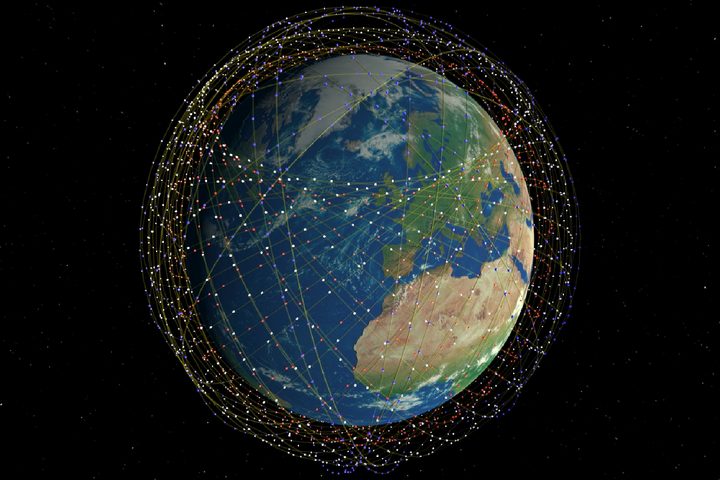
FCC rules require SpaceX to launch 50 percent of its proposed satellites within six years and all of them within nine years unless a waiver is granted. To put this deployment in perspective, there are currently only 1,886 active satellites presently in orbit. These new SpaceX satellites will increase the number of active satellites six-fold in less than a decade. A recent simulation by Mark Handley, professor of Networked Systems in the Department of Computer Science at University College London, visually shows the off-the-charts scale and complexity of the network.

SpaceX already is making progress on this formidable plan. On February 22, 2018, the company successfully launched its first two Starlink test satellites, Tintin A and Tintin B, from California’s Vandenberg Air Force Base. These satellites are being used to test the Starlink network on a small scale and demonstrate its feasibility. It is not known whether these test satellites will be used in the network when it finally is brought online. As part of its approval, the FCC requires SpaceX to have a debris mitigation plan to keep the space junk problem from getting worse.

Kelly Hodgkins
Kelly's been writing online for ten years, working at Gizmodo, TUAW, and BGR among others. Living near the White Mountains of…
The Android Show 2026: Gemini Intelligence, Googlebook, Android 17 updates, and everything else
Gemini Intelligence, Googlebooks, Android 17, and redesigned Android Auto. Google didn't hold back at its pre-I/O show, and the main event is still a week away.
The Android Show 2026

Every year, Google front-loads its Android announcements in a separate pre-show the week before its annual I/O conference. This year, the company did exactly that, and The Android Show: I/O Edition was anything but a warmup act. 

Google showed up well prepared, with plenty of software and a major hardware announcement that took everyone by surprise. One by one, let's talk about everything, including a deeply integrated AI overhaul, a long-overdue security upgrade, an Android Auto makeover that feels like it was designed for 2026, and a brand-new laptop category. 

Read more
Google is redefining the cursor for computers, and it’s AI-charged future looks ridiculous
Google’s Magic Pointer could be the next evolution of AI on laptops
AI, App

The humble mouse pointer has barely changed in decades. It moves, clicks, selects, drags, and occasionally turns into a spinning wheel of frustration. Google now wants to turn that tiny arrow into one of the most powerful AI tools on your laptop, which sounds ridiculous until you think about how often you use it.

The company has announced Magic Pointer for Googlebook, its new category of Gemini-powered laptops. The feature gives the cursor AI abilities, allowing it to understand what you are pointing at and help you act on it without needing a long prompt or a separate chatbot window.

Read more
6 things Gemini Intelligence is about to do across your Android devices
Logo, Disk, Symbol

Google is bringing Gemini Intelligence to Android, which brings the best of Gemini to its most intelligent devices. The company really wants you to get your work done by Gemini throughout the day, all while staying in control and keeping your data private. Google is rolling out these features starting with the Samsung Galaxy and Google Pixel devices this summer. Furthermore, we’ll see these features on other Android devices, including watches, cars, glasses, and laptops, later this year.

Your assistant is about to get a lot more hands-on, without you having to ask twice

Read more