  1. Home
  2. Emerging Tech
  3. News

Spector makes discovering fonts and colors in print easy

Add as a preferred source on Google

Designing for print can be tricky if you are a true designer, the sort of person that is picky about if the font weight or spacing is a bit off or if the orange is a little too orange. It can be hard to figure out what the fonts and colors you are looking at on a printed page really are, but this new device called Spector makes it as easy as the eyedropper tool in Photoshop.

Ask any designer how they would normally hope to get colors or fonts into their computer? Chances are it would involve snapping a photo with their phone or camera and loading it onto their computer. But a student at the Royal College of Art, Fiona O’Leary, decided that was inefficient and complicated, which led her to develop Spector, a tool designed to make capturing printed fonts and colors for use in Adobe’s InDesign easier than ever.

Recommended Videos

Spector is a small device that houses a built-in camera with a mode for capturing text and a mode for capturing color. The user selects what they are trying to capture, places Spector over the color or font, and presses the lone button located on the top of the unit. It is still just a prototype, but as you can see demonstrated in the video — it works.

Once a user presses the button, Spector uses some built-in algorithms to identify shapes and color values, before sending the information to a database for final identification and validation. If the unit is connected to a computer, the user can select text or objects and have Spector automatically match the digital text or color with what it detects from the printed medium. This saves crazy amounts of time, and once fleshed out, could be a game-changer for designers.

Spector

Currently, Spector only identifies seven typefaces, but the plan is to continue growing the identification database to make it compatible with a wider range of fonts. The plan is to make the product into a tool for education, just as much as one for getting work done. Unfortunately, you will have to wait quite a while before you see any of these in stores. O’Leary is not in any hurry to bring the product to the masses, instead focusing on refining and making it more accurate.

Until that time, enjoy your design-related cell phone snaps and treasure them knowing that their days are likely numbered.

Anthony Thurston
Anthony is an internationally published photographer based in the beautiful Pacific Northwest. Specializing primarily in…
Bacteria could be the secret sauce to keeping your computers cool
Scientists find bacteria can grow thermal materials that outperform current cooling tech.
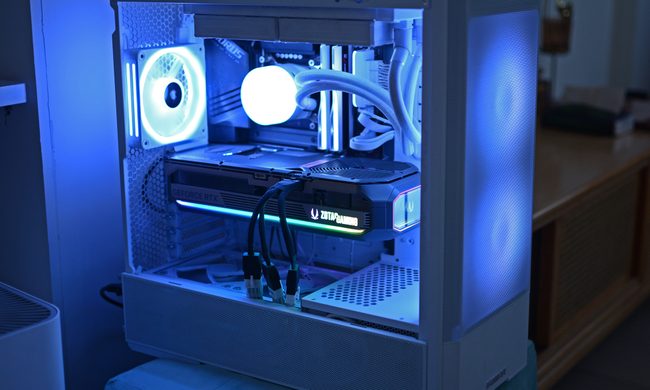
The Zotac RTX 5070 Ti Amp Extreme Infinity plugged into a white gaming PC

Your PC and laptop runs hotter every year, especially now that AI tools and heavy software push it harder than ever. Heat is a real bottleneck for performance, which is why people have gone to wild lengths to solve it, like strapping an actual ice machine to an RTX GPU. A new study points to a far less extreme fix for this problem, and it involves bacteria (via TechXplore).

Researchers have developed a new way to grow thermal interface materials, the substances that sit between a chip and its cooling system to help heat escape faster. The process involves feeding bacteria sugar and metal ions, letting the microbes build the material naturally instead of relying on traditional chemical manufacturing.

Read more
Bored of reading papers? This AI tool turns them into TikTok-like videos
PaperTok brings academic papers to people with short attention spans
Head, Person, Face

Academic papers aren't what you'd consider a fun read. For the average person, the dense, long, and field-specific language-filled papers can be quite intimidating to get into. These are usually packaged as PDFs that look like they were designed to test your willpower. A group of University of Washington researchers thinks there may be a better way to get that work in front of regular people. They are turning the papers into short-form videos.

The tool is called PaperTok, and it uses AI to help researchers convert academic papers into short, social-friendly videos. Think TikTok, except the idea is to explain research instead of sharing brain-rotting content. The best part? PaperTok is building a platform around scientists and researchers who are involved in the process, rather than simply using AI to summarize these papers.

Read more
As AI voices get harder to spot, ElevenLabs adopts Google’s SynthID to help you sniff the fakes
Artificial Intelligence

There was a time when spotting AI-generated content was almost a game. Images came with extra fingers, chatbots wrote like overly enthusiastic interns, and synthetic voices had an unmistakable robotic edge. Those days are disappearing fast.

Today, AI voices can laugh, whisper, pause naturally, and even sound emotional enough to fool many listeners. That’s exciting for creators, but it’s also creating a growing trust problem. If you can’t tell whether a clip is real or AI-generated, how do you know what to believe?

Read more