  1. Home
  2. Emerging Tech
  3. News

Spitzer captures childhood, middle age, and maturity of stars in one image

Add as a preferred source on Google

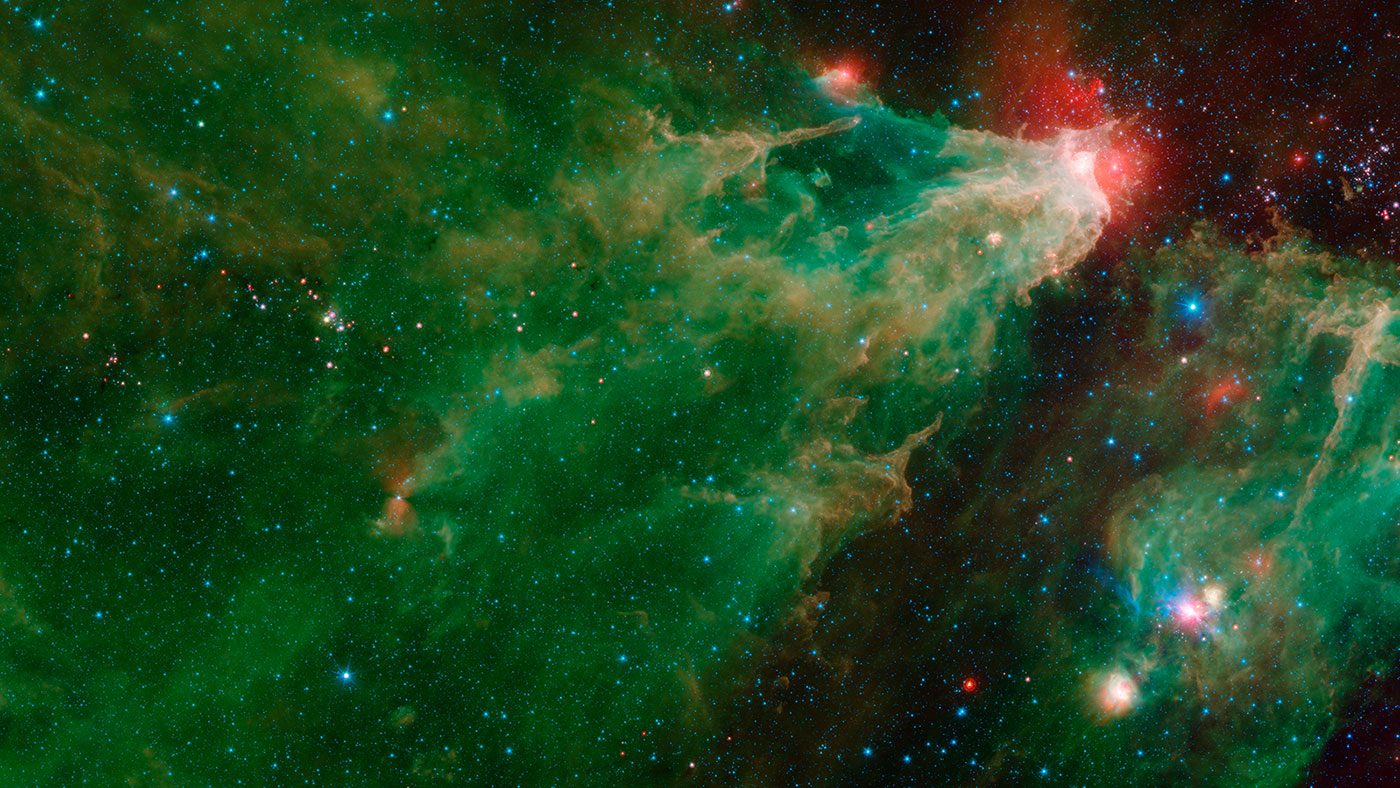
A mosaic by NASA’s Spitzer Space Telescope of the Cepheus C and Cepheus B regions. This image combines data from Spitzer’s IRAC and MIPS instruments. NASA/JPL-Caltech

NASA’s Spitzer telescope has captured a stunning images of a pair of nebulas containing the star clusters Cepheus B and Cepheus C.

Recommended Videos

The majority of the image shows the main nebula, which is a cloud of dust and gas that appears in green and orange. The bright red region at the top right is the tip of the nebula, where bright stars give out radiation which heats the dust and creates a glow. These bright, massive stars are part of a star cluster which extends beyond the edges of the image. This region is the remains of a larger cloud which has been whittled down by radiation from the stars over time.

There is a second, smaller nebula visible on the right hand side of the image. The cluster of pink and white lights in the bottom right are a young nebula which includes a “runaway star.” The runaway is the blue star with a red arc around in the right-hand middle of the image. The red arc is a shockwave caused by the star traveling through the nebula at high speed, creating a bow of matter in front of it.

Another feature visible on the left hand middle of the image is a band of darker color in the nebula. This area is called Cepheus C, and is a dense area of dust and gas which acts as a stellar nursery. Stars are rapidly born here due to the density of materials which allow them to form. As these baby stars grow they produce winds which push away nearby dust, creating more pockets of dense material. This process produces the beautiful shapes of the nebula. Eventually, when the dust clears, the stars remain in their clusters like those in the top right of the image, which is Cepheus B.

This image is compiled from data from two different instruments: Spitzer’s Infrared Array Camera (IRAC) and the Multiband Imaging Photometer (MIPS). The IRAC instrument collects data in the near- and mid-infrared spectrum (wavelengths between 3.6 and 8.0 microns), and the MIPS collects data in the far-infrared spectrum (wavelengths of 24, 70 and 160 microns).

Stars of Cepheus as Seen by NASA's Spitzer Space Telescope
Georgina Torbet
Georgina has been the space writer at Digital Trends space writer for six years, covering human space exploration, planetary…
Edge browser on mobile gets a huge upgrade that makes it a worthy pick over Chrome
Edge mobile gets smarter just before Chrome’s big Gemini moment
Microsoft Edge on a phone

Chrome is still the default browser for many smartphone users, but Microsoft’s latest Edge update gives them a practical reason to try something else.

Microsoft has announced a major Copilot update for Edge across desktop and mobile. The rollout comes ahead of Google’s Gemini-powered Chrome upgrade for Android, which is expected in June, giving Edge a chance to stand out on phones before Chrome’s next big AI push.

Read more
After flubbing with Siri, Apple plans to host AI agents on the App Store
One problem is about money Apple won't commit to not charging. The other is about AI agents Apple can't figure out how to control. WWDC needs to solve both.
Electronics, Mobile Phone, Phone

Apple is currently facing a Siri problem that has nothing to do with Siri at all. With WWDC 2026 just weeks away, The Information reports the company is actively courting developers to integrate their apps with the new Siri coming in iOS 27. 

The mechanism powering the overhauled Siri, App Intents, is an API that lets Siri execute actions inside third-party apps without you actively opening them, which sounds quite useful, I’d say. However, some of the world’s largest developers are dragging their feet on it, not because it’s tough, but because Apple left the door open on charging for it later.

Read more
EV batteries just need some AI top-up nudge, and they get a big 23% life boost, finds research
Charging fast and lasting long seemed impossible. A new AI trick says otherwise.
EV Charging

EV battery charging technology has always had to find the right balance between charging speed and battery longevity. If the charging speed is too fast, it wears down the battery. If the charging is too slow, nobody is happy. 

Researchers Meng Yuan from Victoria University of Wellington and Changfu Zou from Chalmers University of Technology in Sweden may have cracked this long-standing problem using an AI technique called deep reinforcement learning, and the results are pretty encouraging.

Read more