  1. Home
  2. Emerging Tech
  3. News

Beautiful superbubbles may be bombarding the Earth with cosmic rays

Add as a preferred source on Google

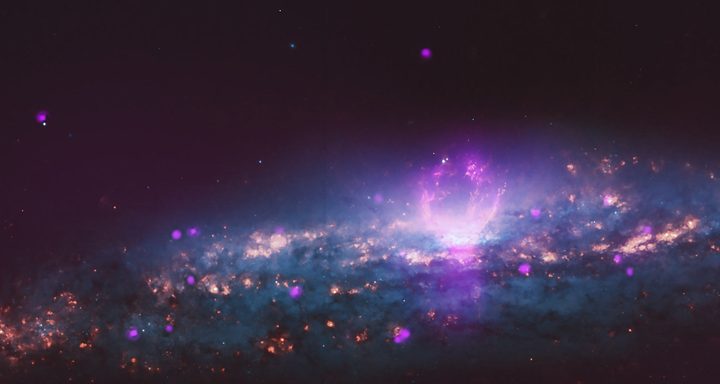
A composite image of the superbubbles made from Chandra (purple and pink) and Hubble data (orange and blue). NASA/STScI.

Soap bubbles are pretty, but superbubbles are prettier. This stunning image shows a new phenomenon recently discovered by astronomers, which is changing the way we think about ultra-energetic particles.

Recommended Videos

Astronomers have identified two “superbubbles,” which are thousands of light-years across and are made of a lighter gas that is suspended inside a heavier one. They believe that the bubbles were created by an energetic supermassive black hole which gave off bursts of energy, or possibly from the winds generated by young stars.

The superbubbles are located in the galaxy NGC 3079 which is 67 million light-years away from Earth. The larger of the two bubbles is 4,900 light-years across, which for reference is nearly 30 quadrillion miles (that’s 30 followed by 15 zeroes) — in other words, it’s very, very big.

The bubbles were identified by using data from both the Chandra Observatory which captures X-rays and the Hubble telescope which captures ultraviolet, visible, and near-infrared light. They are the little brothers to the Fermi bubbles, enormous bulges in the galaxy which can be seen using gamma rays and which were first discovered in the Milky Way in 2010.

These particular bubbles are interesting not only because they are pretty but also because their rim forms a kind of natural particle collider which creates unusual and very energetic particles. When the outer edge of the bubbles meets the gas around them, they generate huge shock waves which could be the source of the cosmic rays that we detect here on Earth.

A Tour of NGC 3079 Superbubbles

“Shock waves associated with exploding stars can accelerate particles up to energies about 100 times larger than those generated in the Large Hadron Collider,” lead author Dr. Jiang-Tao Li from the University of Michigan explained to Sci News. “The outer regions of the superbubbles in NGC 3079 generate shock waves as they expand and collide with surrounding gas … When the particles cross the shock front they are accelerated, as if they received a kick from a pinball machine’s flipper.”

It is this process of acceleration which may kick-start energetic particles outwards, perhaps even toward our planet where they would strike the atmosphere and produce the cosmic rays that were discovered a century ago, but which we still do not know the source of.

The findings are published in The Astrophysical Journal.

Georgina Torbet
Georgina has been the space writer at Digital Trends space writer for six years, covering human space exploration, planetary…
DJI ‘s first 360° drone offers 8K video recording and a freakishly long transmission range
From omnidirectional obstacle sensing to 42 GB of onboard storage, the Avata 360 is DJI doing what DJI does best: raising the bar for everyone else.
DJI Avata 360° drone.

DJI has officially entered the 360° drone arena with the launch of the Avata 360. It’s the company’s first-ever fully immersive FPV drone, and a direct shot at the Antigravity A1, a rival built by an Insta360-incubated brand. Looks like the drone wars just got more interesting. 

What makes the Avata 360 worth looking at?

Read more
I transferred all my chats from other AI apps to Gemini — and it works flawlessly
Google Gemini Graphics Featured

You know that moment when AI assistants like ChatGPT, Gemini, or Claude suddenly lose the plot mid-conversation and start hallucinating like they’re absolutely sure they’re right? Yeah…it’s equal parts funny and painfully annoying. My usual reaction is switching between apps, hoping one of them gets it right. But the real problem is that I have to start over every single time. It feels like I’m stuck in a loop explaining my life story to different AIs, one after the other.

Now with Gemini, I can now jump in from other AI apps without that whole reset conversation. Finally, the Google gods have blessed us. I tried it out expecting the usual hiccups, but it was surprisingly smooth and quick.

Read more
Google expands Search Live globally with voice and camera AI
The feature is now available in 200+ countries with multilingual support
Google Search Live

Google is taking another big step toward turning Search into a full-blown AI assistant. The company has officially expanded Search Live globally, making the feature available in over 200 countries and territories, along with support for dozens of languages.

https://twitter.com/google/status/2037201891130523917

Read more