  1. Home
  2. Emerging Tech
  3. News

Planet hunter TESS finds more potentially habitable worlds

Add as a preferred source on Google
TESS Helps Reveal Multiple Planets, Including Promising World

NASA’s planet-hunting satellite TESS has been hard at work lately, discovering a bevy of exoplanets, some of which could be potentially habitable.

Recommended Videos

Firstly, TESS discovered three exoplanets in orbit around the star UCAC4 191-004642. The planets are small and temperate and the system is relatively close to Earth, making it easier for future experiments to determine if the planets have atmospheres by using tools like the upcoming James Webb Telescope.

In addition, scientists also used TESS to examine GJ 357 b, an exoplanet they had detected by observing a pattern of dimming of star GJ 357. The dimming occurs when the planet passes between Earth and the star. The planet is about 20% bigger than Earth and has a high temperature of 490 degrees Fahrenheit (254 degrees Celsius), making it a “hot Earth.”

But in the course of investigating the planet, the researchers found something unexpected — two more planets, one of which is within the star’s habitable zone.
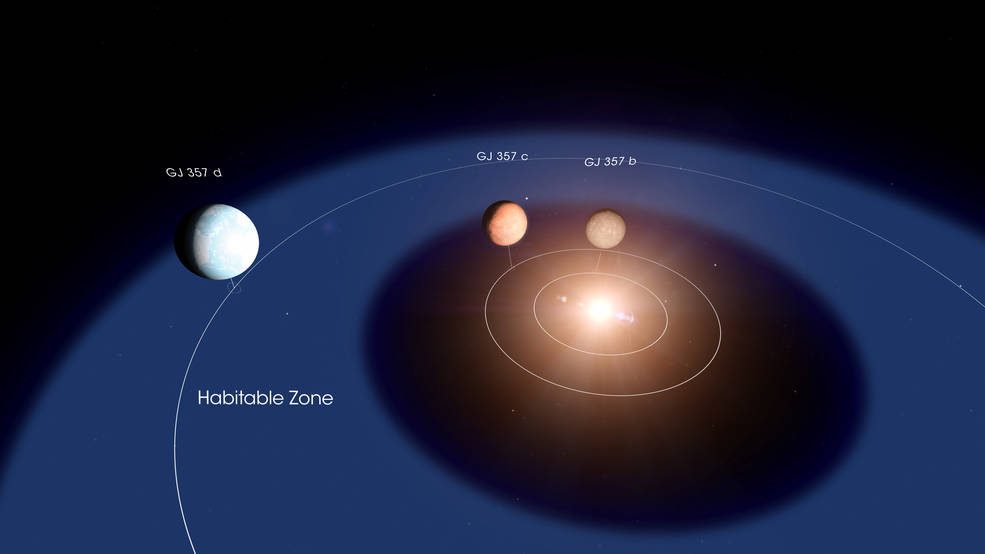
This diagram shows the layout of the GJ 357 system. Planet d orbits within the star’s so-called habitable zone, the orbital region where liquid water can exist on a rocky planet’s surface. If it has a dense atmosphere, which will take future studies to determine, GJ 357 d could be warm enough to permit the presence of liquid water. NASA's Goddard Space Flight Center/Chris Smith

The furthest planet in the system, GJ 357 d, is a prime candidate for further exploration. “GJ 357 d is located within the outer edge of its star’s habitable zone, where it receives about the same amount of stellar energy from its star as Mars does from the Sun,” co-author Diana Kossakowski of the Max Planck Institute for Astronomy in Heidelberg, Germany, said in a statement. “If the planet has a dense atmosphere, which will take future studies to determine, it could trap enough heat to warm the planet and allow liquid water on its surface.”

If the planet does not have an atmosphere it would be extremely cold, with an equilibrium temperature of minus 64 degrees Fahrenheit (minus 53 degrees Centigrade). It is hefty, weighing in at 6.1 times the mass of the Earth, but it is closer to its star than the Earth is to the Sun, at about 20% of the distance. Scientists aren’t sure what the planet is composed of or what size it is, but it is possible rocky and one or two times the size of the Earth.

The findings are published in the journal Astronomy & Astrophysics.

Georgina Torbet
Georgina has been the space writer at Digital Trends space writer for six years, covering human space exploration, planetary…
Robots just ran the Beijing half-marathon faster than the world record holder
humanoid robot running a marathon

A humanoid robot just ran a half-marathon faster than the world record holder. It might not seem impressive at first, but considering last year, the fastest robot at Beijing's humanoid robot half-marathon finished in two hours and 40 minutes, this is a huge achievement. 

As reported by the Associated Press, the winning robot at this year's Beijing half-marathon crossed the finish line in 50 minutes and 26 seconds, comfortably beating the human world record of 57 minutes recently set by Jacob Kiplimo. 

Read more
As if the plate wasn’t already full, AI is about to worsen the global e-waste crisis
New report highlights a rising environmental concern
Stack of graphics cards and motherboards in a landfill site e-waste

AI is already changing how the world works, but it’s also quietly making one of our biggest environmental problems even worse. And no, this isn’t about energy consumption this time. It’s about the hardware. Because every smarter AI model comes with a physical cost.

AI is about to supercharge the e-waste problem

Read more
Smart glasses are finding a surprise niche — Korean drama and theater shows
Urban, Night Life, Person

Every year, millions of people follow Korean content without speaking a word of the language. They stream shows with subtitles, read translated lyrics, and find workarounds. But live theater has always been a different problem — you can't pause or rewind it. That's the problem: a Korean startup thinks it's cracked, and Yuroy Wang was one of the first to try it. The 22-year-old Taipei retail worker is a K-pop fan who loves Korean culture but doesn't speak the language. When he went to see "The Second Chance Convenience Store," a touring play based on a Korean novel that was a bestseller in Taiwan, he expected supertitles. What he got instead was a pair of chunky black-framed AI-powered glasses sitting on his nose, translating the dialogue in real time directly on the lenses. "As soon as I found out they were available, I couldn't wait to try them," he said. Wang is part of a growing audience discovering that smart glasses, a category of tech that has struggled to find mainstream purpose for years, might have just found their calling in the most unexpected of places: live Korean theater.

How do the glasses work?

Read more