  1. Home
  2. Emerging Tech
  3. Legacy Archives

Watch four-legged AlphaDog robot go for a walk and roll over

Add as a preferred source on Google

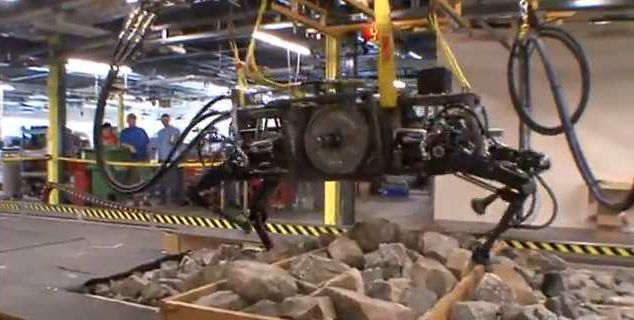
Move over, BigDog, there’s a new headless, quadrupedic robot in town — and its name is AlphaDog.

Robots manufacturer Boston Dynamics recently debuted some video of the next-generation robotic “mule” it’s developing as a method for transporting military equipment around uneven terrain. The company has been working on a four-legged machine for hauling gear since 2005, and its videos featuring the “BigDog” robots have been an online (and on-air) hit, showing off the robots ability to handle all manner of environment and external obstacles (including soldiers trying to knock it down).

Recommended Videos

The AlphaDog video shows that the robot has learned a few new tricks since we last saw it — such as the ability to right itself after being knocked over. The AlphaDog can also carry up to 400 pounds (60 more than its BigDog predecessor), and can walk for 20 miles without needing recalibration or refueling.

Officially titled the Legged Squad Support System (L3), AlphaDog and BigDog are being developed through funding by DARPA, though it will still be a little while before they’re in active use. The military is expected to begin testing the robots in 2012.

Rick Marshall
Former Contributing Editor, Entertainment
A veteran journalist with more than two decades of experience covering local and national news, arts and entertainment, and…
Google built an AI that can see football plays before they happen
DeepMind’s latest research predicts player movement up to eight seconds into the future
Google Deepmind TacticAI Featured

Football managers spend countless hours analyzing corners, free kicks, and player positioning in search of tiny competitive advantages. Google DeepMind believes artificial intelligence can make that process significantly faster, and its latest project, TacticAI, is designed to do exactly that. TacticAI is a football-specific AI assistant capable of modeling player movement, forecasting future play dynamics, and even recommending tactical adjustments for corner kicks. One of its standout abilities is predicting player trajectories up to eight seconds into the future using only broadcast-style visual data.

TacticAI was built with Liverpool FC and validated by football experts

Read more
Radical new coffee-making method uses sound, skips hot water and reduces energy bills
UNSW reserachers brewed espresso with room-temperature water and ultrasonic sound waves, cutting energy use by 75% in blind tests that fooled 100 regular drinkers.
Person brewing espresso in a lab with a modified ultrasonic espresso machine

Researchers at UNSW Sydney have figured out how to brew espresso-strength coffee without heating any water. The method replaces hot water and high pressure with ultrasonic sound waves, and in blind taste tests involving 100 regular coffee drinkers, participants could not tell the two apart.

How it works

Read more
This tiny sensor could help self-driving cars and robots see better in the dark
Penn State researchers have developed a light-adaptive photomemristor modeled on the human eye that achieves over 95% visual accuracy in shifting light conditions.
Waymo Jaguar I-PACE sensors close up

Penn State researchers have developed a light-adaptive sensor component that could make autonomous vehicle cameras and robots far more reliable in shifting lighting conditions. The work, published Monday in Nature Communications, takes direct cues from how the human eye adjusts between bright and dark environments.

Biology as a blueprint

Read more