
When the original Dead Space launched in 2008, it ushered in a new age of video game horror. Gamers were introduced to the now iconic and initially silent protagonist, Isaac Clarke, a space engineer stuck in a nightmare that makes The Thing look like a preschool date. This installment was followed by two sequels that ratcheted up the horror and gore, as well as gave Clarke a full voice.
The franchise is returning to the past this month with a remake that explores Isaac’s first venture into the fear-filled void. Just as Dead Space 2 and 3 did, Dead Space‘s remake is turning everything up to the next level. One of its largest changes is that it’s letting Clarke speak this time around, giving players more to work with than a silent hero who just emotes through grunts. To bring Clarke to life, EA brought in series veteran Gunner Wright to revisit the role and breathe new life into the character.
In an interview with Wright and Dead Space‘s Realization Director Joel MacMillan, the two told me why it was necessary to revisit the past in this way. Giving Clarke more to say wasn’t a throwaway decision that was easy to implement; it forced the team to think about where the original game’s silence doesn’t mesh with his final arc.
Revisiting Isaac
“I’m so blessed to have a character like Isaac Clarke, who I feel I’m a lot like,” Wright tells Digital Trends with a chuckle. “We’re very similar in design and DNA. So it was a pleasure to go back and revisit that character.”
While Wright was more than happy about returning to the role, what prompted the change in the first place? MacMillan and Motive Studio didn’t want him to come off as a “do-boy” as he did in the original. MacMillan notes that Dead Space now comes off as non-player characters telling Isaac what to do and having him go do it, with his lack of response making it feel like he’s being ignorant of the world around him. That created a disconnect that the team felt it could solve.
“We wanted to give him more agency and put him in the driver’s seat,” MacMillan said. “Our version of Isaac is more solution-oriented. He’s more of a pragmatist. He’s the space engineer that gets the job done. I think that gives the player a little bit more engagement, brings the player a little bit more into the fold, and makes them feel like they’re capable and working with a capable protagonist.”
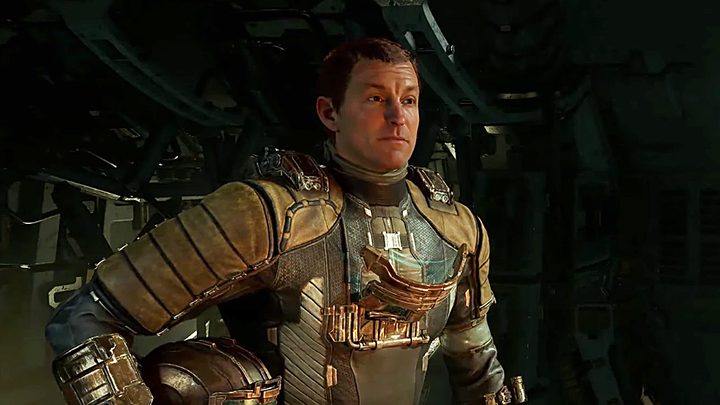
Such a change wasn’t a simple task, but a complicated creative process for EA. As we chatted, I found that giving Isaac a voice wasn’t as cut-and-dried as writing a script, getting Wright in a studio, and recording. There were a lot of careful considerations and self-monitoring on the part of everyone involved. Wright would basically go back in time to complete the puzzle of Isaac’s growth seen in Dead Space 2 and 3. That meant adopting a new mindset to fit the setting, time, and tone. Wright, being the physical manifestation of Isaac, went in knowing exactly how to deliver what was needed in the best way possible.
“I just kept it as an open book,” Wright says. “Isaac Clarke is a character who is just in circumstances, whether they’re extreme or normal to him … At the very beginning of the story, outside of his personal issues with his girlfriend, he’s just going to do a job. I relied heavily on Joel and the creative team to kind of help navigate that and ground it as if I were seeing it for the first time. Advancements in technology in the gaming world and the actual production helped in a weird way by being so new to me. I was able to look at it literally with a fresh set of eyes.”
There are narrative games where protagonists will comment on so much, and it brings a sense of levity and comedy to the experience, which is not what we wanted to do.
Game narratives have changed a lot since 2008, as has the reception to them. MacMillan notes that he, Wright, and the rest of the team at Motive Studio wanted to find a careful middle ground that paid respect to that original, voiceless Isaac while implementing an all-new immersion and experience by using his voice as a tool.
“Right off the bat, we said Isaac only speaks when spoken to,” MacMillan tells Digital Trends. “We wanted to be careful not to have Isaac be too chatty throughout the whole game. There are narrative games where protagonists will comment on so much, and it brings a sense of levity and comedy to the experience, which is not what we wanted to do. Isaac’s going through these corridors and he’s alone and it’s scary. We wanted the player to feel that way, and if we had Isaac speaking through those moments, it would deflate a bit of that tension and give the player some artificial security.”

Legacy honored
For the team, it was about honoring Isaac Clarke’s legacy, rather than rewriting it. “We were very sparing with where we put his dialogue,” MacMillan says. “If you see something like a brutal mauling happen right in front of your eyes and don’t have any sort of reaction to that would feel a bit odd. Back in 2008, our sensibilities towards that would be different. Today, we expect the characters to react a bit more than they did in the original, and that’s kind of the metric and the guiding light we went with for this. But we didn’t want to betray the Isaac that the original had set out to define. So we were very conscious of that the whole way through and we tried to ride that knife’s edge very finely.”
Dead Space‘s remake is looking to be the definitive entry in the series by adding a more complete character approach to the fold. While adding a voice to accompany players throughout the adventure seems simple, Wright and MacMillan make it clear that such a move requires more care than you’d think. Finding that balance between a chatty and silent protagonist doesn’t appear to be an easy one, but Dead Space seems to be getting the job done.
Dead Space launches on January 27 for Xbox Series X, PlayStation 5, and PC.


