  1. Home
  2. Gaming
  3. Android
  4. News

Google I/O: Stadia team says latency in game streaming is a thing of the past

Add as a preferred source on Google
Google Stadia latency video quality research i/o 2019
Image used with permission by copyright holder

Google Stadia is an ambitious platform that will likely live or die on the strength of the technology behind it. At the official reveal in March, the company set high expectations for the game streaming service and at Google I/O 2019, the company put the platform’s potential into additional perspective while attempting to address some concerns.

“Latency is the first word we hear when we say we’re working on game streaming,” said Google Stadia Product Manager Khaled Abdel Rahman. “We did a lot of research about latency. As a matter of fact, we have constant weekly research sessions about every single aspect of latency in addition to our wider scale testing.”

Recommended Videos

“It’s important to note that different latency requirements, even within the same game,” he explained. “Even the same mechanic across two different titles can have wildly different behaviors and requirements.”

He followed up that statement by diving into the research done regarding latency and how it impacts different games and genres.

“Latency perception is closely tied to the player’s level of experience with a particular title,” he said. “A casual player can fully enjoy a sports game without significant latency perception even when we dialed those numbers up to absurd levels. On the other hand, a more experienced player may be looking to do some skill shots, special passes, and things that are not feasible at high or inconsistent latency levels.”
Google Stadia latency video quality research i/o 2019
Image used with permission by copyright holder

Latency in this context is the small gap of time between player input and the game relaying that input on the screen. While it is true that a more skilled and experienced player may perceive latency at a higher degree, any heightened latency could cripple even a casual gamer’s experience. The team behind Stadia is trying to find a sweet spot for performance and there’s a lot more going into the equation, as you can see in the full session on YouTube.

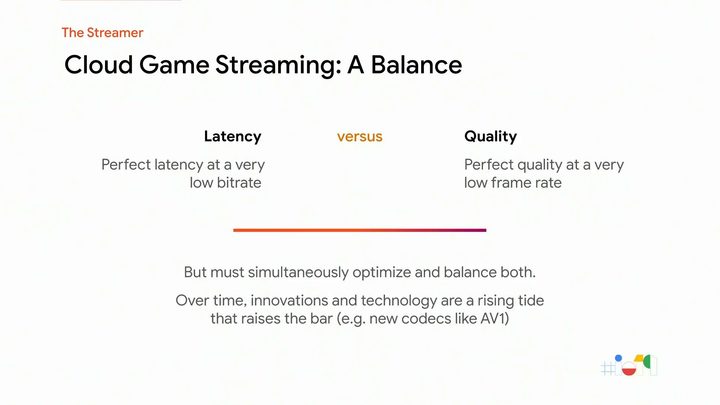
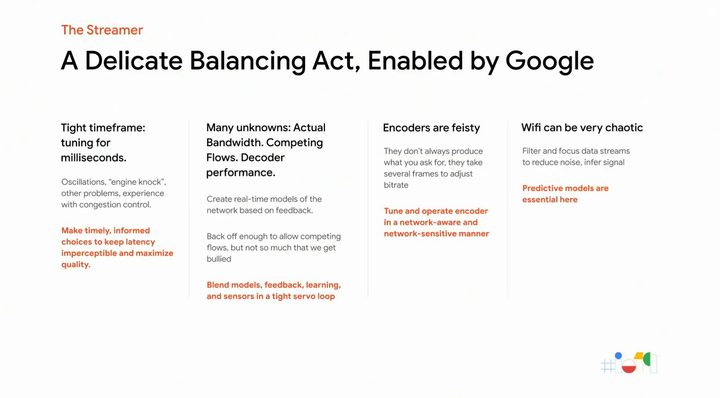
Considering the many different circumstances gamers have within their households when it comes to internet connections, latency and video quality are major concerns when it comes to Google Stadia. During the deep dive into Stadia’s tech, “balance” was the overarching theme throughout the sessions. Google is trying to find ways to prioritize different elements of the gaming experience on the fly, balancing the player’s gaming experience with the inconsistent bitrates and connections in different households.

Latency and video quality will be key points of contention when comparing Google Stadia to its competition. The team presented a wealth of internal initiatives and technology put in place to handle these different connection speeds, but the majority of consumers’ concerns won’t really be answered until Google Stadia is made available to them.

Charles Singletary Jr.
I'm a Birmingham, AL raised author, journalist, and gaming enthusiast currently residing in San Antonio, TX. My work has…
Assassin’s Creed Black Flag Resynced finally gets a showcase date
Gaming's worst kept secret finally gets its day!
Assassin's Creed IV Black Flag

After multiple rounds of rumors and leaks, Ubisoft has officially confirmed a Worldwide Reveal Showcase for Assassin's Creed Black Flag Resynced. The reveal was first rumored for last week, only for fresh rumors to push it to this week instead. Ubisoft has now put that speculation to rest.

The event goes live on April 23 at 9AM PDT / 4PM UTC / 6PM CEST on YouTube. Ubisoft even leaned into the whole saga, dubbing it "Gaming's Worst Kept Secret" in its teaser video. That's hardly an exaggeration given how long the rumors have been circulating online.

Read more
Intel’s secret handheld chips might just give AMD a run for its money
Two Intel chips built for handheld gaming just leaked online, and things are about to get interesting.
zotac zone front view

Intel has been quietly working on something interesting. A new leak has revealed two unannounced chips, the Arc G3 and Arc G3 Extreme, built specifically for handheld gaming consoles. These chips are expected to show up sometime in Q2 2026, and they could shake up the handheld gaming market in a big way.

Shortly after Intel revealed its full Panther Lake lineup, rumors started swirling about two chips that didn't make the cut. These were originally designed to compete with AMD's Ryzen Z2 series, but their launch was delayed for reasons we don’t know. Now, one of them has resurfaced online.

Read more
OnePlus’ gaming controller for phones has a neat little charging trick that you’ll love
The new add-on does more than add buttons, it could make charging and cooling much less awkward during longer phone gaming sessions
Body Part, Finger, Hand

OnePlus’ new controller for the Ace 6 Ultra looks like another attempt to turn a phone into a handheld, but the smarter idea is the open space in the middle. OnePlus says that section is meant for cooling, and the company’s promo images make clear that this isn’t just a grip with triggers bolted on. It’s a design that tries to leave room for heat management and easier power options at the same time.

OnePlus is still selling it on gaming features, including four physical buttons, hybrid touch-and-button controls, micro-switch inputs, a 1 kHz polling rate, and a claimed 1.8 ms response time. But comfort over time is the more convincing pitch, especially for shooters that punish awkward hand positions and a hot phone.

Read more