“Gran Turismo 6 is a diagonal step for the series, improving some minor aspects but losing some of its predecessors’ charm in the process.”
- Excellent physics
- Dynamic weather
- 1200+ cars
- Very little new
- Less content
- Less personality
“Why you can trust Digital Trends – We have a 20-year history of testing, reviewing, and rating products, services and apps to help you make a sound buying decision. Find out more about how we test and score products.“
During World War II, a now-famous propaganda poster posed the question “Is your journey really necessary?” It was meant to question whether your travel was worth the precious wartime resources it consumed, but the same question could be posed to Sony and Polyphony Digital regarding Gran Turismo 6. Were the more than three years of development worth their journey, and your money?
Given, the game’s less-ambitious goals and the developers’ unusual decision to release the game on the PlayStation 3 while the three-week-old PlayStation 4 controls the spotlight, the answer might not have pleased wartime authorities.
A new game on an old platform
Since the last Gran Turismo title came out three years ago, it would have made sense to position GT6 as a next-gen launch title – the same sense that lead Microsoft to take that approach with Forza 5. Instead we’ll need to wait two years for GT7 on the PS4.
Sony’s wisdom may have had something to do with the millions of PS3s already out there, the game’s rabid following in Japan where the PS4 isn’t out yet, or any number of factors. But the fact remains: To release a game in the shadow of next-gen consoles, it needs to stand on its own. It needs to hook people back into playing a game they’ve already played before. It needs to win people over.
It needs to make its journey necessary.


Gran Turismo 6 makes strides in that direction with a number of notable improvements over GT5. More cars? Check. More tracks? Check. Better graphics? Check(ish). And so on. There are even some major additions that make the series better, like improvements to the physics that will likely carry over into future iterations. But there are also things that are missing.
Creeping forward
First, the good: Gran Turismo’s driving physics have always been exceptional, and they are even better in GT6. Individual cars handle a bit differently, and once you are familiar with them, you’ll be able to quickly tell the difference between a rear-wheel-drive and a front-wheel-drive car, regardless of whether it’s a high-performance ride or an economy car. Certain stats have more impact than ever before – like the weight of a car versus its horsepower, or the gear ratios. These were always important elements, but now more than ever you’ll notice the subtle differences. Race a few times around a mud-soaked rally track and you’ll begin to appreciate why weight distribution matters so much.
GT6 takes what was introduced with GT5 and fine tunes it, but strips it down as well.
While winning races still earns credits that you put toward buying cars, you’ll also earn between one and three stars just for racing – a new addition for the series. Stars automatically unlock new races and modes when you reach a new goal. The system keeps you trying new races and replaying old ones, but other racing games have used a similar system for years.
A streamlined new user interface makes it easier to keep track of your car’s performance upgrades. You can still spend hours in the tuning menus, but sorting through them all is easier than ever. The game explains and even simplifies some of the options. Gearheads may find them a little too simplistic, but it makes it a bit more accessible. GT6 also removes the limits on performance tuning and racing mods that existed in GT5.
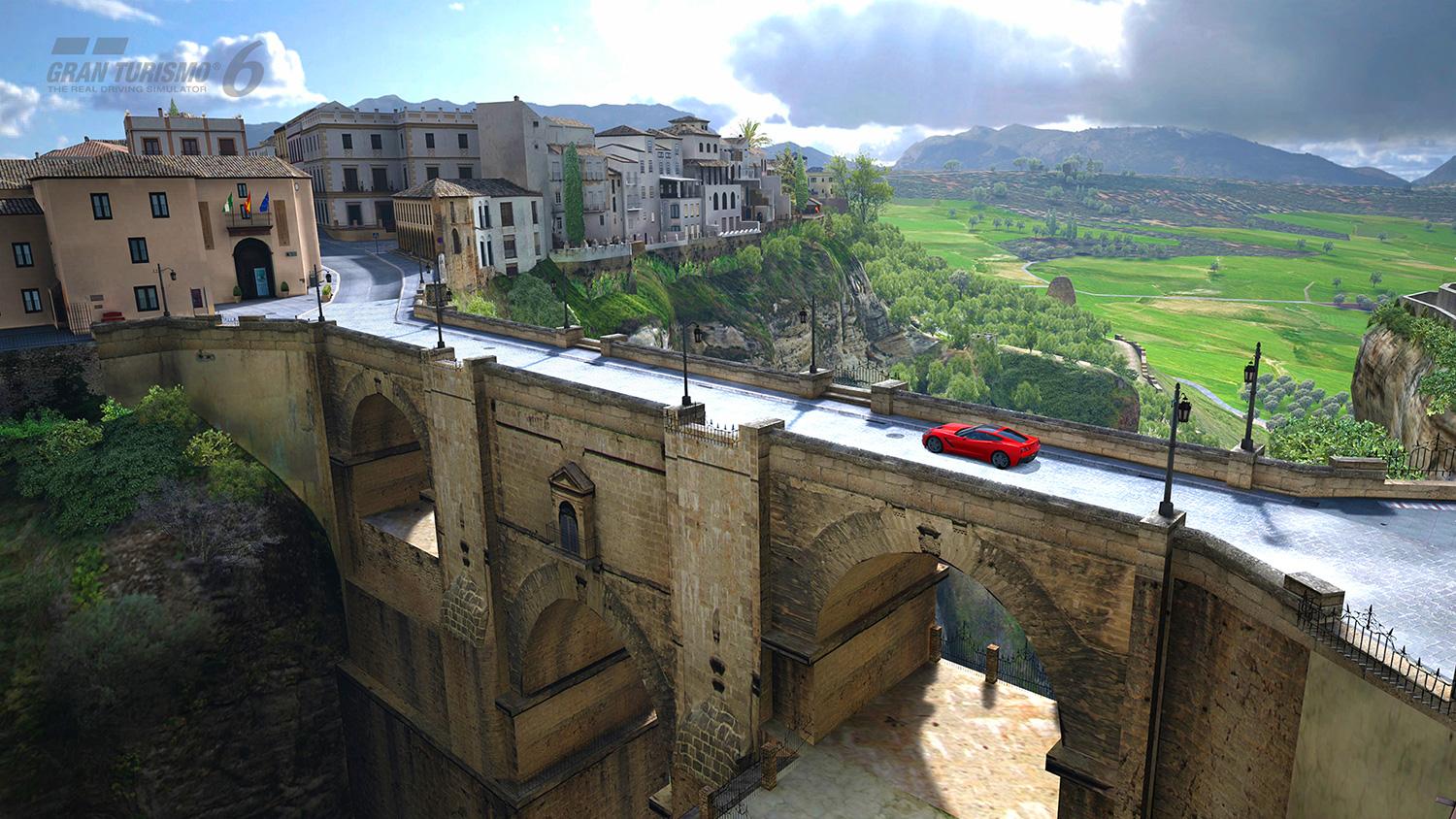
Completely overhauled weather features now offer changing conditions even within the same race. Night races are a highlight as well, with constellations accurately reflecting the location of the track in the real world. If you are racing in Japan and look at the stars, it’s the same night sky a real person looking up in Japan would see. It’s a neat trick, but one few will notice.
Graphics are slightly improved as well, polishing the already lauded car representations of the previous game. Shadows and other details show less pixilation, making the world seem a bit more seamless. Backgrounds are somewhat unremarkable, but if you are looking at them instead of the car and road, you are probably driving straight into a wall anyway. Load times are also noticeably improved.
Where’s the innovation?
All of this comes with a cost, though. Say what you will about the often quirky presentation of GT5, the game was ambitious. Not everything worked, but features like Gran Turismo TV – which highlighted real-life motorsports – were an original touch. GT6 brings very little of that to the table, making it feel like a much more generic game as a result. This is amplified by a generic soundtrack filled with unremarkable – and often annoying – tracks.
To release a game in the shadow of next-gen consoles, it needs to stand on its own.
There is a lot to do, but less than in GT5, at least until you are deep in the game and have unlocked multiple classes. Even then, the game feels stripped down from its predecessor. Going into the arcade mode confirms this. At any time you can try a single race, time trial, or drift trial. You then choose a track from the game based on real locations, an original track the GT team designed, a city course, or a rally track. You then can choose one of your own cars, or from a list of just 20.


There is no way to just jump in a Bugati and try it out; if you want to drive a Veyron, you’ll need 2 million credits. The lack of a true free mode isn’t uncommon in a racing game, but it’s a shame. You can earn that in the course of a game, but the easier way is to buy it with real money. Sony has sworn up and down that these new microtransactions are completely noninvasive, but they feel necessary if you want to try out some of the best cars in the world.
Ultimately, the game feels a little lacking, and less packed full features than GT5 was. It makes up for it with the online play though – or at least it will – the online features were still locked during the review session. (We’ll update the section as necessary.) You can race real players, set up custom lobbies, all the things you would expect. There are also “seasonal events,” which include rotating challenges uploaded by the team. Over the coming months beginning in January, more content is promised (including a course maker), and you can expect plenty of DLC.
Conclusion
GT6 takes what was introduced in GT5 and fine tunes it, but strips it down as well. It’s less ambitious than its predecessor, and has less personality as a result. The changes to the driving physics though, are going to define the series going forward. For racing fans, that is likely all that will matter, and the new cars, tracks, and weather will be enough to keep those fans playing for years.
On the presentation side though, there is nothing we haven’t seen before. Polyphony has proven it can innovate, but this game feels familiar to a fault. Gran Turismo 6’s journey is a good one, but it doesn’t feel like a necessary one.
This game was reviewed on a PlayStation 3 using a copy provided by Sony.
Highs
- Excellent physics
- Dynamic weather
- 1200+ cars
Lows
- Very little new
- Less content
- Less personality