
“Kirby's Return to Dream Land Deluxe is an exceptionally well-handled rerelease, bringing new content that enhances the Wii classic.”
- Base game is as fun as ever
- Fantastic art upgrade
- Smart experiments in new content
- Great minigame implementation
- Lacking challenge and variety
- Magolor Epilogue is light


“Why you can trust Digital Trends – We have a 20-year history of testing, reviewing, and rating products, services and apps to help you make a sound buying decision. Find out more about how we test and score products.“
Kirby’s Return to Dream Land Deluxe is a classic example of “right place, right time.”
In the age of double-dips, video game rereleases can often feel a little random. It’s great that we got a full remake of Dead Space in 2023, but why now? How is the 2008 game enriched in a new modern context? Not every remake or remaster has a real answer to those questions, but Kirby’s latest Nintendo Switch adventure certainly does. On the heels of 2022’s excellent Kirby and the Forgotten Land, the pink puffball found himself riding a new wave of adoration from both old fans and young ones meeting him for the first time. Now was as good a time as any to bring back one of his best 2D adventures — a Nintendo Wii classic that had nearly been lost to time – and Nintendo has gone above and beyond in doing so.
Kirby’s Return to Dream Land Deluxe is even more charming now than it was over a decade ago thanks to an excellent visual makeover that makes classic platforming feel modern again. Though what’s especially impressive here is the package’s brand new features, which double the amount of content and give developer Hal Laboratories space to experiment with ideas that could radically reinvent Kirby’s next mainline adventure.
Reason to return
Kirby’s Return to Dream Land originally launched in 2011 for the Nintendo Wii and has since been hailed as one of the series’ finest moments. For those who never got a chance to play it (a club I was in before the deluxe edition), Return to Dream Land is a traditional 2D Kirby game that isn’t overly complicated by gimmicks. It focuses on the series’ signature platforming gameplay, where Kirby inhales enemies and uses their abilities to solve puzzles. Its added twist is that it includes four-player co-op and a handful of Super Abilities that let the puffball temporarily wreak havoc on Dream Land.
Despite being over a decade old, the base Return to Dream Land campaign is as fun and polished as any mainline Kirby game that’s come after it. It’s not that it does anything fancy — it’s just Hal Laboratories doing what it does best. Levels are colorful and full of personality, acting as delightful 2D playgrounds to explore. Puzzles are easy to grasp, but always satisfying to execute. There’s a fair amount of variety packed in too, from high-stakes sequences that have Kirby running from a wall of darkness to side challenges that’ll take some mastery to clear with a gold rating.
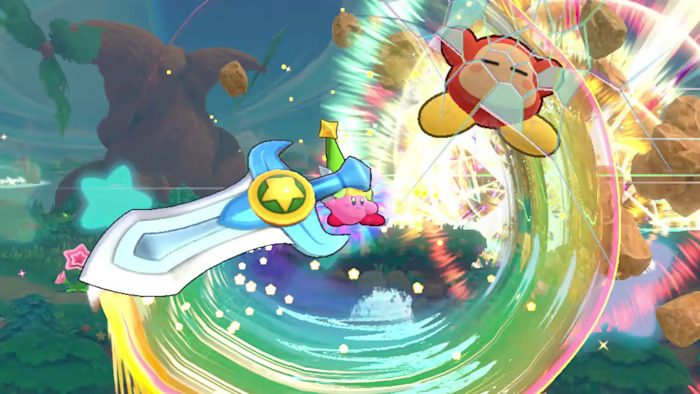
Kirby’s Return to Dream Land Deluxe might be one of the best-looking games on the Nintendo Switch …
Part of its success is due to how it handles Kirby’s copy abilities. The deluxe edition features 25 powers in total — Kirby and the Forgotten Land only had 12 by comparison — including two new ones. Abilities here aren’t just a simple, one-function tool. Each comes with pages of controls and nuances, which makes each transformation exciting to experiment with. Deluxe’s new mecha suit is a shining example of that. The ability has five pages worth of moves that give me way more to play with than I’m used to. I can arc fireballs at enemies, charge up a powerful beam, duck to pepper enemies with fast energy blasts, or float above them and drop explosive proximity mines. That one ability has as much utility as an entire hero’s move set, and it’s only 1/25th of what he can do. It almost feels like I’m controlling a Super Smash Bros. character at times.
Hal Laboratories seemed to recognize how strong the core experience was and didn’t try to get in its own way with a complicated overhaul. What it does do, though, is give it a fantastic visual touch-up that makes it easy to appreciate an old game through fresh eyes. Its new art style is incredibly appealing, utilizing bright colors and thick lines to make the adventure feel like a playable cartoon. It’s yet another Switch game that proves strong art direction can always trump high fidelity when done right. For proof, just compare it to 2018’s Kirby Star Allies, which looks flat by comparison with its less stylistic aesthetic approach. Kirby’s Return to Dream Land Deluxe might be one of the best-looking games on the Nintendo Switch and it didn’t need a “pro” upgrade to pull it off.

While I adored my time with Return to Dream Land Deluxe, it does still have many of the same problems that hold back even the best Kirby games. Its front-loaded with a slew of fun ideas, but runs out of them by world four. The most disappointing aspect in that regard is the Super Ability system. Early on, I had a blast discovering new forms, as I rolled a giant snowball Kirby into bowling pins or used an enormous sword to slash through levels. There are only five in total though, which are repeated multiple times through the end. It feels like a missed opportunity considering the huge number of base forms that could have gotten more creative with a superpowered form.
It’s an especially easy Kirby game too, which isn’t too much of a problem. In fact, that makes it the perfect game for kids who just met the character last year, giving them a full adventure they can realistically tackle on their own. The multiplayer here works better for parents who want to play along too, as it doesn’t feel like extra players are sidekicks as they did in Forgotten Land. I finished the adventure at 100% without really trying, not missing a single collectible along the way. Collectibles are usually the area that Kirby games offer a slight challenge for older players, giving them incentive to go back and find some extras they missed. Secrets aren’t terribly secret here, which meant I was entirely finished with the campaign once the credits rolled.

Fortunately, there is some extra challenge to be found thanks to an unlockable story mode. The “Extra” campaign lightly remixes every level, makes bosses more difficult, and gives Kirby far less health — plus, it’s stingier with healing items. For those who want to get more out of the adventure, it’s an excellent compromise that’s legitimately hard – some of its fights make Elden Ring look like the real kid’s game of the two.
Whether you’ve played the original before or are newer to the series, Return to Dream Land Deluxe feels like the exact right chaser for Kirby and the Forgotten Land. It proves that the series has always been as fun and inventive as its 2022 high point. If the series continues down its 3D path for good following that game’s success, at least Return to Dream Land Deluxe feels like a definitive version of the series’ 2D life span. This is about as good as it gets for Kirby.
More Magolor
Had the remake package stopped there, I would have been satisfied. I would have gotten a perfectly entertaining Kirby game with some glorious visuals to gush over and an extra challenge to chase. What’s impressive about the Deluxe version, though, is that Hal Laboratories wasn’t content with a simple double-dip. Instead, it uses its own return to Dream Land to test out new ideas, creating an additive experience that enhances the original game.
Magolor Epilogue is a little light … but it’s an ideal piece of extra content for a rerelease like this.
That’s especially true of its entirely new story campaign, Magolor Epilogue. The almost DLC-like content is its own distinct platformer unlocked after completing the base game. In it, players take control of the villainous Magolor after being defeated in a battle. The subgame’s premise is that Magolor has lost all of his powers in the process and must gain them back by completing his own adventure. It’s a clever way to extend the game’s story, in the same vein as Nintendo greats like Metroid Zero Mission.
While Magolor Epilogue is a little too brief to reach the heights of Nintendo extras like Bowser’s Fury, it uses its runtime to test out some creative innovations to the 2D platformer genre. The goal of each level is to collect as much energy as possible, which can be used to gradually upgrade Magolor’s abilities. To maximize how much energy is gained in a level, players are encouraged to continually build a combo meter for more rewards. That creates an experience that’s faster and more fluid than any Kirby game, as players try to chain through enemies as fast as possible, mastering their movement and skills in the process. There’s a lot of satisfaction in returning to a level later with more powers and zipping through it in one continuous chain.
That adds a satisfying, fast-paced twist to a game that’s historically a little slow, but the real power comes from its progression hook. When the epilogue starts, Magolor can only jump and fire a short laser blast. That move set keeps building with every level, even evolving after the credits roll if you stick around. By the end, I could drop bombs, raise spikes from the ground, execute a special laser beam attack, and much more. It’s essentially a story about a game’s end boss accumulating their powers one by one, breaking down the design process of a great game enemy.
Magolor Epilogue is a little light and culminates in a left-field difficulty spike, but it’s an ideal piece of extra content for a rerelease like this. It gives players new insight into Return to Dream Land’s big bad and almost acts as a playable behind-the-scenes featurette. It would have been easy to just give the base game a paint job and drop it on the eShop, but extra touches like this make it more than a simple nostalgia trip for Wii owners.
Getting minigames right
That same philosophy applies to the rerelease’s most pleasant surprise: Merry Magoland. In the original release, players could play a small handful of minigames and challenges, which has become customary for the series. Rather than simply reproducing those and calling it a day, Hal Laboratories goes all out by creating an entirely new hub world that’s home to 10 minigames, a ranked online competition, a massive collectible system, and a progression hook that ties back into the base adventure.
Merry Magoland feels like Hal Laboratories auditioning to make the next Mario Party game.
The mode’s theme park presentation is a bit ingenious. Previous Kirby games have always included minigames, but had a hard time giving players much reason to engage with them. Here, I found that I was way more eager to jump into games because of how well integrated they are into the rest of the package. Playing games would allow me to collect over 80 masks that I could wear in any mode to look like my favorite Kirby character. Those masks are unlocked by collecting stamps and filling a card with enough of them. I can get stamps by playing minigames, but they’ve also been added to the campaign as hidden collectibles. Every time I’d complete a few levels, I’d fly over to Magoland to cash them in, play a few games, and equip a new mask.
None of that would work as well as it does if the minigames weren’t fun, but Merry Magoland feels like Hal Laboratories auditioning to make the next Mario Party game. There isn’t a dud among the batch, which is largely composed of classic minigames from the series’ past and a few new ones. Checkerboard Chase has me trying to knock enemies off a platform by removing panels under their feet, while Crackity Hack is a short and sweet competitive button-timing game about cracking as much Earth as possible. What’s even smarter, though, is that each game comes with its own set of missions to complete, which gives me tangible goals to chase within each. I became obsessed with completing all 100 missions, playing minigames for hours more than I usually would in a Kirby game.

Though I love Merry Magoland as a solo experience, I do feel like it leaves much more space for Hal Laboratories to explore its multiplayer potential in the future. Up to four players can hop in together and compete against each other, but it isn’t exactly set up for success as a party game. Aside from playing individual games, there’s only one mode (Magoland Tour) that shuffles four games together in sequence. That surprisingly makes the mode work a little better as a solo experience, but I’m at least left excited about the potential of a full-on Kirby party game down the line.
“Potential” is the word I keep coming back to when playing through Kirby’s Return to Dream Land Deluxe. I’m smitten with every piece of the package on its own merits, but I’m also left excited about what it could signal for the future of the series. There’s a lot of room for Hal Laboratories to take the combo-based platforming of Magolor Epilogue or the progression systems of Merry Magoland and use them to innovate its next original Kirby game, whether it’s 2D or not. This may be a blast from the past, but it’s even more exciting when viewed as a peek at what’s to come.
Kirby’s Return to Dream Land Deluxe was tested on a Nintendo Switch OLED in handheld mode and on a TCL 6-Series R635 when docked.