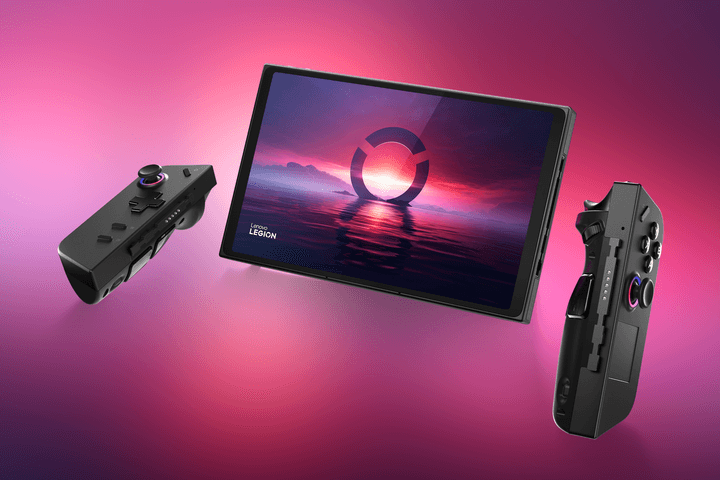
The race is on. After Valve released its popular Steam Deck last year, hardware manufacturers have rushed to put out their own portable PCs. We already have a viable rival in the Asus ROG Ally from this year, and there are plenty of offbeat options like the Ayaneo 2S out there, but now Lenovo is joining the scene with the Legion Go.
At first glance, the Legion Go might just look like your standard portable PC. It’s a hefty Windows handheld packed with some impressive specs. Look closer, though, and you’ll find that Lenovo is bringing some genuine innovation to the table. With detachable controllers, a kickstand, an innovative “mouse mode,” and more, the Legion Go sets itself apart from its competitors in plenty of ways. But is it worth plopping down $700 this October for yet another portable gaming device?
That’s shaping up to be a surprisingly complicated answer. In a hands-on session ahead of the device’s reveal, I got to test out the Legion Go’s wealth of unique features. Some of its ideas already feel groundbreaking for a machine like this, creating a device that better bridges the gap between handheld and PC. On the other hand, its enormous size and complicated features might make it a harder sell for casual gamers just looking to take their PC games on the go.
A capable device
On paper, there’s no doubt that the Legion Go is ready for battle. Equipped with an AMD Ryzen z1 Extreme processor, it has the same power potential as the Asus ROG Ally. The powerhouse system comes with 16 GB of RAM, 512 GB of storage, and a 49.2 Wh battery, all of which justify its competitive price tag. With all that power packed into a fairly massive, vent-filled form factor, I expected to see some impressive results when I actually jumped into a game. That wasn’t exactly the case.
When hopping into Hi-Fi Rush, I was immediately surprised to see it running at an unusually choppy frame rate. I initially chalked that up to unoptimized graphics settings (the internal tools that’ll come with the device weren’t ready to test quite yet), but the real culprit may actually be its most impressive feature: the 1600p display.
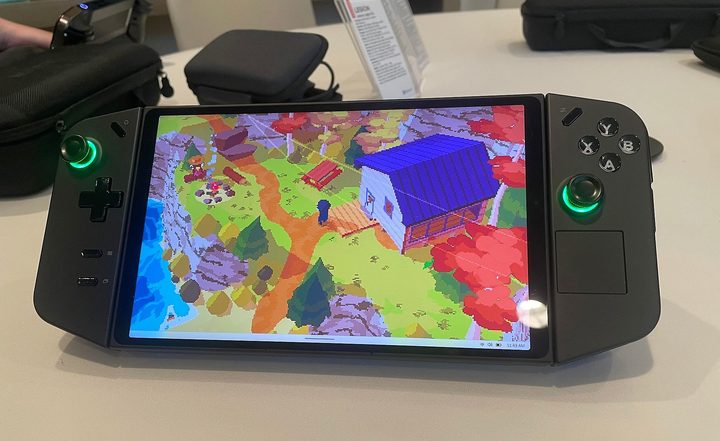
Yes, you read that right. The Legion Go sports perhaps the most impressive display available on a handheld gaming device in the form of its 144Hz 8.8” QHD+ screen. It’s that 1600p figure that really stands out though — but perhaps not for the reasons Lenovo is expecting. While it’s a great selling point on paper, it’s also a bit impractical. That figure is even too demanding for most low-end gaming laptops, let alone a handheld device with a significantly smaller screen. It’s especially high for the Z1 Extreme, which may explain why Hi-Fi Rush’s performance underwhelmed. There’s clearly a lot of experimentation to be done to see how well the Legion Go can be optimized to favor performance over a perhaps unnecessarily clear display.
Though that might be overkill, Lenovo’s other ambitions seem like they’ll pay off more. Particularly, the inclusion of two USB-C 4 ports could go a long way. Toss in Bluetooth support, a microSD slot, a built-in camera, two 2-watt speakers, and you’ve got a fairly loaded system on your hands. It’s also a Windows device with a responsive touchscreen, which makes navigating in desktop view a fairly natural experience.

Of course, all of this comes with one heavy catch: The Legion Go weighs a whopping 1.8 pounds. While Lenovo says it’s still trying to shave some weight off that staggering number (a mere two months out from launch), don’t expect too much to change there. At that weight, the Legion Go is significantly heavier than a Steam Deck — and I could tell. It’s hard to imagine holding it for a long period of time without feeling some strain. That aspect alone might give it some trouble in a battle against the much more portable and equally powerful ROG Ally.
Innovative controls
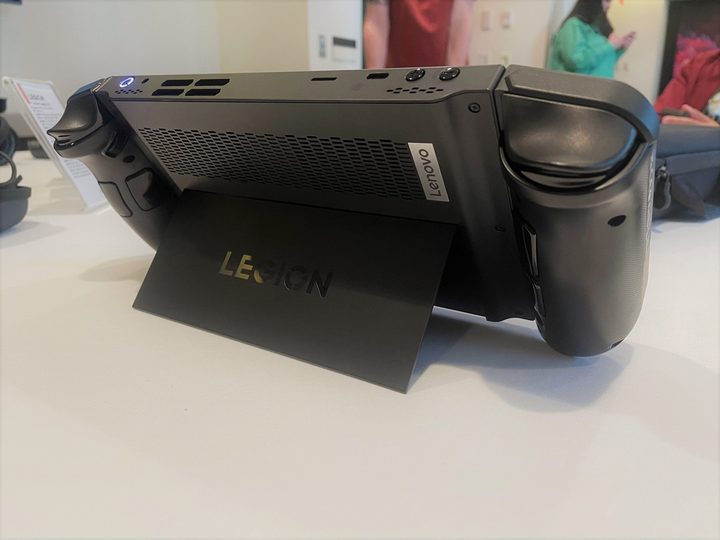
I get the sense that Lenovo not only knows the weight factor is a pain point, but designed around it too. That’s evident in its innovative approach to controls which takes more inspiration from the Nintendo Switch than the Steam Deck. The Legion Go features fully detachable controllers that easily undock from the screen. It even features a built-in kickstand similar to the Switch OLED’s, which supports the idea that Lenovo is targeting a tabletop use case more than a handheld one.
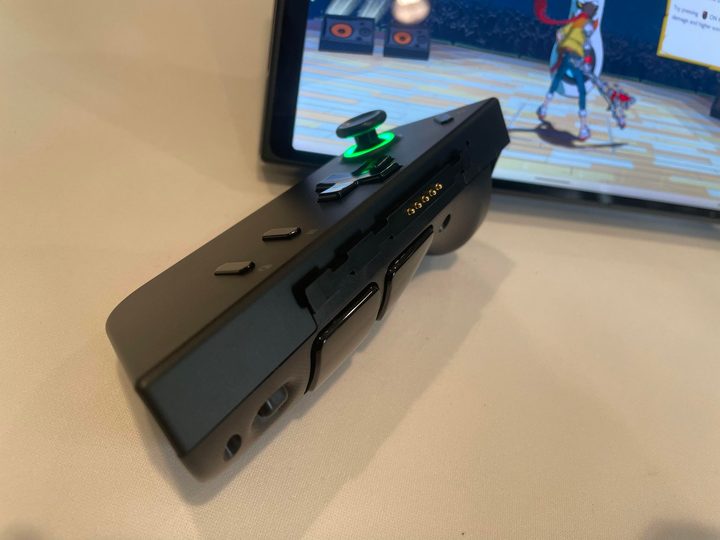
While the controllers feature a standard ABXY layout, they’re the most untraditional controllers we’ve seen on a device like this yet. A trackpad on the right controller gives it an edge over the ROG Ally, while its six assignable grip buttons leave tons of room for control customization. The only problem there once again comes down to comfort. When detached, the controllers feel chunky and overly angular in the hands. It feels like I’m holding two thick triangles, which is a weird feeling after so many years of handling Nintendo’s lightweight Joy-Cons. I imagine it’s something I’d get used to over time, but I do have some questions about how they’ll feel in longer play sessions.
That’s not the Legion Go’s most surprising innovation, though. The device also features a somewhat ingenious setup that turns the right controller into a mouse. The Legion Go comes bundled with a little plastic ring that can be placed down on a table (the final version will be magnetized, but the one I tested was not). By flipping an “FPS” switch on and placing the right controller in the ring, it can essentially be controlled like a flight stick. The right bumper and an extra one down the side of the controller act as a left and right mouse click, while a secret wheel near them gives players the ability to scroll.

As far as gimmicks go, it’s the same kind of toy-like charm that made me fall in love with the Nintendo Switch the first time I tried it. I could use the mode to play Powerwash Simulator with pinpoint accuracy, holding the left controller in my other hand to switch nozzles. It seems like an ideal option for people who play genres specifically built for PC, like CRPGs and strategy games. That could help the Legion Go become the preferred option for something like Baldur’s Gate 3, making it the PC player’s handheld.
Of course, a first-of-its-kind control scheme like this is bound to have some hurdles. When FPS mode was turned on, the games I demoed immediately assumed I was playing with a mouse and keyboard. That meant that any in-game controls shown to me were useless, leaving me to fiddle with buttons until I figured out what did what. I imagine that would create a lot of confusion in PC-focused games that rely on dozens of keyboard commands rather than controller shortcuts.
Even with that caveat, FPS mode offers something no other gaming handheld does — and that’s key for Lenovo. We’re currently in a sort of Wild West era of portable PCs where hardware manufacturers need to work hard to convince players their device is preferable to one they bought months ago. Lenovo’s sales pitch, as far as I can tell, is that the Legion Go acts as a much stronger bridge between a handheld and a laptop, delivering both experiences with a more flexibly designed device.
It’s a great idea — one that carries a techie wow factor — but what remains to be seen is how practical it all is. Is the Legion Go’s massive size worth the strain? Does an overly ambitious screen hurt more than it helps? Is the optimal use case here too niche for a general audience? Those are questions I’ll only be able to answer upon spending more time with the final Legion Go. That said, Lenovo is entering the market with a genuinely fresh idea rather than a copycat device whose only pro is a negligible power bump. Even if the Legion Go isn’t the best version of what it could be, the stage is set for it to shake up the market in a way that could put it at the top.
The Legion Go is scheduled to launch this October and retail for $700. Lenovo says it’s working on a cheaper, less powerful model of it too, though that doesn’t have a release window yet.