Logitech’s gaming peripherals have shown up noticeably late to the flashy LED and positional sound headset party, but at least they have arrived. With the entry-level G432 headset and the more premium G935, I would say that they have brought some real competition to the table, even if it’s not drastically different from everything else.
The newly announced G432 and G935 headsets are sleek, but they are also familiar. Resembling the G430 and G933 headsets that came before them, there are a few changes that help them stand out. The most notable change is in the leatherette ear cups which undoubtedly make the headsets look more striking. But as we know, when it comes to headsets, looks aren’t everything.
Style over comfort?
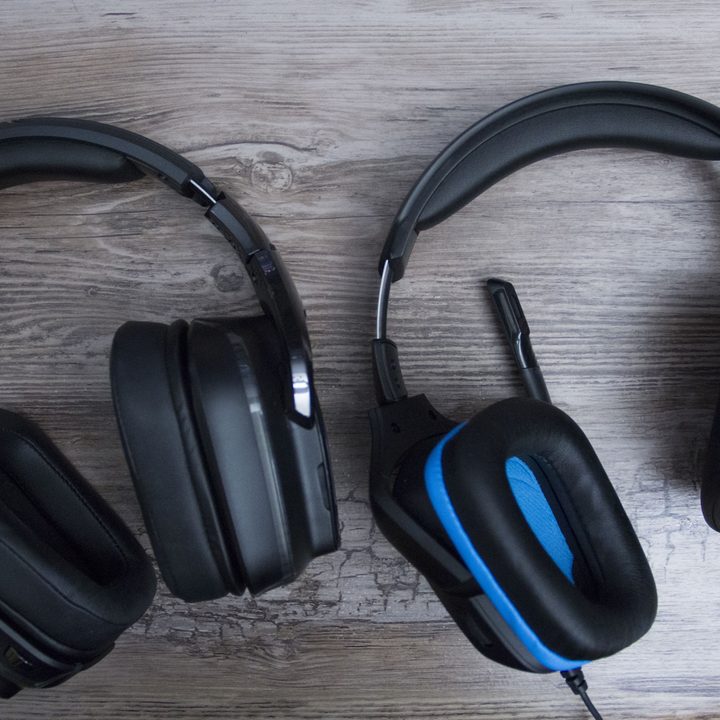
The leatherette isn’t as breathable as the fabric mesh ear pads featured on the previous headsets. While I didn’t experience any problems with sweaty ears, I did find that the leatherette on the G432 made the headset feel claustrophobic. As a longtime user of the G430, this was noticeable the moment I put them on. Unlike the mesh, the leatherette has some resistance to it and it doesn’t go well with the already tight diameter of the ear cups.
As for the G935, the headset didn’t feel nearly as restrictive and the ear cups felt comfortable even six hours into a gaming session. They’re extremely comfortable — and this is coming from someone who has a hard time keeping headsets on for extended periods of time.
Unlike its lightweight predecessors, these headsets feel sturdy and have some weight to them. This isn’t a bad thing, though. I would argue that the G430 was so lightweight that it almost felt flimsy. Seriously — every time I went to put them on, I’d check to see if they were broken. The G432 and G935 feel like quality, and personally, I really like the idea of not having to think about purchasing another headset for a long time.


Just like the previous designs, the ear cuffs swivel so that when you don’t have them on, they rest nicely around your neck. The G935 is wireless with about 12 hours of life after a full charge, and a range of 15 meters. It comes with a braided charging cable and an analog cable that you can connect to your PC, Xbox One, PS4, or Nintendo Switch.
It also features an on/off switch, volume adjuster, and a set of programmable G-keys along the side of the headset — a design choice they should’ve nixed in this generation. I found myself constantly confusing the G-keys as there’s nothing from a tactile standpoint that distinguishes one from another. If I were to adjust my headset, I’d accidentally press one of the three G-keys and change a setting, only to spend a few more moments trying to figure out how to switch it back. There are comparable headsets that do this much better (see the Turtle Beach Stealth series) utilizing only one preset button that takes up minimal real estate and can easily be found after only a few uses.
The G432 is a wired headset, ditching the braided cable of the G430 for a thin rubber one. It’s compatible with PC, PS4, Xbox One, and the Switch, just like the G935. My one complaint is that the on-cable controls have been removed in lieu of onboard volume control. While another popular design choice, this is something I’ll likely never use. The idea of taking my hand off the keyboard to reach up near my head and feel around for my volume control feels dated and counter-intuitive. I’ll keep my on-cable controls because at the very least, I can keep those closer to my hands.
Roger that
Despite arguable design flaws, the upgraded mics and audio on these headsets is incredible. Both have a flexible six-millimeter mic that turns off and on when flipped up and down. The G935’s mic extends further if you pull it down and can be tucked discretely back up into the body of the headset. Mic quality is incredibly clear. Pals in Discord never had a problem hearing me. In fact, they could hear me so well that they’d joke that I was making attempts at ASMR.
Instead of the 40 mm drivers of the older headsets, the G935 and G432 both have 50 mm drivers, offering up a fuller sound pallet. Both feature DTS: Headphone X 2.0 surround sound, a fancy term for tech that offers positional audio. I played Battlefield 5, trying out both headphones to see how they sized up, and I could distinctly hear the direction from which the bassy grumbling of tanks and planes were coming. I was able to detect the exact location of explosives and gunshots. It definitely added to the quality and enjoyment of my gaming experience, and honestly, sounded great while listening to music or watching YouTube videos as well.


Both headsets can be personalized using Logitech’s G Hub, a community-driven software interface that allows players to customize and share their gaming profiles. These customizations include sound profiles, RGB lighting using Lightsync, and G-Key programming. The G935 has a strip of RGB lighting along the sides of the ear cups that can be customized with different colors, patterns, and effects using G-Hub. If you have other Logitech gear with RGB lighting, they can all be synced up to match, and it’s actually pretty cool.
On the whole, these headsets are solid but unsurprising. The sound quality is the highlight, and that’s a very good thing. The efforts to make the G935 and G432 more attractive have paid off as well, but possibly at the cost of comfort and ease of use. The G935 comes in at the price of $169.99, which is a bit high compared to similar headsets in the same price range with similar offerings such as the Corsair Void Pro, HyperX Cloud Flight, and Turtle Beach Ear Force Stealth. As for the G432, its price of $79.99 seems fair, if only for the superb sound, sharp appearance, and cross-platform support.