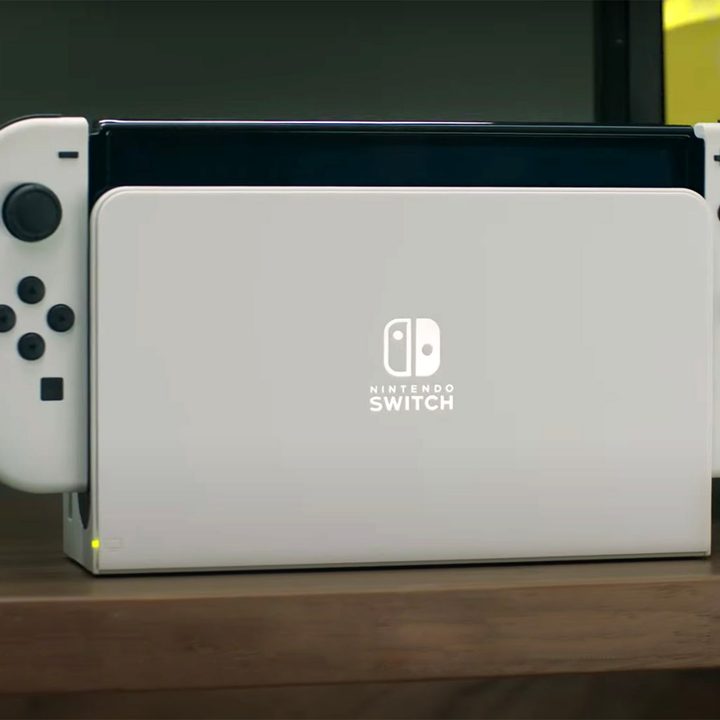
This week, Nintendo announced a new model of its Switch console. The updated console features an OLED screen, a new dock with a hardwired Ethernet port, and a sleek white finish. However, the Joy-cons and CPU haven’t been improved, contrary to early reporting about the supposed Switch “Pro,” leaving fans wondering who and what this new system is for.
One questionable addition to the console is the hardwired Ethernet port on the new dock. The Nintendo Switch and its widely available Ethernet adapter add-on were released four years ago on March 3, 2017. The games that pushed players to purchase this peripheral such as Splatoon 2, Mario Kart 8 Deluxe, and Super Smash Bros. Ultimate have also been available for quite some time now. It’s likely that serious competitive players have already spring for that adapter at this point in the Switch’s life cycle.
A hardwired LAN option is a nice extra for new players, but it doesn’t address technology hurdles like poor netcode that have hindered the Switch online experience since 2017. The fact of the matter is that no hardwired Ethernet will fix the console’s online issue.
How Nintendo’s online works
Netcode is the framework of the network of online video games. There is a multitude of different kinds of netcode with Nintendo currently being known to use two.
The first is “pia,” a network based on a “peer-to-peer” build. As explained by Oatmealdome, this means each Nintendo Switch console directly interacts with one another to provide networking. This type of netcode is used in Splatoon 2, Mario Kart 8 Deluxe, Arms, and the Nintendo Entertainment System Online titles.

The second is the archaic, delay-based netcode — a very infamous network build among fighting game players. This netcode delays player inputs to match networking conditions. This makes it hard to consistently react and generally input commands thanks to fluctuating online environments. This code is most notably used in Super Smash Bros. Ultimate.
Since the release of the Switch, many pro and casual players immediately pushed for everyone to adopt an Ethernet cable and adapter in order to shoot for the best online experiences possible. Thanks to Nintendo’s decades-old networking choices, getting a consistent online experience is extremely difficult. In fact, the poor quality of the netcode for a game like Super Smash Bros. Ultimate makes it play much differently than how it’s played offline locally.
Rolling back
Those in the know realize that there are better choices for online structure. The most popular right now that fighting game players have been constantly asking for is called “rollback” netcode. The Fighting Game Glossary offers an in-depth explanation of how that system works.
“An approach to implementing netcode in a fighting game that plays your own inputs immediately, and then rewinds and resimulates (or ‘rolls back’) the game if network delay causes inconsistencies, “the site explains. “Rollback is the best known netcode solution for fighting games; since all your local inputs come out without delay, the game feels like offline play, and clever design choices can often hide any network trouble as well, leaving you with a close to flawless online experience even across long distances.”
An amazing example of this networking in action can be seen in the new Arc System Works fighting game, Guilty Gear Strive. Its usage of rollback netcode allows online matches to be played like never before. The smooth connections between players, even those separated by oceans, allow for serious matches, which makes real tournaments possible from the comfort of one’s home.

Fans of the Smash series, Ultimate, in particular, have had to watch on as other fighters have implemented this online structure over the years. The list of games includes a fan client, which updates Super Smash Bros. Melee with rollback and true matchmaking, making its scene more lively and accessible than ever.
With Nintendo apparently looking into a new multiplayer server system titled, “NPLN” and adding a hardwired Ethernet port to the Switch OLED, we’re all left wondering if there will be some true updates to smooth out its networking coming soon. However, Super Smash Bros. community members are pessimistic that they will see meaningful changes. Smash community leader and commentator Terrence “TKBreezy” Kershaw notes that the community’s pleas have continually gone on deaf ears.
“At this point, it’s too hard to figure out what Nintendo is thinking,” Kershaw tells Digital Trends. “They’ve been hearing the same complaints for years about internet and stuff and they’ve done nothing.”
While Kershaw plans on picking up a Switch OLED model, he doesn’t believe the new wired port will have a real impact on the issues that have plagued the Smash fanbase for years. “I plan on buying one, but I don’t think this fixes Nintendo netcode issues by any means. That’s a server-side issue they’d have to overhaul in my opinion,” Kershaw says.
While Nintendo seems to be making better networking conditions somewhat more accessible through the new Ethernet port addition, it just feels too little too late for the Nintendo Switch. It wouldn’t truly improve anyone’s online experiences. Nintendo is treating a symptom instead of tackling the root cause.
All we can hope is that the company will finally look into true netcode upgrades to make its Switch online subscription worthwhile. As for the potential NPLN plan, we’ll have to wait and see if that’s a real solution to its decade-old issue.