
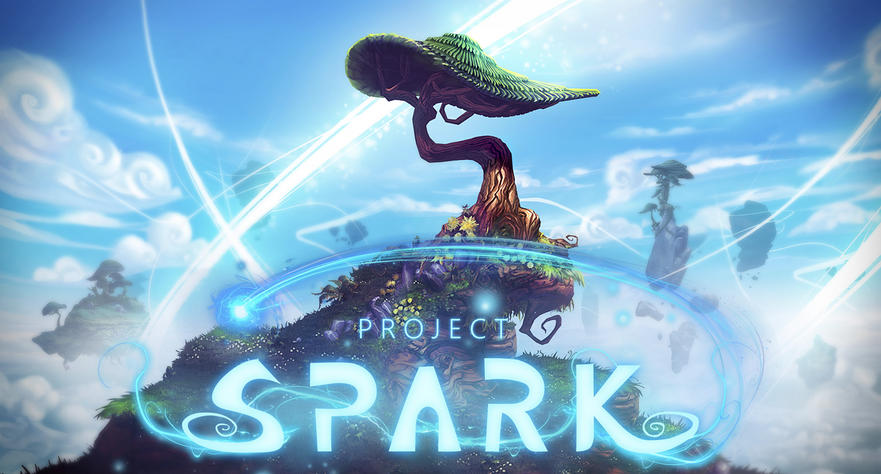
Project Spark isn’t the sort of game that drips with sexy spectacle. It’s capable of going big and loud, as we saw during Microsoft’s E3 2013 press conference, but it feels at first glance – and second glance, as you’ll soon see – like a game that gives back as much as you put into it. That’s the blessing and the curse of games built around user-generated content. Minecraft isn’t the flashiest game in the world, but the potential that unfurls before you once you dig in and learn its systems is euphoric, to say the least. Project Spark boasts the same sort of appeal, and it is, in hindsight, one of the most potentially exciting offerings of the coming year.
Story/Concept

Standing at the Crossroads. There is no story in Project Spark outside of the ones that you and others create. The game’s Crossroads mode is at the heart of this; it’s where you build a world, then populate it with objects and beings. The creation tools are meant to favor flexibility over all other things. If you want to painstakingly place each and every object, that’s an option. The game is also smart enough to provide general layouts, beings, and even mission objectives based on menu selections that you make. The closest analogs are Minecraft and LittleBigPlanet, though Spark is best described as a combination of the two, combining the flexibility and 3D landscapes of the former with the visual splendor and whimsical charms of the latter.
Gameplay
Your world, your way. Our behind closed doors demo at E3 offered a very top-level look at the content creation features offered by a mixture of gamepad and SmartGlass controls. Kinect is also an option, as we saw at the press conference, but it didn’t factor into this particular demo. You can have the game randomize a base environment that you can then “paint” with whatever terrain features or biomes you’d like or, alternatively, you can simply start with a flat, empty space that you then carve and grow terrain onto.
In practical terms, terrain creation involves the use of a “brush” that you can customize the diameter of. There’s an “expand brush” that is used to grow mountains and hills and an “erode brush” that cuts into the ground. Then there are a variety of terrain types – temperate woodlands, arctic glaciers, desert dunes, etc. – that you literally “paint” into the world however you like. The Xbox One gamepad handles all of these tasks in a seemingly intuitive manner, but SmartGlass support looks like the most effective way to go for intuitive world-building. It’s difficult to say without going hands-on how complex it feels, but our eyes-on session certainly gave the impression that it comes down to menu selections and point-and-click interactions.

Filling it all out. Once you’ve got a chunk of land polished off, you’ll generally want to populate it with a variety of objects. Project Spark comes with a vast inventory of items to fill your worlds with, all of which come with pre-built behaviors that can be tweaked however you like. A simple rock, for example, will pretty much just sit there and be the best damn rock it can be. A goblin, on the other hand, has an aggressive attitude by default; if you pop into your map to test out your creation, the little fella will try to end you.
By popping into the game’s “Brain Gallery,” you can change the presets for any object as you see fit by applying one or more logic behaviors to it from a database of options provided by the developer and created by the community (yourself included). Want to have a friendlier goblin that won’t try to kill you and eat your face? Make him a party goblin. Don’t like the way he’s looking at you? Make him an exploding goblin instead. This can also be used to imbue otherwise inanimate objects with life, as we all saw during the press conference with the increasingly capable pet rock. Like the terrain crafting, it’s hard to really say how deep you can go with only an eyes-on look. Flexibility appears to be the principal focus though.
Presentation

Just right. Project Spark isn’t kitted out with eyeball-searing photorealism, but it has a particular style that works very well. The graphics have a computer-generated cartoon-y appeal, like an old-school adventure/platformer from Rare or a Pixar production. You can create your own interpretation of visual splendor, but the strength of the presentation lies more in the way this seemingly vastly complicated creation engine is rendered in simple terms than anyone can intuitively grasp. You’ve got a massive palette to work with even in just the stock blank slate that you’re given when Crossroads is fired up. The maximum limits of a world as of now form a 4km-by-4km square on the Xbox One, a range that Microsoft expects that most players won’t be bound by until they’ve made a truly significant time investment. That said, hands-on time will be required before we can really get a sense.
Takeaway
The sky-high ambitions for Project Spark – a free-to-play launch window release for Xbox One – are apparent the moment you sit down and watch someone start crafting a space to play in. Really, the best demo for this game came at Microsoft’s press conference. The evolution over the course of a few minutes from simple “look at my pet rock” scenario to a “few-versus-many” showdown between a horde of goblins and a rock-powered giant mech gives a good sense of what’s going on here, and the accompanying sizzle reel demonstrated the wide assortment of options and even play styles that you can choose from when you create. Microsoft’s behind closed doors booth session offered a closer look at the controls, and we’re pleased to report that they seem intuitive enough.
There are still many questions. We’re not fully clear on how user-created content curation will work, beyond the fact that both the developer and members of the community will participate as moderators. Adult players can look forward to sharing and trying out content in less of a “safe,” family-friendly space. Windows 8 and Xbox 360 versions are planned as well, and there’s more still to be revealed about how those will work. All that said, E3 2013 offered a promising first look at the insane creativity-driven scope and ambition of Project Spark.


