
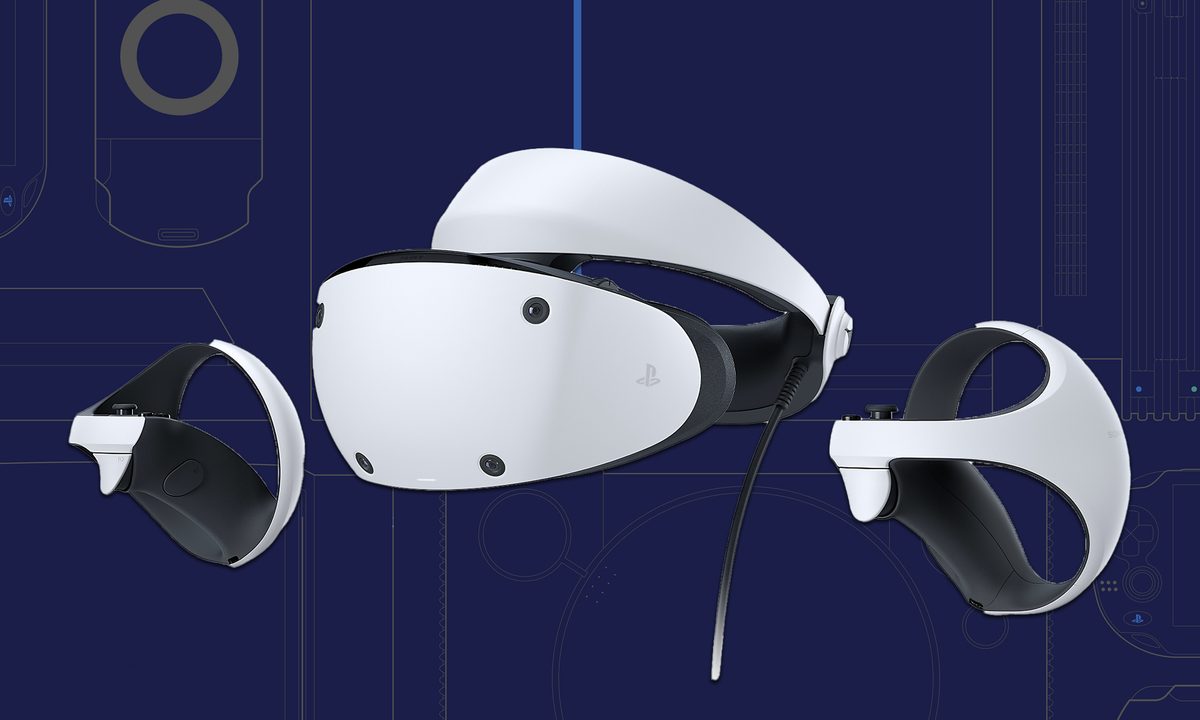
The VR landscape has evolved drastically since the technology first became available to consumers. Most major VR units have evolved to their second iteration, such as the PlayStation VR 2 and the Meta Quest 2. Just like comparing any two pieces of tech, the newest or most expensive one isn’t necessarily the best. Gamers, in particular, will want to know all the ins and outs of both units before investing in a new headset. To help you decide which headset is right for you, we’ve pitted the PSVR 2 and Meta Quest 2 against each other to see how they stack up in key categories.
Specs

Looking at the scpecifications is the most objective way to judge these two headsets. Here’s what they offer:
PSVR 2
The PSVR 2 will give you a 2000 x 2040-pixel display per eye on an OLED screen with HDR capabilities. It has a maximum refresh rate of 120Hz, a 110-degree field of view, and even eye-tracking technology. In terms of power, the PSVR 2 is running off your PlayStation 5, so it will be capped at what the console can push out.
The tracking technology in the PSVR 2 is inside-out tracking utilizing the four built-in cameras. In addition to being a very accurate way to synchronize your movements in real life with the game, it also allows for an easy passthrough mode so you can temporarily see “through” the headset to your surroundings without needing to remove the headset. This tracking also applies to the Sense controllers, which come with all the haptic feedback and adaptive trigger technology of the DualSense controller, plus touch detection for more options in terms of hand gestures.
Meta Quest 2
The Meta Quest 2 has a slightly lower visual resolution at 1832 x 1920 per eye, however the biggest differences will be in the LCD screen and lack of HDR. All this combined can result in a worse-looking image than just the resolution would imply. The refresh rate can range from as low as 72Hz up to 120Hz, but is highly dependent on the games or app being run. Another major drawback is the Meta Quest 2’s highest field of view being 96 degrees. A lower field of view, even on normal displays, can cause motion sickness, which is naturally exacerbated when in VR.
Meta Quest 2 matches the PSVR 2 in terms of inside-out tracking with four cameras that allow for a passthrough view, however, it lacks any internal eye tracking. On the other hand, it does feature hand tracking. In terms of controllers, they feature everything the Sense controllers do, but lack all the haptic and adaptive technology.
One additional spec only the Meta Quest 2 has to consider is battery life, which typically ends up at around three hours.
Games

PSVR 2 has launched with dozens of games, most of which are also available on other VR devices. The notable exceptions are games like the exclusive Horizon Call of the Mountain, and the VR mode for Resident Evil Village. The downside is twofold. First, if you own a PC VR headset, most of the games currently available for PSVR 2 are ones you will already have, or had the option to play. Second is that PSVR 2 is not backward compatible with original PSVR games, though some have already gotten PSVR 2 versions.
The Meta Quest 2, unless you’re a console-only gamer, has to take the win in this category if only for the sheer amount of options you have. Being a PC unit, the Meta Quest 2 can run any compatible Steam game, of which there is an almost limitless amount. While PSVR 2 will likely have a smaller, more curated library with better production values, Meta Quest 2’s variety and lower prices on games make it a safer bet for most gamers.
Design

Your PSVR 2 will look very sleek and futuristic. It is a single-strap headset that is very adjustable for comfort. You can move the front screen in or out, which is especially useful if you have glasses, plus it has a cooling system to prevent moisture buildup inside the unit during longer sessions. It is very comfortable and lightweight, however there is one string attached, or should we say cable. PSVR 2 isn’t completely wireless, with one mandatory USB-C cord running from the headset to you PS5. While leagues better than the PSVR’s setup, it is still a possible hindrance.
The Meta Quest 2’s main selling point is the fact that it can be used as a standalone unit completely wireless. This full freedom of movement can’t be understated, as you can essentially play VR anywhere you want (assuming there’s a decent amount of space). The actual design of the headset has two straps, one wrapping around horizontally and another across the top of your head. It uses Velcro straps, which can be slightly annoying to situate properly and tend to slip.
Both VR units’ controllers look almost identical visually. Aside from the specs, there’s really not much difference aside from color.
Price

PSVR 2 is far newer than the Meta Quest 2, and the price reflects that. The base unit, which comes with the controllers, will cost you $550 minimum, or $600 to get a bundle with Horizon Call of the Mountain. If you don’t have a PS5 yet, then you’d also need to add that price into the equation.
The Meta Quest 2 currently comes in two options: the 128GB for $350 or the 256GB for $430. Both are cheaper than the PSVR 2, and don’t require a PC to play any games. Of course, if you do have a PC ,you can connect to it to utilize its power as well.
One final pricing factor to weigh is games. While PSVR 2 does have some games you can get through cross-buy, if you already own a large library of Steam games that are VR compatible, then you won’t have to invest anything more to start playing.


