  1. Home
  2. Gaming
  3. News

Steam Deck is much more powerful than we thought, per spec correction

Add as a preferred source on Google

Valve has clarified the technical specifications for the Steam Deck on its website. The site now properly displays that the Steam Deck has a quad-channel 32-bit LPDDR5 memory with a bandwidth of 88 GB/s.

Originally the site claimed that the handheld console had a dual-channel LPDDR5 memory with only about 44Gbps of data transfer. This correction properly reflects the true power of the Steam Deck and practically doubles its power compared to the initial announcement.
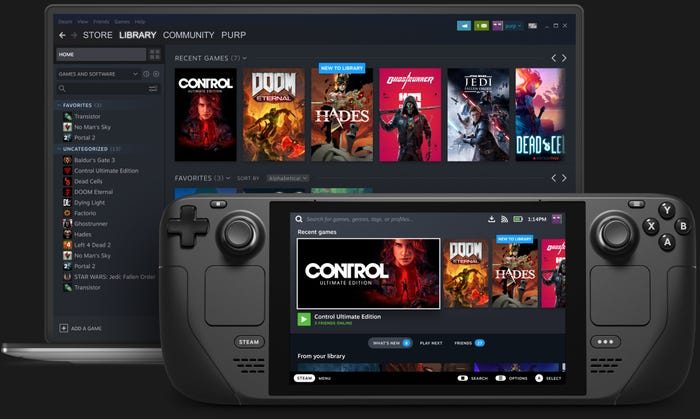
Steam Deck
Image used with permission by copyright holder

When the Steam Deck was first announced, many people dived right into the technical specifications for the product. The original specs raised some concerns, as players expected the console to be more powerful. Initially, the Steam Deck would be more powerful than the Nintendo Switch’s 25.6Gbps data flow, but would still be outpaced by even some laptops. Most laptops hover around the 68Gbps of data transfer, which would mean that the Steam Deck would be less powerful than hardware that is not even fully dedicated to gaming.

Recommended Videos

With this correction, Valve’s upcoming handheld is more in line with what we would expect from a PC gaming-focused company. The newly clarified technical specs show that the Steam Deck will be able to handle game performance better than initially expected.

While the console still will not be as powerful as many dedicated gaming PCs, the Steam Deck is still an impressive piece of hardware. People who were concerned about potential bottlenecking with this console can rest easy now as we now properly understand what to expect for the performance and hardware for the Steam Deck handheld.

Andrew Zucosky
Former Digital Trends Contributor
Andrew has been playing video games since he was a small boy, and he finally got good at them like a week ago. He has been in…
Steam Machine confirmed to land this summer, but we’re still in the dark about its price
Steam Machine is getting closer to launch, with broader game verification arriving before Valve reveals what it’ll cost.
Steam Machine with Steam Controller

Valve has confirmed that Steam Machine is shipping this summer, giving PC gamers a real launch window for its SteamOS living room PC. The missing piece is still price, and that’s the detail many buyers need before they can decide whether it fits their setup.

The update came as Valve expanded its Verified program to cover Steam Machine and Steam Frame. For Steam Machine, games will be checked for default controller support, default graphics settings, and how well they run without manual setup. Valve says the hardware is roughly six times as powerful as Steam Deck, while still using SteamOS, the Steam interface, and Proton.

Read more
Corsair fitted the Elgato Stream Deck’s soul into a hotkey on its Nightsword v2 mouse
Stream Deck macros, Discord controls, and app shortcuts move to the mouse
Corsair NIGHTSWORD v2 Wireless Stream Deck gaming mouse side view

Corsair has launched the Nightsword v2 Wireless SD Stream Deck gaming mouse, a right-handed wireless mouse with a dedicated Stream Deck launch button, at Computex 2026.

The Stream Deck support is an in-house integration rather than a third-party collaboration, since Corsair owns Elgato. It brings Elgato’s shortcut system directly to the mouse, letting gamers, streamers, and creators trigger app, gaming, and workflow controls without reaching for a separate desktop panel.

Read more
Nvidia confirms more RTX Spark processors are coming with N2X and N3 series lined up
Huang confirming a multi-generation roadmap before the first device has even shipped is the clearest signal yet that this is a decade-long commitment.
nvidia-rtx-spark

The PC and laptop industry has run on Intel and AMD silicon so long that most people don’t even question whether these are the only options. 

Nvidia just answered that question at Computex 2026, in the form of the RTX Spark superchip, and Jensen Huang’s comments about what comes next suggest that it wasn’t a one-time experiment. 

Read more