
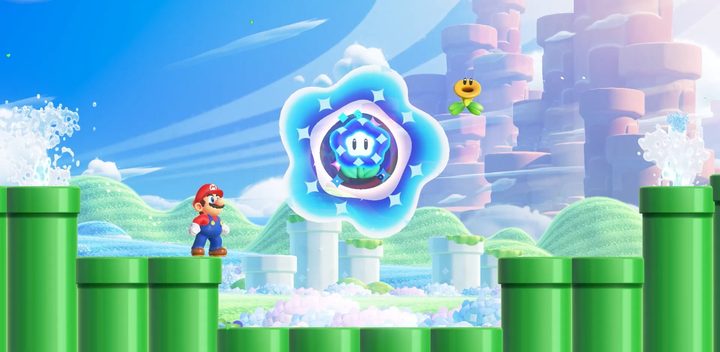
Last year, Nintendo brought Mario back to his 2D roots with a surprise new game, Super Mario Bros. Wonder. The critically acclaimed platformer was an instant crowd-pleaser thanks in no small part to its namesake feature, Wonder Effects. These power-ups completely transformed Mario’s world, letting its developers experiment with wacky ideas from wiggling pipes to singing Piranha Plants.
The notoriously secretive Nintendo has now peeled back the curtain on how those creative swings came to be. The company hosted a panel about the game’s development at this year’s Game Developers Conference. In it, Producer Takashi Tezuka and Director Shiro Mouri went in depth about how it built Wonder Effects. The panel included some wild ideas that ended up on the cutting room floor – enough to fill a sequel.
According to Mouri, a big part of the team’s original design vision was to call back to the secret-filled world of the original Super Mario Bros. Though Mouri’s first proposed twist planted the seeds for what would become Wonder Effects, Tezuka would push him to turn the idea up a notch.
“I thought about creating a new version of these secrets and mysteries,” Mouri said. “I tried making something where if you hit a block, a special item comes out, and if you take this item, you can go to another area. When I showed that to Mr. Tezuka, he said, ‘This isn’t so different from how it’s always been. Can’t you make it so that instead of going to another area, the environment itself changes?’ So I said, if I’m going to change the environment anyway, I might as well go hard.”
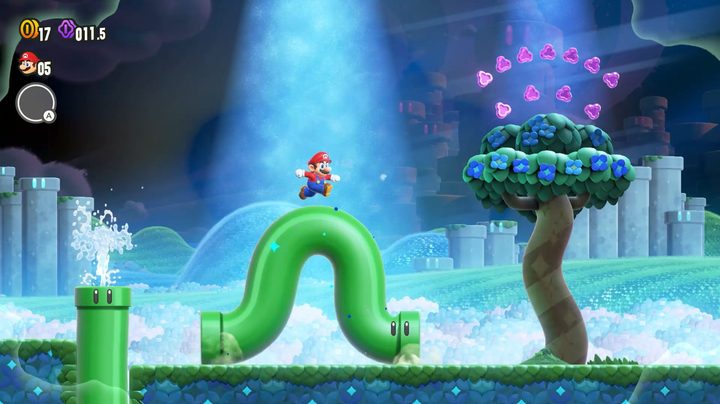
Mouri would get to work on his first radical ideas for the game. He’d start by creating a wiggling green pipe that moved around like an inchworm. If you’ve played Super Mario Bros. Wonder, you might recognize that concept: It’s the very first Wonder Effect in the final game. Mouri shared his original prototype for the animation during the panel, which saw the pipe moving in an almost snakelike manner compared to the inchworm-esque final version.
Both that and a concept for singing Piranha Plants gave the project the spark it needed. The team would get to work dreaming up potential transformations. That task wasn’t just up to Mouri, though; it was a massive team effort that produced a staggering amount of ideas.
“It was up to everyone on the team to come up with ideas regardless of job title,” Mouri says. “Nintendo believes that everyone on the team is a game designer. At first, we asked everyone to write any and all ideas on sticky notes without any conditions. After all, if you stick to conditions, you stifle creative freedom. At this stage, we collected around 2,000 ideas.”
The team would quickly establish some ground rules for Wonder Effects. They decided that each one needed to have some sort of “Pre-Wonder Effect,” which would make the transformation feel more natural. For instance, the team felt that turning Mairo into a balloon out of the blue would confuse players. To introduce that idea more smoothly, the tea would create balloon-like enemies to set up the effect.
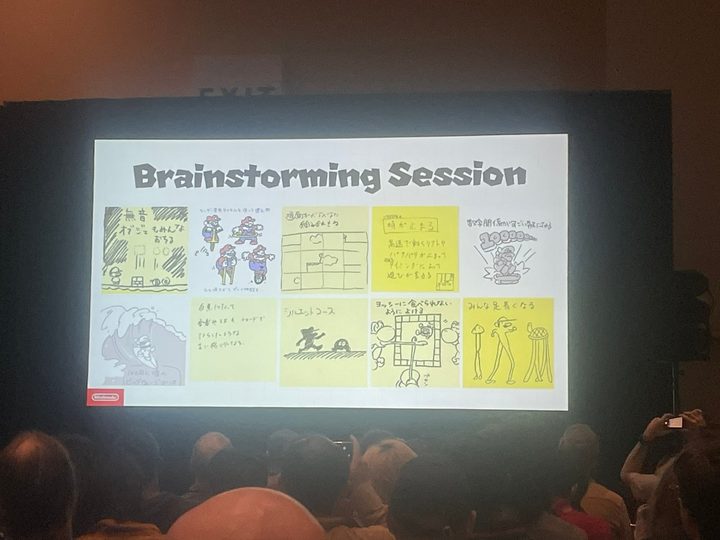
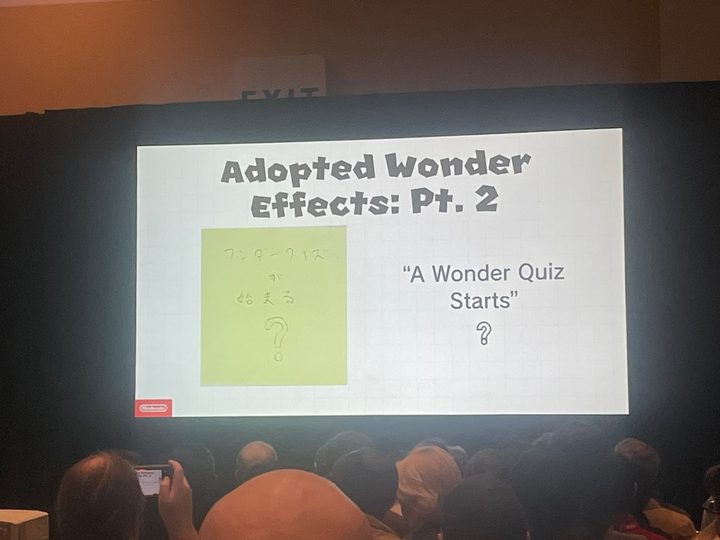
The panel would get especially fascinating when Tezuka and Mouri revealed some of the initial sticky notes. Some would make it into the game. Mouri would poke fun at a note from a first-year developer that simply said, “A Wonder Quiz Starts” with no further information (“Do you think we can call this a good idea?” Mouri joked). That would spawn a pop quiz level in the final game.
Not every idea was a winner. One slide showed off several ideas that never made it into the game. One seemingly shows a screen rearranged into a tile puzzle. Another shows Mario and some enemies walking around with extremely long legs.
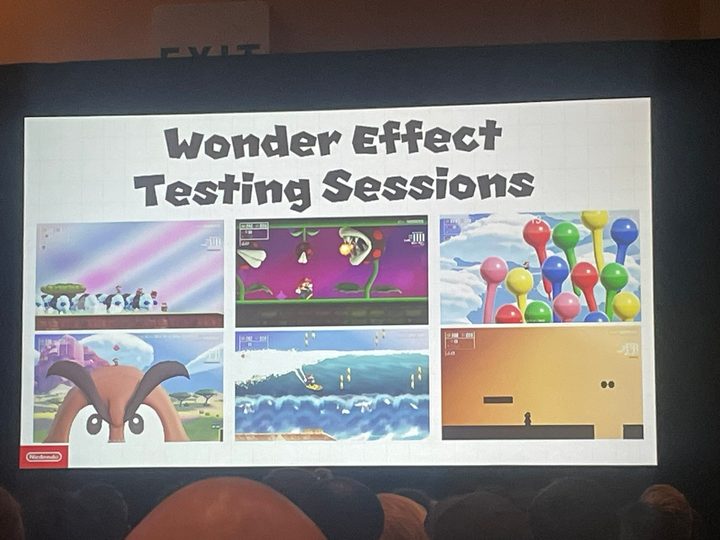
Some of those ideas actually made it to the prototyping phase. Another slide showed off some fully realized prototypes that never made it into the final game. One sees Mario standing on top of an enormous Goomba head. The most eye-catching one shows Mario surfing on a giant wave.
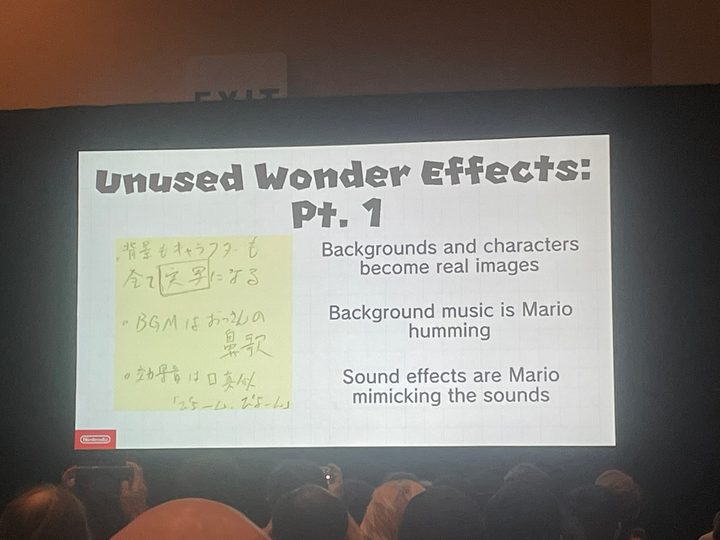
Other ideas were even more out there. One pitch would imagine a level that replaced all characters and backgrounds with real images, including a realistic Mario with human proportions, with Mario mimicking every sound effect. The idea was ultimately rejected as the team couldn’t crack what the pre-Wonder Effect would be and didn’t feel that gameplay would change enough, even with real images. Though that idea wouldn’t make it into the game, Nintendo would adopt the audio half of it with Wonder’s Sound-Off badge, which replaces all sound effects with Mario’s approximations.
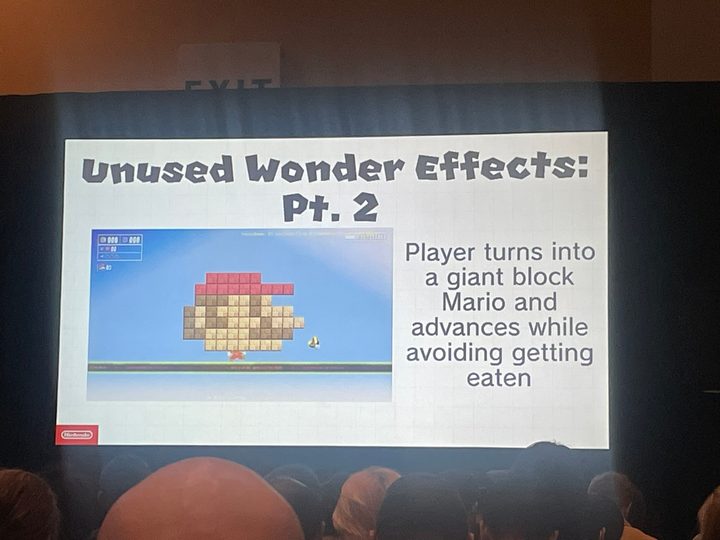
An even wackier idea would have supersized Mario’s head, turning it into its blocky, 8-bit design. Mario would then have to navigate a level filled with hungry birds that could eat each block. It’s a hysterical visual, but it wasn’t practical. Due to the size of the blocks, it was difficult to create an actual strategy to run away from the birds. That would just turn the level into a “mad dash towards the end” of the level, and reducing the size of the blocks took away from the off-the-wall nature of the effect.
During the presentation, Tezuka stressed that the ultimate success of the Wonder Effects was a team effort. The collaborative nature of their creation, combined with the lack of restrictions early on, allowed the team to experiment with tons of ideas, even if the vast majority of them never saw the light of day. The power of that process can be felt in the response to the final product, which garnered acclaim from critics and fans alike at launch.
So, if you’re wondering if Nintendo has enough gas in the tank to make lightning strike twice, best rest assured: There are still well over a thousand ideas floating around on sticky notes. Perhaps we’ll get our surfing Mario level soon enough.


