
“The Talos Principle 2 turns puzzle solving into a sacred act with its super-sized suite of intellectual challenges.”
- Intriguing world
- Sharp puzzle design
- Creative tools and twists
- A strong intellectual challenge
- Long-winded
- Later puzzles run out of steam

“Why you can trust Digital Trends – We have a 20-year history of testing, reviewing, and rating products, services and apps to help you make a sound buying decision. Find out more about how we test and score products.“
Humanity is dead and gone. All that remains is one lone city populated by 1,000 lost androids. They wander their metallic utopia in search of answers to impossible questions that their creators failed to leave behind. Their very existence is a puzzle, a mess of disconnected fragments floating in their silicone DNA. But the thing about puzzles — or well-designed ones, anyway — is that no matter how confusing they may seem, there’s always a solution. It just takes patience and determination.
That’s the worldview that lives in The Talos Principle 2, a cerebral sequel that maxes out its 2014 predecessor in every way. While it’s set up as a gloomy, dystopian story about the aftermath of humanity’s demise, there’s an underlying optimism in its wide cast of robotic characters. Their society is built on bright-eyed curiosity as they seek to solve both the physical and philosophical puzzles of their world. It’s a celebration of humanity’s incredible potential to untangle any problem it faces.
The Talos Principle 2 excels at giving players a suite of brain-busting puzzles built around strong eureka moments, even if it can feel as long-winded as a philosophy professor with its wandering existential monologues. Only the most determined genre experts may see the end of its super-sized story, but those who brave its gauntlet of mysterious islands are sure to walk away with newfound confidence in their ability to accomplish the impossible.
Science and spirituality
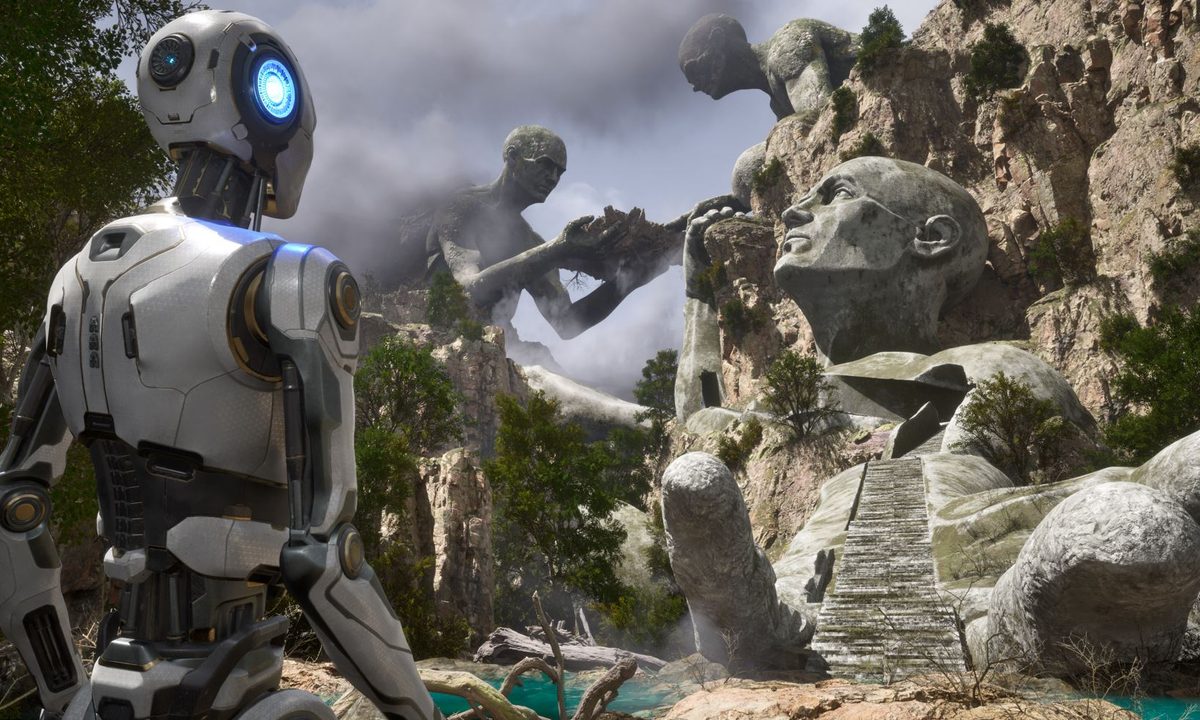
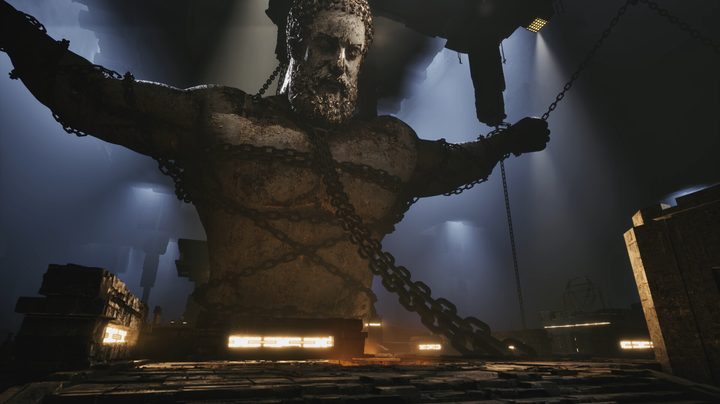
At first, The Talos Principle 2 doesn’t seem too different from its predecessor. When I boot it up, I’m wandering around a familiar desert solving straightforward puzzle chambers in first-person. The veil quickly lifts, introducing me to the sequel’s brave new direction. There’s a much larger emphasis on story this time around, as I soon discover I’m controlling the one thousandth — and final, according to a strange law of the land — android born into a robot society. A celebration ensues, but it’s cut short when a projection of Prometheus appears and sows confusion among the locals. In the aftermath, a crew of androids set out to investigate a pyramid-like megastructure that’s popped up on a mysterious island full of puzzles.
The journey takes players to a dozen explorable biomes surrounding the enormous pyramid, each of which is populated with eight primary puzzle chambers and a few secrets to discover in each. That setup gives the sequel a much grander scale than its intimate predecessor. I can spend more time soaking in the quiet environments as I discover text and audio logs that paint a more thorough picture of the android society and the lost race that created it.
While the first Talos Principle was something of a tone piece, the sequel delivers a bigger narrative vision that’s almost unheard of for the genre. Crew members frequently pop up on my comms to chatter about the deeper meaning of puzzles. I often stop to chat with NPCs wandering around and pick their robotic brains about the meaning of life. The society even has its own social media app where I can engage in philosophical debates with other robots. It’s a lot of dedicated, often engrossing, worldbuilding, though it can be dry and meandering in moments. Pace-slowing conversations can make players feel like they’re sitting in a semester-long crash course in philosophy that broadly picks at as many debates as possible.
The act of puzzle solving is sacred in The Talos Principle 2.
Though it can be a touch eye-rolling, it leaves intellectually curious players with a lot of different bones to chew on. I was struck by the way the sequel connects spirituality and science. Rather than seeing the two concepts as being at odds with one another, it finds common ground between them. The androids are deeply spiritual machines who revere their human creators like Gods. Rather than simply accepting their unknowable power, they utilize scientific theory to uncover the answers they seek. They operate under the assumption that everything, even God, has its own internal logic that can be learned. Considering that media tends to pit science and faith against one another, it’s a thoughtfully nuanced approach to a long-standing debate.
And it’s one that specifically fits in the confines of the genre. A level-based puzzler like this hinges on the idea that there’s always an answer, no matter how hard the problem is. Players have to have faith that the creators (Croteam, in this instance) have carefully built an intricate set of laws that govern its world and all its challenges. The act of puzzle-solving is sacred in The Talos Principle 2; when I finally crack a seemingly impossible problem, I feel closer to a digital God.
Solving the impossible
All of this only works if the puzzles within a game like this are sharply designed, and that’s fortunately where The Talos Principle 2 excels. Each island and its chambers are built around a defining twist that becomes more complex with each primary puzzle. It all begins easily enough when I’m redirecting beams of light to sensors of their matching colors to unlock doors and activate a machine at the end. Those initial eight puzzles teach me the basics of how that works with mounting nuance, making me consider spatial reasoning as I solve problems.
Each new twist mounts on top of the last. Later chambers introduce RGB splitters that combine two colored beams into a new one. Another introduces a teleporter that lets me transport myself and any object I’m carrying to otherwise unreachable areas. In the most mind-bending turn, a series of chambers has me taking control of different androids and finding ways to stack them on top of one another with platforms and boxes. Each tool unveils a new natural law of the land that I need to commit to memory before I’m handed down another mechanic like scripture.
Those who have the patience to push their brains to the limits will be rewarded.
The most impressively designed puzzles can feel downright impossible at first glance. Sometimes I’m left standing in a chamber racking my brain as I try to figure out how I’m going to get past a seemingly impassable wall with a handful of tools. The Talos Principle 2 doesn’t give players much help either, as there are no hints or a quick undo button to lean on when I make a critical, irreversible error. The only minor help comes from a handful of collectible Prometheus Flames that allow players to bypass a chamber entirely. It isn’t a friendly experience for more casual players and that’s sure to leave some poring over YouTube videos for solutions.
Those who have the patience to push their brains to the limits, though, will be rewarded. Any time I was faced with an “impossible” challenge, I’d stop and break the problem down into pieces rather than trying to solve it all at once. A late puzzle had me trying to unlock a chamber locked behind a fence I couldn’t climb over and a static wall I couldn’t cross. I’d have to pass through another blocked wall to get there, as well as free a moving platform and a blue light source. I’d tackle each problem individually, reverse engineering the problem by learning how I could theoretically bypass each lock with the tools I had. When I simply couldn’t crack the final mystery of the final fence and impassable wall, I’d put the game down and sleep on it as I reverse-engineered solutions in my head.
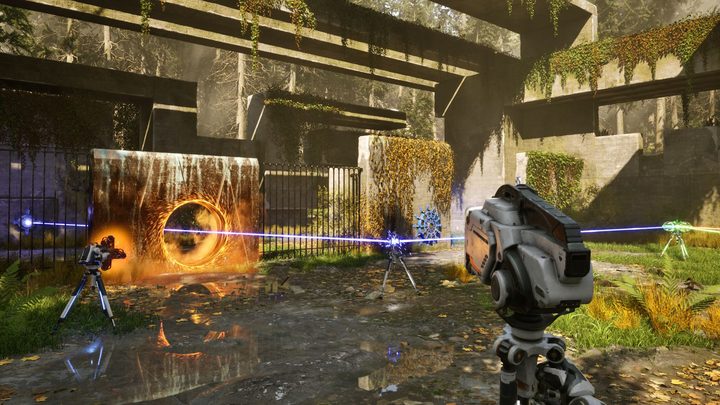
Without realizing it, I was carrying out the scientific method to solve rooms like that. I’d figure out the problem of each room, observe every corner of it to see what tools I had to work with, build several small hypotheses, and carry out experiments. When an idea would fail, I’d start again, but folding in any newfound information I learned on my last attempt. After lots of trial and error, I’d eventually solve that tricky room by realizing where both I and an electronic-jamming device would need to be positioned to unlock two doors. When I finally cleared that puzzle, it felt like I’d ascended to another plane.
That feeling is kept up throughout the 20+ hour adventure, though it can get mentally exhausting. Late puzzle islands run out of creative tools, instead relying on less exciting gimmicks like moving platforms that feel like they belonged at the start of the challenge gauntlet, not the end. A few puzzle suites don’t do a terribly strong job at teaching their core hook off the bat either, which can leave the first chambers on some islands feeling harder than their last few. Pacing issues provided just a few moments where I questioned the all-mighty creators.
That feeling isn’t at odds with The Talos Principle 2’s teachings, though. The sequel encourages players to question their world and interrogate why things are built the way they are. Is there a good reason for a society to fall in line with certain universal laws? What do we gain from prodding them? That’s a key debate that’s central to one of the story’s most puzzling questions: Why must the android society cap its membership at 1,000? It’s never explained, but it’s a goal that Robotkind has blindly chased like a heavenly decree at the expense of growth. Perhaps there’s a good reason, but the population will never know until they ask “Why?”
If you ever find yourself critiquing developer Croteam’s design decisions during a headache-inducing puzzle, you’re playing The Talos Principle 2 right.
Buy at Steam was tested on PC and Steam Deck.