“Ultros is a bold and beautiful artistic vision, but a convoluted Metroidvania.”
- Psychedelic art
- Fantastic music
- Unique gardening system
- Unclear visual design
- Underexplained systems
- Tedious backtracking
“Why you can trust Digital Trends – We have a 20-year history of testing, reviewing, and rating products, services and apps to help you make a sound buying decision. Find out more about how we test and score products.“
My bloody quest to kill a grotesque demon is about to reach its climax when I stop to do a bit of intergalactic gardening. Testing out a mysterious new tool I received, I blow a puff of blue gas at a hanging vine. At first, I’m confused as all I can seemingly do is slightly change the direction it’s growing in. That’s when I accidentally direct it into a pool of golden liquid. Suddenly, vines sprout out in every direction, cutting through the substance like a newly grown nervous system. After marveling at the wonders of nature, I lodge my handy digger drone into the wall and completely uproot my creation, turning it back into a simple seed.
Birth. Death. Rebirth.
That simple loop powers Ultros, a stylish new Metroidvania by developer Hadoque, like a healthy heart locked behind a twisted rib cage. Once I weed through its dense sci-fi lore and overcomplicated gameplay systems, I begin to discover a more digestible spiritual journey about the unknowable cycle of life and death. Getting there can be a frustrating journey, though; Ultros is a confusing labyrinth of ideas that I still find myself a little lost in even now.
A psychedelic trip
In Ultros, I take on the role of an astronaut in a slick red coat who crash-lands on a massive vessel, The Sarcophagus. I quickly learn that the ship doesn’t just house corridors full of colorful plant life, but also a demonic entity known as Ultros. To vanquish it, I’ll need to hunt down seven Shaman, taking a different technological power from them that’ll help unlock new biomes on the ship. To make matters more complicated, all of this is happening in a black hole. At key points in the story, the entire cycle begins anew. I’m in a constant cycle of rebirth.
It’s like I’m exploring the inside of a human body.
The story leans into hard sci-fi, with a narrative so wrapped up in its own alien worldbuilding that it feels like reading a different language altogether. Like a lot of things in the game, it can be difficult to fully comprehend what’s going on even after the credits roll. Thankfully, Ultros’ more clearly communicates through its art design and gameplay systems — even if its most creative swings make the adventure feel even more obtuse.
What immediately sticks out here is Ultros’ astonishing art style. Inspired by the distinct work of French artist Moebius, The Sarcophagus is a psychedelic trip that’s unlike any digital world I’ve ever explored. Each 2D room is filled to the brim with colorful details, from gnarly insects with rows of gnashing teeth to vibrant plant life that intermingles with crumbling alien architecture. It’s a distinct mix of organic and otherworldly; it’s like I’m exploring the inside of a human body that shuts down at the end of each cycle.
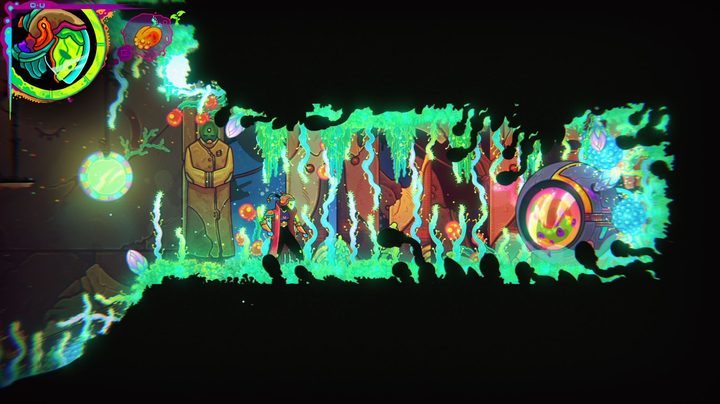
That’s equally matched by composer El Huervo’s positively hypnotic score. Like the art style, it’s a rich soundscape of textures that makes traditional strings and woodwinds sound like they’re beaming in from another planet. Everything in Ultros feels foreign and disorienting at first glance. The more I peel back the layers, though, the more I find familiar DNA under alien flesh. It pulls me back into the humanistic themes during moments where it feels like I’m drifting in space.
Struggling to reinvent
While that artistic flair is its greatest strength, it’s the first of many areas where Ultros’ bold creative swings have some unfortunate side effects. With so much detail on-screen, I often struggle to figure out what I can interact with or where I’m supposed to go. I end up spending too much time in menus as I try to parse a complicated map that doesn’t offer much in the way of guidance tips. I often find myself lost, but not in the right way.
[Ultros] has trouble nailing down the fundamentals of the Metroidvania before pulling them apart.
Unfortunately, that’s a core problem that can create trouble for a genre that hinges on freeform exploration. As a Metroidvania, Ultros’ complicated design twists often disrupt an elegant 2D action-adventure formula. That’s especially apparent in its time-loop twist. Every time the cycle begins again, I have to retrace my steps to find a weapon and regain all my powers (including a double jump). I also lose every unlocked power on my skill “cortex.” While I can find hidden items that permanently lock upgrades in place, each new cycle inevitably starts with some extra backtracking. It’s a thematically sound idea that visualizes its circular nature, but one that doubles down on the most tedious part of the genre.
The wider problem is that Hadoque has trouble nailing down the fundamentals of the Metroidvania before pulling them apart. While I get my hands on some creative power-ups, like a buzzsaw drone that can cut through dangerous foliage, I’m not always sure how to use them. My digging drone hardly gets used in any practical puzzle or exploration context. When I do use it to uproot plants, I struggle to grasp how exactly I need to position it to properly pull a seed out of the ground.
Both that and the unclear visual design makes exploration a pain too, which is a mortal sin for the genre. When I bump into a dead end, I’m often not even sure what the roadblock is. I lose that Metroidvania joy of taking mental note of an obstacle and having a eureka moment when I discover the new tool that can act as a key to that lock. More often than not, any discovery I make is an accident that occurs while I’m aimlessly backtracking the same corridors as I try to find my way to the next Shaman.
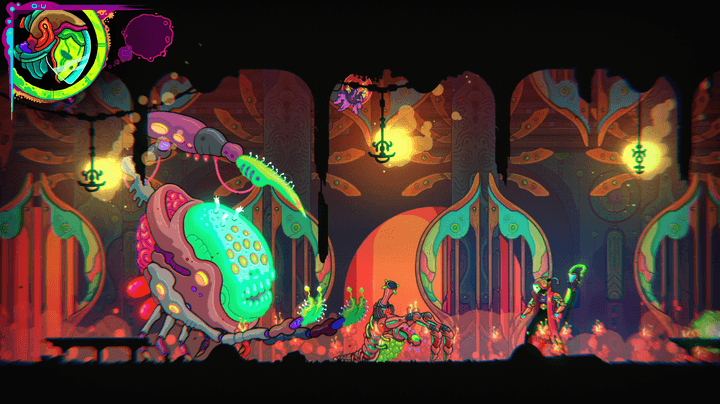
All of this was compounded by some frustrating bugs in my playthrough. Some fragile walls wouldn’t properly break when I smashed them, forcing me to reload my save and try again. An overly sticky wall jump turns vertical platforming through narrow exits into a nightmare. At some point, I’m not even able to tell what jumps I’m supposed to be able to make and which ones I’m not. That led to at least one situation where I seemingly broke into a section of the level I wasn’t supposed to get into and spent 10 minutes wandering around confused before realizing I’d worked my way into a dead end.
At the very least, Ultros does offer some creative 2D combat in spite of stiff movement. I can use my slashes to juggle enemies in the air and even launch them into others for extra damage. It gets old eventually due to a small handful of enemies that don’t require much strategy aside from dashing behind shields, but it’s an area where the stylish art works in concert with some equally flashy action.
Out in the garden
Ultros is much more successful when it’s focused on its most unique aspect: gardening. Throughout my journey, I can plant seeds in patches of soil to grow plants. That opens the door for some clever puzzling, as I can create a mushroom platform to reach a far-off ledge or grow yellow grass on a wall that I can run on. The long-term joys of it come from filling the ship up with plant life, transforming The Sarcophagus into a living planet.
The second half of Ultros becomes a much more compelling puzzle platformer …
Like a lot of other systems, gardening can be confusing. It’s not terribly clear which seeds do what. Eating plants and other alien parts also raises up some stats that allow me to unlock skills, but that’s never well explained either. Most head-scratching of all is a late game power-up that allows me to splice plants together. It’s a great idea, but it’s one that I only ever need to use once, to progress the story. I end the adventure not really understanding how it all works.
Even with those practical problems, gardening still winds up being the most compelling aspect of Ultros. It’s not just a beautiful visual, but a clean metaphor for its philosophical themes. I’m constantly bringing new life to the ship, one described as a “cosmic uterus” (really driving the point home as clear as day). When I dig up a plant, it becomes a seed that I can replant once again. Death is only one phase of life in Ultros; there’s always hope that the cycle can begin anew.
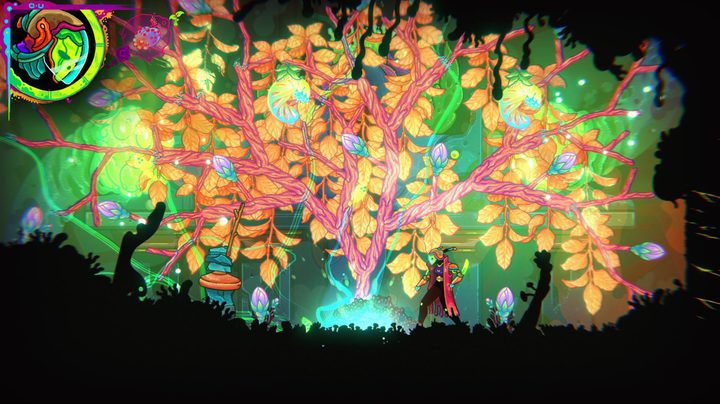
Its most powerful moment comes from the one gameplay twist that doesn’t have an asterisk attached. Midway through the story, I wind up in some kind of cosmic space within the ship. There, I unlock the ability to string plants and other key objects like save pods together by running vines between them. The second half of Ultros becomes a much more compelling puzzle platformer where I’m linking the entire world into one natural network, unlocking doors and fast travel points as I go. It’s an oddly moving visual, one that posits that all life is in some way connected.
Though I often feel lost and frustrated in Ultros’ alien world, I’m never alone. I can always hold on to the hope that I’m part of something bigger even if I don’t understand it. Perhaps I’ll be reborn into the ecosystem when I die, my flesh turning into soil for an alien tree that’ll keep growing and producing seeds with each cycle. The universe is always expanding in Ultros, and so too am I.
Ultros was tested on PC and Steam Deck.