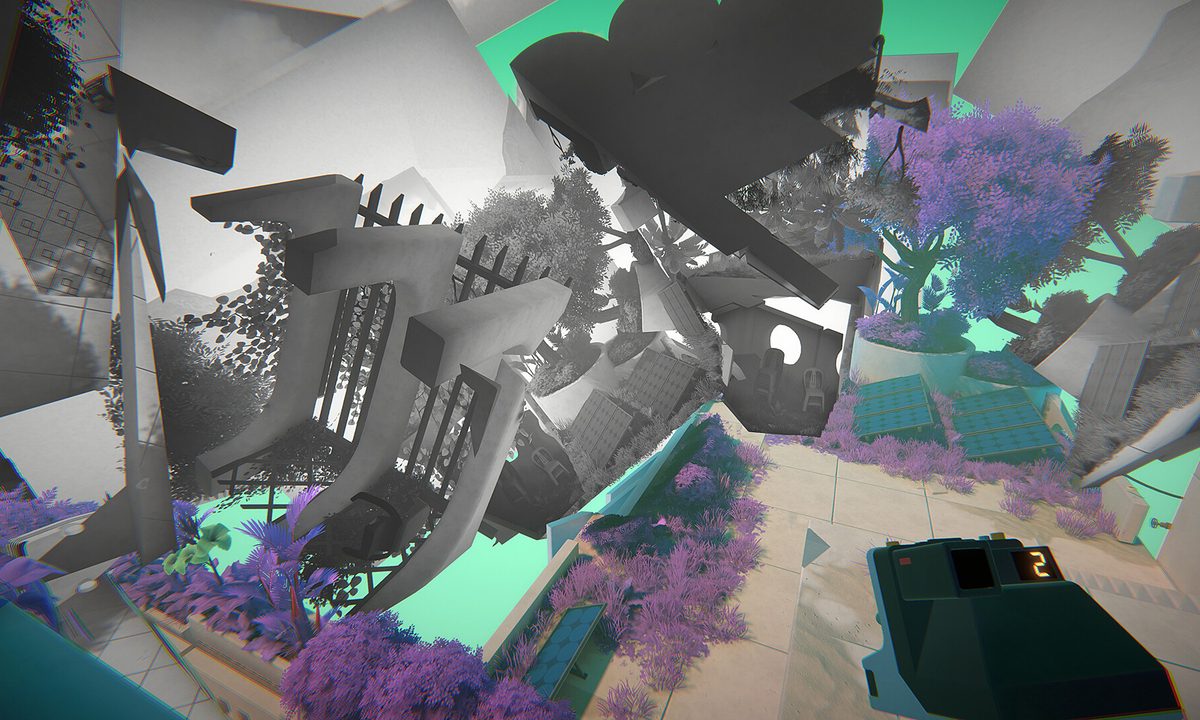

“Viewfinder is an ingenious puzzle game that wows at every turn, even if its sci-fi story stretches to find deeper meaning in its mind-bending photo hook.”
- Ingenious puzzle hook
- Room for multiple solutions
- Clever gameplay twists
- Doesn't overstay its welcome
- Limited experimentation
- Some clumsy storytelling

“Why you can trust Digital Trends – We have a 20-year history of testing, reviewing, and rating products, services and apps to help you make a sound buying decision. Find out more about how we test and score products.“
The first moment I held up a 2D photo in Viewfinder and saw it seamlessly transform into a fully traversable 3D space, I felt like I could accomplish the impossible. It’s an unbelievable trick that immediately makes the indie puzzler feel limitless. I couldn’t stop dreaming up creative solutions to every problem it would throw at me, proving that I was always smart enough to tackle even the trickiest conundrums.
That rewarding gameplay loop makes Viewfinder’s story all the more tragic. Just outside the walls of its sunny test chambers, overflowing with colorful flora, the real world is a wasteland. Decimated by the effects of climate change, the planet is awash in a hazy red veil that makes it look more like Mars than Earth. When I stop gleefully playing around with photos and start reading the stacks of sticky notes and research logs scattered around me, I discover the story of a scientist desperate to find the one answer that’ll fix it all. It’s an impossible problem in search of an impossible solution — one that not even a reality-bending magic trick can solve.
Like Portal, Viewfinder is the kind of game that immediately wows thanks to an astonishing central hook that works without a hitch. Though its self-serious narrative can feel entirely disconnected from that playful system at times, it’s the kind of ingenious puzzle game that encourages players to stay curious and always tackle every problem from every perspective they can find before giving up.
A true magic trick
Even if you haven’t heard the name Viewfinder, there’s a chance you’ve actually seen it. The project sprung out of a viral tweet in 2020, in which developer Matt Stark shared a work-in-progress prototype of its unique puzzle system. The video shows him taking Polaroid photos of a room in first-person and placing them, instantly turning them into 3D environments. It was attention-grabbing enough to earn over 200,000 views, but the jury was out on whether or not that idea could transcend gimmick in a full game. Be rest assured, it does with ease.
A game full of surprises that always left me wondering what else was possible.
The first time that you recreate that trick in one of several puzzle chambers feels genuinely magical. One straightforward early puzzle, for instance, has me trying to figure out how to cross a gap between platforms that’s too long to jump over. After rummaging around, I find a photo of a bridge. I position myself just right so that it neatly fits between the two platforms and place it with the press of my DualSense’s right trigger. With not so much as a frame drop, that flat image instantly becomes part of the world, creating a new platform I can walk across.
Explaining it in writing, or even watching it in a video, doesn’t do it justice. You need to try it yourself to truly believe it.
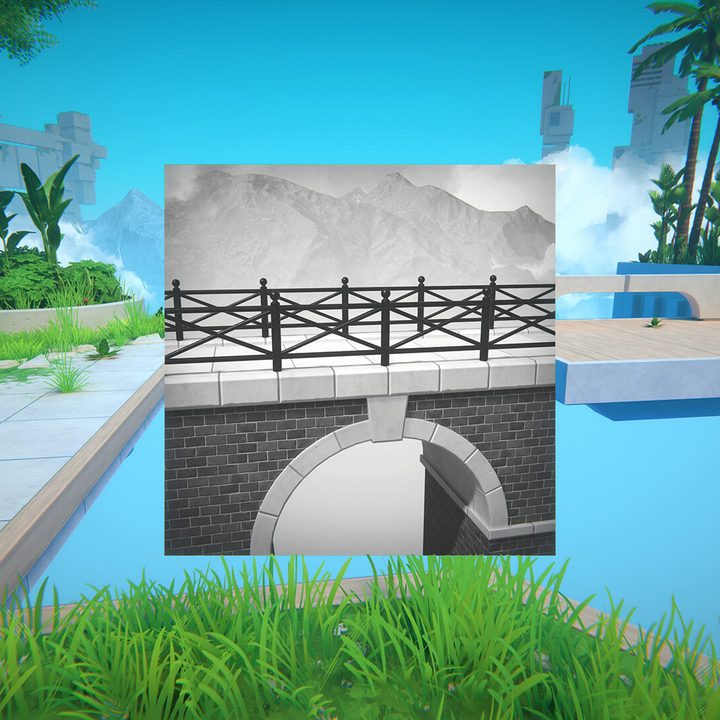
It’s not just a one-trick pony. Viewfinder finds several ways to twist that idea and create a wide range of puzzles that play with perspective. The gist of just about every puzzle is that players need to find a teleporter to proceed, which often needs to be powered up with a few batteries. That’s either accomplished by using specific photos lying around the level or by using a Polaroid camera that has limited shots. The basic idea mutates in several clever ways throughout the adventure, usually calling for a unique solution. One puzzle has me trying to clone a battery by taking a photo of it, dragging the battery within that shot next to the other, and taking a picture of both to create four. A more complex variation has me taking that shot next to an extra roll of film for my camera, making sure that I can take an unlimited number of shots. No puzzle is too difficult to solve thanks to how easy it is to place photos and rewind time to test another hypothesis without penalty.
Like any good puzzle game, extra mechanical twists keep chambers engaging up to the end of a compact, four-hour experience. One set of levels introduces sound-powered teleporters, which has me taking photos of noisy radios and placing them next to the sensor. Later, I find a photocopier, allowing me to clone photos and connect them to an M. C. Escher-like maze of hallways. There isn’t a dud in the batch, as Viewfinder is careful not to overdo any of its ideas. There’s refreshing self-restraint on display here, as developer Sad Owl Studios always focuses on experiments that feel fun rather than complex for the sake of challenge. Though I do wish I had more room to experiment outside of its handful of tightly constructed puzzle rooms that often signpost a clear solution.
Above all else, Viewfinder never forgets to have fun. Levels are packed with little Easter eggs that are mostly there for the sake of creating purely playful interactions. In one level, I pick up a screenshot of a computer desktop and start drawing in a Microsoft Paint-style app. In another, I place a simple children’s drawing in the world and am stunned when I realize I can walk through the front door of the crudely drawn crayon house in it. It’s a game full of surprises that always left me wondering what else was possible.
Impossible problems
While I wasn’t expecting much in the way of narrative, Viewfinder actually does have quite a bit to say thanks to a surprising sci-fi twist. I’m not working through random puzzle levels, but rather solving problems in a digital simulation created to test solutions that might solve the planet’s more serious crisis. You may find yourself asking how the Polaroid photosystem thematically connects to a serious meditation on climate change. Admittedly, it’s a major stretch.
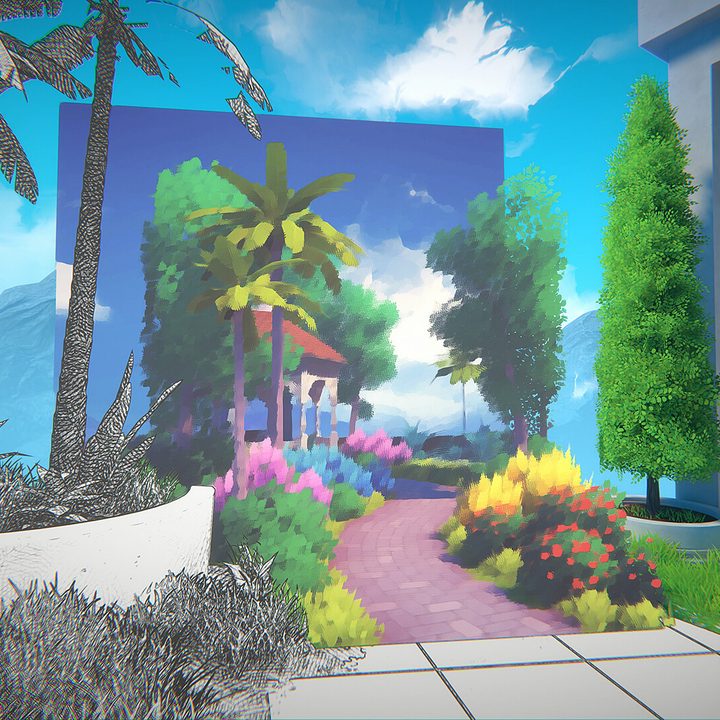
Playing through the narrative, I couldn’t help but feel like its big-picture story came much in development later than the guiding gameplay hook. The link between the interactions and worldbuilding feels entirely random at times, with the photosystem barely contextualized in a story about researchers trying to reintroduce plant life to a dead planet. Just as those characters set out to solve a difficult problem with no easy answer, developer Sad Owl perhaps ran into that same hurdle when trying to pull the right meaning out of a fun gameplay gimmick.
That’s not to say that Viewfinder is entirely unsuccessful in its narrative ambitions. I found myself connecting to the story of a determined researcher battling a mounting sense of hopelessness. That arc, told entirely through scattered notes and phonograph recordings, dovetails nicely with the game’s own difficulty curve, as her frustrations line up with trickier puzzles that had me racking my brain for answers. The severity of those two experiences is a clumsy mismatch, but it’s a thoughtful way to represent an “all hope is lost” build through puzzle game structure.
Viewfinder at least leaves me hopeful that human ingenuity can always find a way to win.
Viewfinder is at its best when it’s speaking in broader terms about the human experience. It’s a celebration of our malleability, testing our ability to persevere when we’re willing to view a problem from every perspective. For every well-designed video game puzzle, there’s at least one solution to be found. And though that design philosophy may not translate to the overwhelming, existential threats we face in the real world, Viewfinder at least leaves me hopeful that human ingenuity can always find a way to win.
And how could I not think that after playing something like Viewfinder? Even after completing all its puzzles, I’m still left in awe of how a developer could create such a mind-bending system, become a viral sensation, and turn that momentum into a full release as impressive as this. If that unlikely success story doesn’t leave you with a bit of hope, maybe you’re viewing it from the wrong angle.
Viewfinder was reviewed on a PS5 hooked up to a TCL 6-Series R635.